

Memory foam mattresses trap heat because they’re made from dense polyurethane with a closed-cell structure that blocks airflow. When you lie down, the foam conforms tightly to your body, creating a seal that eliminates air pockets and prevents ventilation. This dense composition acts like insulation, trapping your body heat and moisture instead of allowing it to escape. Traditional memory foam densities above 5.0 pounds per cubic foot worsen this effect, though modern cooling technologies can help address these thermal issues.
The Science Behind Memory Foam Heat Retention
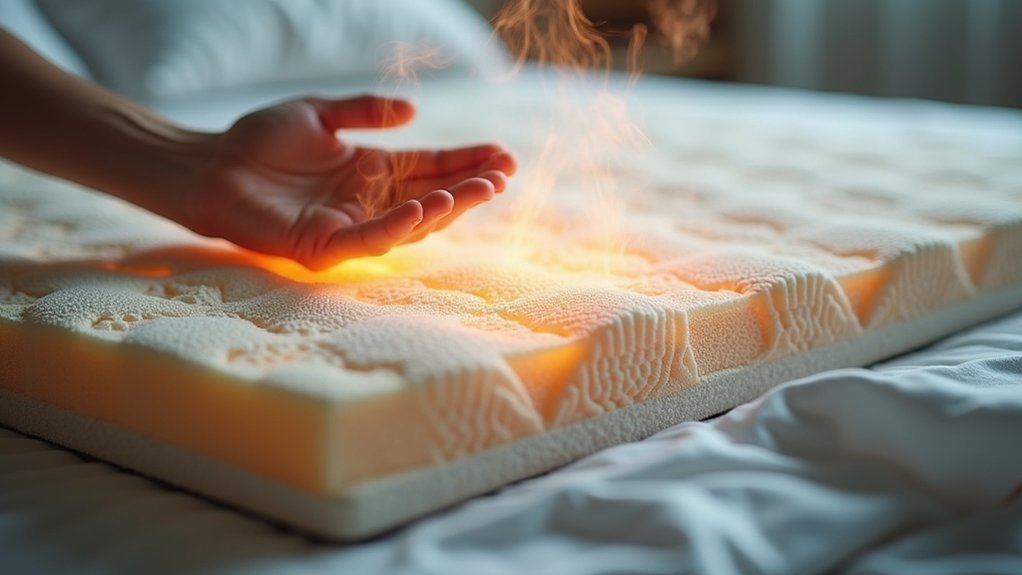
When you sink into a memory foam mattress, you’re experiencing the unique properties of high-density polyurethane that make this material both supportive and problematic for temperature regulation.
The closed-cell structure of traditional memory foam prevents proper airflow, creating a barrier that traps your body heat instead of allowing it to escape. This dense material, often exceeding 5.0 lbs per cubic foot, molds closely to your body but sacrifices breathability in the process.
The result is significant heat retention that can disrupt your sleep comfort. Modern cooling technology has responded to this issue through innovations like gel-infused memory foam and open-cell designs, which improve airflow and enhance temperature regulation compared to earlier memory foam formulations.
How Dense Foam Structure Limits Airflow
Dense memory foam’s tightly packed cellular structure creates a significant barrier to airflow that directly impacts your sleep temperature. When you lie down, the dense structure exceeding 5.0 lbs compresses under pressure, eliminating air channels essential for ventilation.
| Mattress Type | Airflow Rating | Heat Retention |
|---|---|---|
| Memory Foam | Poor | High |
| Innerspring | Excellent | Low |
| Hybrid | Moderate | Medium |
Unlike innerspring mattresses with open coil spaces, memory foam’s solid composition restricts air movement throughout the night. Your body weight increases compression, further reducing the foam’s ability to breathe. This lack of airflow prevents effective moisture wicking, causing heat and sweat buildup. The result? You’re sleeping hot because the dense structure can’t dissipate your body heat efficiently.
Body Contouring Properties That Trap Warmth
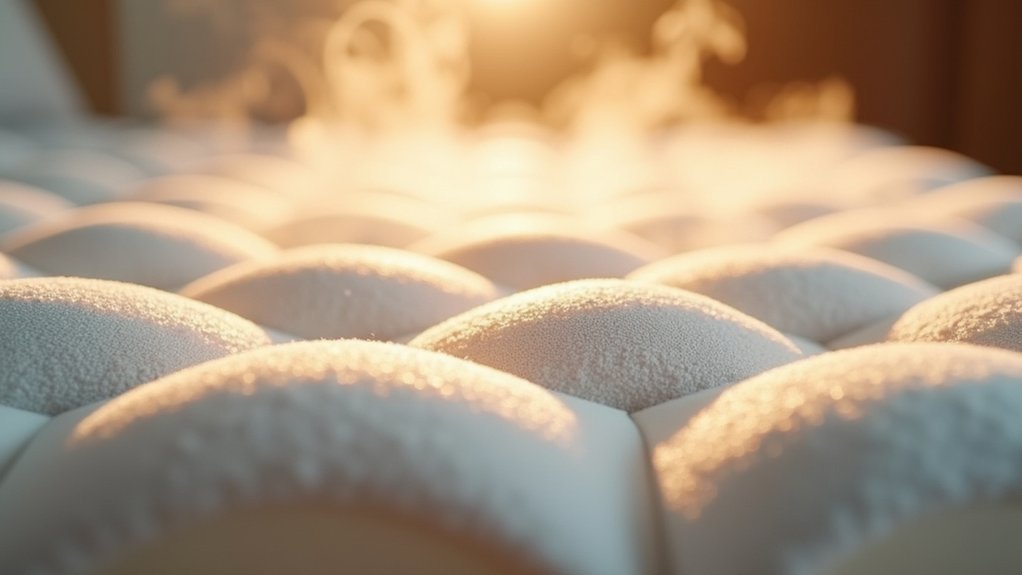
When your body sinks into memory foam, the material wraps tightly around your contours, creating a snug seal that prevents heat from escaping.
This close conforming action compresses the foam around you, blocking the natural air pockets that would otherwise allow cooling airflow.
You’ll find that the tighter the foam hugs your body, the more it restricts ventilation and traps your body heat against your skin.
Close Body Conforming
The contouring magic that makes memory foam so appealing for pressure relief becomes its Achilles’ heel when it comes to temperature regulation.
When memory foam molds closely around your body’s curves, it creates an intimate embrace that notably restricts airflow circulation. This close body conforming effect forms a cocoon-like environment where heat can’t easily escape.
Higher density foams above 5.0 lbs are particularly problematic because they conform even more precisely to your contours.
The tighter the foam hugs your body, the less space remains for air to move freely around you. This restricted airflow prevents natural heat dissipation, causing warmth to accumulate in the small gaps between your skin and the foam surface, leading to uncomfortable heat retention throughout the night.
Reduced Airflow Circulation
As memory foam compresses beneath your weight, it creates a closed-cell structure that blocks natural air movement around your sleeping surface.
This reduced airflow circulation becomes particularly problematic with memory foam mattresses hot sleepers often complain about. When you lie down, the foam’s density prevents air from flowing freely through the material, creating pockets where heat retention in memory foam accumulates.
Your body temperature rises as the material continues to absorb body heat without adequate ventilation to release it. Unlike traditional spring mattresses that allow air to move through coil spaces, memory foam’s solid structure acts as an insulating barrier, effectively trapping heat against your body.
Without modern cooling technologies, older memory foam models lack the breathability necessary for temperature regulation.
Material Composition and Thermal Conductivity Issues
Understanding why memory foam mattresses trap heat requires examining their fundamental material composition and thermal properties. Your memory foam mattress is primarily made of dense polyurethane, which lacks the interconnected air channels necessary for proper heat retention management.
This material’s low thermal conductivity means it can’t effectively dissipate your body heat, leaving you overheating during sleep.
The dense structure that gives memory foam its contouring abilities also works against breatheability and airflow circulation. Without adequate moisture-wicking properties, your mattress traps both heat and humidity around your body.
Fortunately, manufacturers have developed solutions like gel infusion and open-cell foam structures to combat these thermal issues, creating cooler sleeping surfaces that maintain memory foam’s pressure-relieving benefits.
Traditional Memory Foam Vs Modern Cooling Technologies

If you’ve experienced sweaty nights on a traditional memory foam mattress, you’re dealing with the inherent heat retention problem of dense foam materials that trap your body heat.
Modern memory foam manufacturers have responded with innovative cooling technologies like gel infusion, open-cell structures, and phase change materials that actively work to regulate your sleeping temperature.
These advances bridge the gap between memory foam’s pressure-relieving benefits and the superior airflow you’d typically find in innerspring mattresses.
Dense Foam Heat Retention
When you sink into a traditional memory foam mattress, you’re experiencing the very characteristic that makes it retain heat. Dense foam heat retention occurs because these memory foam mattresses typically exceed 5.0 lbs in density, creating a barrier that restricts airflow around your body.
As you sleep, the dense material conforms closely to your shape, trapping warm air and preventing proper ventilation. This heat retention becomes particularly problematic for hot sleepers who struggle with temperature regulation throughout the night.
Modern cooling technologies have emerged to combat this issue, incorporating breathable materials, gel infusions, and open-cell structures that promote better airflow and heat dissipation compared to traditional dense foam construction.
Modern Cooling Innovations
While traditional memory foam’s dense structure creates a heat trap around your body, today’s cooling innovations have revolutionized how these mattresses manage temperature. Modern memory foam mattress designs incorporate advanced materials that actively combat heat retention through sophisticated cooling technologies.
Gel-infused memory foam absorbs and redistributes your body heat, while open-cell structures promote airflow throughout the mattress. Ventilation channels create pathways for heat to escape, and moisture-wicking covers enhance temperature regulation. Phase change materials adapt to your body’s fluctuations.
| Traditional Memory Foam | Modern Cooling Innovations |
|---|---|
| Dense, heat-trapping structure | Open-cell, breathable design |
| Limited airflow circulation | Enhanced ventilation channels |
| Heat accumulation zones | Gel-infused heat redistribution |
| Static temperature response | Adaptive phase change materials |
| Basic foam construction | Advanced multi-layer systems |
Why Hot Sleepers Struggle With Memory Foam
Because memory foam’s dense structure traps your body heat rather than allowing it to dissipate, you’ll likely experience uncomfortable temperature buildup throughout the night.
As a hot sleeper, you’re particularly vulnerable to this heat retention since your natural body temperature of 98.6 degrees gets absorbed and contained by the foam’s body-hugging properties. Without proper airflow, you’ll wake up sweaty and overheated, disrupting your sleep experience.
While some manufacturers have introduced cooling features like gel memory foam and open-cell structures, many memory foam mattress models still fail to provide adequate ventilation.
If you’re a hot sleeper, you’ll need to carefully research which mattresses offer genuine cooling technology rather than settling for traditional memory foam that’ll leave you uncomfortable.
Temperature-Related Sleep Disruption Patterns
As your body temperature rises from heat retention, you’ll experience a cascade of sleep disruptions that follow predictable patterns throughout the night.
When your memory foam mattress begins to retain heat, you’ll first notice difficulty falling asleep as your core temperature fails to drop naturally.
Mid-sleep, temperature-related disruptions cause frequent awakenings and restless tossing as you search for cooler spots on the mattress surface.
You’ll likely kick off covers repeatedly, only to feel chilly once your body temperature adjusts.
These cycles prevent deep REM sleep and leave you feeling unrested.
Without proper airflow around your sleeping surface, your body temperature remains elevated.
Implementing effective cooling solutions helps you sleep better by maintaining the ideal temperature balance your body needs for restorative rest.
Heat Absorption and Release Mechanisms
When you lie down on your memory foam mattress, the dense cellular structure immediately begins trapping the heat your body radiates. The foam’s closed-cell design prevents efficient heat absorption and release, creating a cycle where your body heat gets contained rather than dissipated.
Traditional memory foam lacks adequate airflow channels, forcing heat retention instead of natural temperature regulation. Higher density foams worsen this problem by conforming tightly to your body, eliminating air pockets that would normally allow heat escape.
| Heat Process | Traditional Memory Foam | Gel-Infused Foam |
|---|---|---|
| Heat Absorption | Slow, inefficient | Enhanced with cooling gel |
| Heat Release | Poor ventilation | Improved redistribution |
| Airflow | Minimal channels | Better breathability |
| Body Heat Response | Traps warmth | Draws heat away |
| Temperature Regulation | Limited capability | Active cooling properties |
Environmental Factors That Worsen Heat Retention
While your memory foam mattress’s design contributes greatly to heat buildup, several environmental factors can amplify these temperature issues and make your nights even warmer.
Your bed foundation plays an essential role in heat retention. Solid surfaces like plywood floors trap heat beneath your mattress, preventing proper ventilation. If you’re using slatted frames, verify slats aren’t spaced more than 2.75 inches apart—wider gaps reduce airflow considerably.
Your bedding choices matter too. Polyester sheets and heavy blankets insulate your body, preventing heat from escaping into the air around you.
Room temperature and ventilation directly impact your sleep environment. Poor air conditioning or inadequate airflow elevates ambient temperature, worsening your mattress’s heat retention.
Even electronic devices and bright lighting generate additional heat, further disrupting your night’s temperature balance.
Impact of Mattress Age on Temperature Regulation
Over time, your memory foam mattress loses its ability to regulate temperature effectively, becoming a heat trap that disrupts your sleep quality.
After 6-8 years, the materials break down and lose their temperature regulation capabilities, making heat retention markedly worse.
Older mattresses lack modern cooling technologies like gel infusion and breathable covers that newer models feature.
Modern mattresses incorporate advanced cooling features like gel layers and breathable fabric technologies that older models simply don’t have.
As your mattress ages, the foam density increases, reducing breathability and limiting air circulation that would normally dissipate body heat.
The deteriorating support structure compounds these problems by restricting airflow throughout the mattress.
If your memory foam mattress is over eight years old, replacing it can dramatically improve temperature control and restore your overall sleep comfort.
Identifying Signs Your Memory Foam Sleeps Too Hot
If you’re questioning whether your memory foam mattress runs too hot, several telltale signs will confirm your suspicions.
You’ll wake up sweaty or overheated, disrupting your sleep quality throughout the night. Your hot memory foam mattress will feel excessively warm to the touch and retain heat even after brief use, indicating poor temperature regulation.
You’ll notice the mattress takes longer to cool down after you get out of bed, showing how effectively it can trap heat. Limited airflow through the dense foam structure prevents proper cooling.
If your mattress lacks breathable covers or adequate ventilation design, it’ll exacerbate heat retention issues. These signs clearly indicate your memory foam mattress struggles with temperature control, affecting your overall sleeping experience.
Frequently Asked Questions
Why Does My Memory Foam Mattress Make Me Hot?
Your memory foam mattress traps your body heat because it’s dense and conforms tightly to you, blocking airflow. This creates a heat-retaining cocoon effect that prevents proper temperature regulation while you sleep.
Why Are People No Longer Buying Memory Foam Mattresses?
You’re avoiding memory foam mattresses because they trap heat and make you sleep uncomfortably warm. You’re choosing hybrid and latex alternatives that offer better airflow and cooling features for improved sleep quality.
How to Stop Memory Foam From Making You Sweat?
You can use a cooling gel-infused topper, choose breathable cotton or bamboo bedding, keep your room at 65°F, wear lightweight sleepwear, and regularly rotate your mattress for better airflow.
Is a Memory Foam Mattress Good for Hot Sleepers?
Traditional memory foam mattresses aren’t ideal for hot sleepers since they retain heat. However, you’ll find modern gel-infused and cooling memory foam options that regulate temperature better, making them suitable choices.


