

You can achieve better rest through progressive muscle relaxation by systematically tensing and releasing muscle groups from your toes to your head. This technique, developed in the 1920s, trains your body to recognize tension and actively release it, reducing cortisol levels and promoting faster sleep onset. Start by creating a quiet environment, then tense each muscle group for five seconds before relaxing for 10-20 seconds while maintaining steady breathing patterns. Master this practice to access deeper, more restorative sleep naturally.
What Is Progressive Muscle Relaxation and How It Works
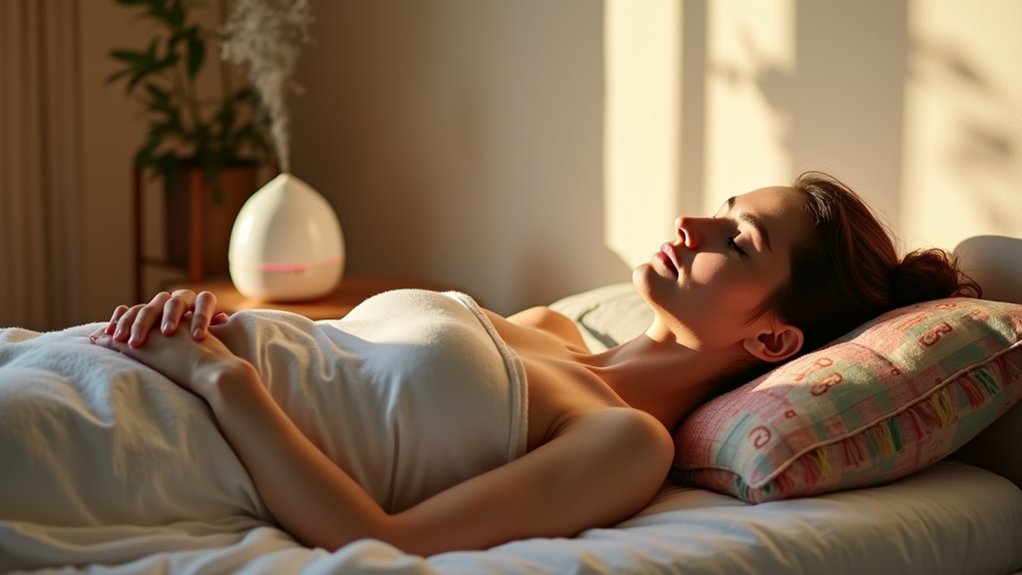
Tension grips your shoulders after a long day, your jaw clenches during stressful moments, and your mind races when you’re trying to sleep.
Your body holds stress in countless ways, from tight shoulders to racing thoughts that refuse to quiet down.
Progressive Muscle Relaxation offers a proven solution to break this cycle of physical and mental stress.
This muscle relaxation technique, developed by Edmund Jacobson in the 1920s, works by having you systematically tense and then release different muscle groups throughout your body.
You’ll start with your toes and progress upward to your head, focusing on the distinct contrast between tension and relaxation in each area.
The process trains your body to recognize tension and consciously release it.
As you practice regularly, you’ll develop better awareness of physical stress and gain the ability to quickly achieve deep relaxation when needed.
The Science Behind PMR for Improved Sleep Quality
When you practice Progressive Muscle Relaxation before bed, you’re tapping into well-documented physiological changes that directly promote better sleep. Research demonstrates that PMR markedly reduces cortisol levels, the stress hormone that often keeps you tossing and turning.
By systematically tensing and releasing muscle groups, you’re actively decreasing physical tension and anxiety—two major barriers to quality rest. Studies involving postpartum mothers and burn patients show PMR consistently reduces sleep disturbances across diverse populations.
The technique enhances your body’s natural relaxation response, helping you fall asleep faster and achieve deeper sleep cycles. Additionally, PMR balances serotonin levels, which decreases insomnia frequency and creates more restorative sleep experiences.
This scientific foundation makes PMR a reliable, evidence-based approach for improving your nightly rest.
Health Benefits Beyond Better Rest
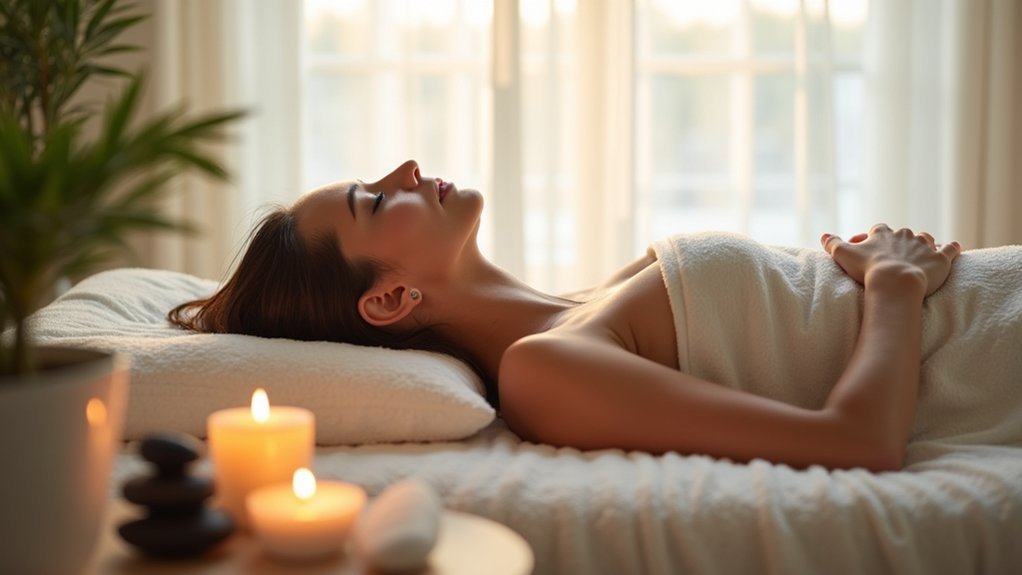
While PMR’s sleep-enhancing effects are well-established, this powerful technique delivers impressive health benefits that extend far beyond your nightly rest.
PMR offers remarkable wellness benefits that reach well beyond better sleep, transforming your overall health and daily quality of life.
When you practice PMR regularly, you’ll experience significant reductions in anxiety symptoms, making it particularly effective if you’re dealing with generalized anxiety disorder or stress-related concerns.
The technique’s ability to release tension provides remarkable physical benefits too. You’ll find relief from chronic pain conditions, including persistent neck and back pain that impacts your daily life.
PMR also helps manage hypertension by lowering your blood pressure naturally.
If you suffer from migraines, PMR can decrease their frequency by balancing serotonin levels and eliminating underlying tension.
These extensive health benefits make PMR a valuable wellness tool for your overall well-being.
Preparing Your Environment for Effective PMR Practice
Your PMR practice’s effectiveness depends heavily on the environment you create beforehand.
You’ll want to establish a quiet, distraction-free space that signals to your mind and body it’s time to unwind.
The right setup with proper positioning support can make the difference between a successful relaxation session and one where you’re constantly adjusting or fighting discomfort.
Creating Quiet Spaces
Before you can fully benefit from Progressive Muscle Relaxation, you’ll need to establish an environment that naturally encourages deep relaxation and mental clarity. Creating quiet spaces becomes essential for relaxing your muscles effectively and achieving deeper states of calm.
| Element | Action |
|---|---|
| Electronic devices | Remove or silence all distracting technology |
| Lighting | Dim lights or use soft, warm illumination |
| Comfort items | Add pillows, blankets, or supportive cushions |
| Location consistency | Use the same space to condition your relaxation response |
| Background sounds | Include gentle music or nature sounds if helpful |
Your designated PMR space should signal to your mind that it’s time to unwind. This environmental preparation enhances your body’s ability to release tension and stress through focused muscle relaxation techniques.
Optimal Positioning Setup
Once you’ve established your quiet space, positioning your body correctly becomes the foundation for successful Progressive Muscle Relaxation practice. Your ideal positioning setup starts with choosing between lying on your back or sitting in a supportive chair. Both positions work effectively, so pick what feels most comfortable for your body.
Place a pillow under your head or knees to eliminate any physical discomfort that might distract you during the session. Position your arms comfortably with palms facing up, keeping them slightly apart from your body to promote unrestricted blood flow.
This careful attention to your physical setup directly impacts your ability to achieve better sleep through PMR. When you’re properly positioned, you’ll find it easier to focus on tensing and releasing each muscle group systematically.
Step-by-Step Guide to Full Body Muscle Relaxation

When you’re ready to begin full body muscle relaxation, find a comfortable position lying on your back with your arms slightly apart from your sides.
Take several deep breaths and exhale with a long sigh to release any tension before starting progressive muscle relaxation.
Begin the sequence by tensing your toes for five seconds, then work upward through each muscle group.
As you tense each area, inhale deeply for three counts, hold briefly, then exhale slowly for four counts while consciously relaxing.
Focus on the contrast between tension and relaxation to heighten your awareness of bodily sensations.
Pay special attention to your shoulders, neck, and jaw—areas that commonly hold stress.
After completing the entire sequence, take a few moments to focus on your breathing and allow any remaining tension to dissipate completely.
Lower Body PMR Techniques for Deep Relaxation
Starting with your feet provides a solid foundation for lower body progressive muscle relaxation.
This systematic approach to muscle contraction and release helps prepare your body for quality sleep by eliminating accumulated tension.
Follow this sequence for effective lower body PMR:
- Feet and toes: Curl your toes and arch your feet, maintaining tension for 5 seconds before relaxing completely and letting them sink into your surface.
- Calves: Flex your feet upward while tightening your calf muscles, then release to experience heaviness throughout your legs.
- Thighs: Squeeze both front and back thigh muscles simultaneously, hold briefly, then let go to promote deep relaxation.
- Glutes: Tighten your gluteal muscles firmly, then relax to release pelvic tension.
Focus on contrasting sensations between tension and relaxation for best results.
Upper Body and Torso Relaxation Methods
After completing the lower body sequence, you’ll shift to upper body relaxation by focusing on the shoulder and neck region first. Lift your shoulders toward your ears while inhaling deeply, then exhale and let them drop, releasing built-up physical tension. Next, squeeze your shoulder blades together while lifting your chest to target the upper back, then relax completely.
| Body Part | Tension Action | Hold Duration | Release Method | Breathing Pattern |
|---|---|---|---|---|
| Shoulders | Lift to ears | 5 seconds | Drop down | Inhale up, exhale down |
| Upper back | Squeeze blades | 5 seconds | Let go | Inhale squeeze, exhale release |
| Arms | Make tight fists | 5 seconds | Open hands | Inhale clench, exhale open |
| Chest | Arch forward | 5 seconds | Sink back | Inhale lift, exhale lower |
| Neck | Lift head | 3 seconds | Lower gently | Inhale up, exhale down |
Head, Neck, and Facial Muscle Release Techniques
Your head, neck, and face carry tremendous tension from daily stress, often without you realizing it.
These areas require specific techniques that target the unique muscle groups around your skull, jaw, and cervical spine.
You’ll find that releasing tension in these regions creates an immediate sense of relief and helps establish deeper overall relaxation.
Neck Tension Release
The neck and shoulder region carries much of our daily stress, making targeted relaxation techniques essential for releasing accumulated tension.
When you’re ready to address neck tension, these movements will help you find relief:
- Chest and shoulder blade positioning – Lift your chest while squeezing your shoulder blades down, then let your shoulders relax completely to promote ease in your neck area.
- Shoulder elevation breathing – Inhale deeply as you gently lift your shoulders toward your ears, hold briefly, then exhale while letting them drop down.
- Head rotation movements – Rotate your head right and left, pausing after each rotation to focus on relaxing your neck muscles.
- Pillow pressure technique – Press your head gently into a pillow during inhalation, then relax into it while exhaling to release stiffness effectively.
Facial Muscle Relaxation
While tension accumulates throughout your body during stressful periods, your facial muscles often bear the brunt of emotional strain through clenched jaws, furrowed brows, and tight eye muscles. Facial muscle relaxation techniques effectively address this concentrated stress, promoting better mental health through systematic tension release.
| Muscle Area | Tension Technique | Release Method | Duration | Mental Benefit |
|---|---|---|---|---|
| Forehead | Scrunch while inhaling | Release and drain tension | 5-10 seconds | Reduces worry lines |
| Eyes | Close firmly during inhalation | Relax upon exhalation | 5-10 seconds | Alleviates eye strain |
| Ears | Activate playfully while breathing | Gentle relaxation | 5-10 seconds | Enhances comfort |
| Jaw | Tighten during inhalation | Release completely | 5-10 seconds | Reduces stress |
| Head/Neck | Lift head, draw chin to chest | Relax into pillow | 5-10 seconds | Eases overall tension |
Incorporate gentle head rotations left and right to enhance overall facial muscle relaxation effectiveness.
Breathing Patterns That Enhance Muscle Relaxation
Although many people overlook the connection between breath and muscle tension, proper breathing patterns form the foundation of effective Progressive Muscle Relaxation. Your breath serves as the bridge between muscle contraction and release, making this relaxation technique considerably more powerful.
Breath acts as the essential bridge between muscle tension and release, transforming Progressive Muscle Relaxation into a more powerful practice.
Follow these essential breathing patterns to maximize your PMR practice:
- Inhale through your nose for three counts while tensing muscle groups
- Exhale through your mouth for four counts during muscle release
- Take cleansing breaths between muscle groups with deep inhalations and full exhalations
- Maintain focus on your breath to minimize distractions and deepen body awareness
Regular practice of controlled breathing with PMR improves respiratory function, reduces anxiety, and enhances sleep quality while helping you achieve deeper relaxation states.
Common Mistakes to Avoid During PMR Sessions
Mastering proper breathing patterns sets you up for PMR success, but even experienced practitioners can undermine their progress with subtle mistakes that sabotage relaxation.
Breath-holding ranks among the most common errors—you’ll reduce PMR’s effectiveness if you forget to maintain steady inhalation during muscle tension and complete exhalation during release.
Don’t rush between muscle groups. You need 10-20 seconds for proper relaxation after tensing each area.
Over-tensing muscles creates unnecessary strain rather than therapeutic benefit, so apply gentle, moderate pressure instead.
Choose quiet environments free from distractions that’ll break your concentration.
Most importantly, focus deliberately on the contrast between tension and relaxation. Without conscious awareness of this difference, you’re missing PMR’s core benefit and won’t achieve the deep relaxation you’re seeking.
Creating a Consistent Bedtime PMR Routine
Since consistency amplifies PMR’s sleep-enhancing benefits, you’ll want to establish a dedicated 15-20 minute window each night for your relaxation practice.
Creating this routine will help reduce anxiety while preparing your body to sleep better naturally.
Regular PMR practice trains your nervous system to shift into relaxation mode, naturally easing nighttime worries and promoting deeper sleep.
Follow these essential steps for your bedtime PMR routine:
- Prepare your environment – Turn off electronic devices and find a quiet, comfortable space where you won’t be disturbed.
- Position yourself properly – Lie down in a supported position and take several deep breaths to center yourself.
- Follow the progression – Tense each muscle group for 5 seconds, then relax for 10-20 seconds, moving from toes to head.
- Use guided recordings – Consider bedtime-specific audio to maintain focus and structure throughout your practice.
Combining PMR With Other Sleep Enhancement Strategies
While PMR effectively prepares your body for sleep on its own, you’ll achieve even better results when you combine it with complementary relaxation strategies. Pairing PMR with mindfulness meditation techniques helps clear racing thoughts while releasing physical tension, providing thorough pain relief for both mind and body. Deep breathing exercises enhance PMR’s effectiveness by lowering your heart rate and reducing anxiety.
| Strategy | Benefit | Best Timing |
|---|---|---|
| Mindfulness meditation | Clears racing thoughts | After PMR session |
| Deep breathing | Lowers heart rate | During PMR practice |
| Guided audio recordings | Maintains focus | Throughout routine |
| Cool, dark environment | Improves sleep onset | Before starting PMR |
| Consistent sleep schedule | Better sleep patterns | Daily implementation |
Creating the ideal sleep environment with comfortable bedding and cool temperatures addresses physical barriers while PMR handles mental preparation.
Frequently Asked Questions
What Are Some Progressive Muscle Relaxation Techniques?
You’ll tense and relax muscle groups sequentially from toes to head, holding tension for five seconds, then releasing for ten to twenty seconds. Focus on contrasting sensations while breathing deeply.
How Could Progressive Muscle Relaxation Help You Have Uninterrupted Sleep?
You’ll reduce physical tension and calm your mind through PMR, making it easier to fall asleep quickly and stay asleep throughout the night without frequent awakenings.
What Is the Jacobson Technique?
You’ll tense and relax muscle groups systematically using the Jacobson Technique, developed in the 1920s. You’ll hold tension for five seconds, then release for ten to twenty seconds, moving from toes to head.
What Are 5 Relaxation Techniques?
You can practice deep breathing exercises, progressive muscle relaxation, guided imagery, mindfulness meditation, and body scan techniques. Each method helps you reduce stress and achieve better rest through different approaches.


