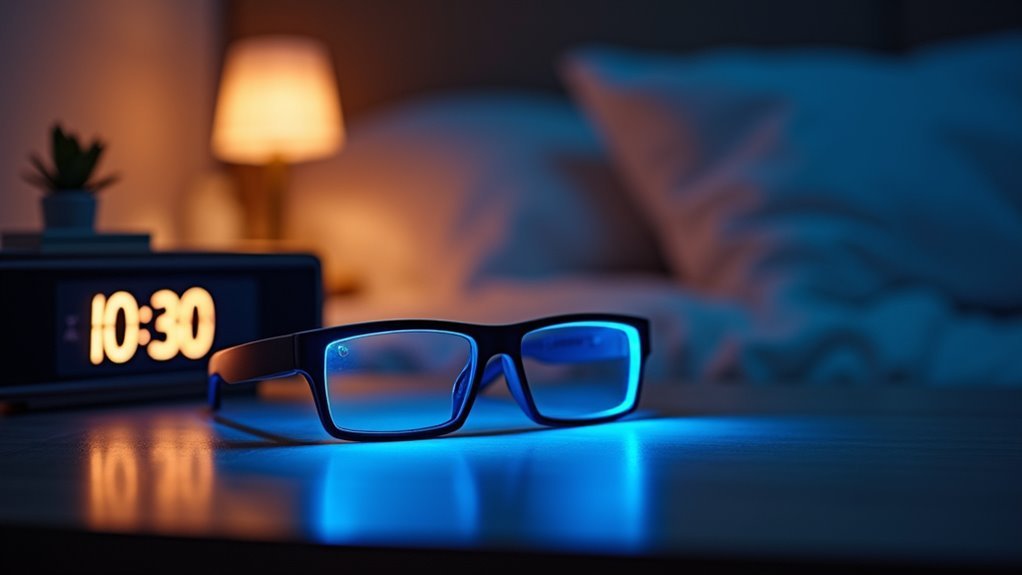
Blue light glasses filter out harmful wavelengths around 480 nanometers that disrupt your body’s natural melatonin production in the evening. When you wear them 2-3 hours before bedtime, they block the blue light from screens that tricks your brain into thinking it’s daytime, allowing your circadian rhythm to function properly. This helps restore your body’s natural sleep preparation process, making it easier to fall asleep despite continued screen use. Understanding the ideal timing and lens types can maximize these benefits.
Understanding Blue Light and Its Wavelengths
When you’re exposed to light throughout the day, your eyes encounter various wavelengths that greatly impact your body’s natural rhythms. Blue light exposure occurs between 450 and 495 nanometers, with the most essential wavelengths of blue light centered around 480 nm. This specific range directly affects melanopsin, a photopigment that’s highly sensitive to these frequencies.
Your circadian rhythms rely on blue light exposure during daylight hours to maintain proper synchronization. This natural process regulates your sleep-wake cycle, hormone production, and digestive patterns.
However, artificial sources like computer screens and LED lights can disrupt melatonin production when you’re exposed to them in the evening. Even small amounts of blue light can compromise your sleep quality by delaying sleep onset and altering your internal clock’s timing.
How Blue Light Affects Your Circadian Rhythm
Your body’s circadian rhythm operates like an internal clock that naturally regulates when you feel alert and when you’re ready for sleep.
Blue light exposure during the day helps maintain this cycle by keeping you awake, but it becomes problematic when screens flood your eyes with the same wavelengths in the evening.
This evening exposure tricks your brain into thinking it’s still daytime, suppressing melatonin production and throwing off your natural sleep-wake pattern.
Related guide: Best Blue Light Blocking Glasses for Better Sleep
Natural Sleep-Wake Cycles
Although your body naturally follows a 24-hour sleep-wake cycle, blue light exposure can considerably disrupt this delicate internal clock known as your circadian rhythm.
Your brain’s circadian clock is most sensitive to blue-green light around 480 nm, making it particularly vulnerable to interference from digital devices and artificial lighting.
During daylight hours, blue light exposure actually benefits you by promoting alertness and synchronizing your natural rhythms.
However, when you’re exposed to blue light in the evening, it suppresses melatonin production—the hormone responsible for making you feel sleepy.
This disruption can shift the timing of your circadian rhythm, making it harder to fall asleep and affecting your overall sleep quality throughout the night.
Melatonin Production Timing
Because melatonin production serves as your body’s primary sleep signal, understanding how blue light interferes with its production becomes essential for maintaining healthy sleep patterns.
Your brain’s melanopsin photoreceptors are most sensitive to blue-green light around 480 nm, which means evening screen time can severely disrupt your natural melatonin release.
Blue light exposure in the hour before bed can suppress melatonin production by approximately 50%, making it harder to fall asleep.
This disruption affects three key areas:
- Sleep onset timing – You’ll struggle to feel drowsy at your normal bedtime
- Sleep quality – Your restorative sleep cycles become fragmented
- Circadian alignment – Your internal clock shifts, especially during shift work or jet lag
Blue light glasses can help minimize this exposure and protect your melatonin timing.
Evening Light Disruption
When evening arrives and you’re winding down with your favorite show or scrolling through your phone, the blue light from these screens sends confusing signals to your brain. Your body naturally expects darkness to trigger melatonin production, but blue light exposure tricks your system into thinking it’s still daytime. This disrupts your circadian rhythm and delays sleep onset.
| Time Period | Blue Light Impact | Melatonin Response | Sleep Effect | Recommendation |
|---|---|---|---|---|
| 8-9 PM | Moderate disruption | Delayed production | Slight delay | Reduce screen brightness |
| 9-10 PM | Significant interference | Suppressed levels | Increased latency | Limit device use |
| 10-11 PM | Maximum disruption | Severely inhibited | Poor quality | Avoid screens completely |
| 11 PM+ | Lasting effects | Minimal secretion | Restless night | Blue light glasses |
| Morning | Beneficial regulation | Natural timing | Better rhythm | Welcome bright light |
Even minimal exposure can inhibit this essential sleep hormone.
The Science Behind Melanopsin and Sleep Regulation
Your eyes contain specialized cells with melanopsin, a photopigment that’s incredibly sensitive to blue light around 480 nanometers and directly communicates with your brain’s circadian clock.
When melanopsin detects blue light—especially during evening hours—it signals your brain to suppress melatonin production, the hormone that makes you feel sleepy.
This process explains why scrolling through your phone before bed can keep you wide awake, as even small amounts of blue light exposure can shift your body’s natural sleep-wake timing.
Melanopsin Light Detection
Although you mightn’t realize it, specialized cells in your eyes constantly monitor light exposure to regulate your body’s internal clock. These retinal ganglion cells contain melanopsin, a photopigment that’s particularly sensitive to blue light around 480 nanometers.
When melanopsin detects light exposure, it sends direct signals to your brain’s circadian clock, influencing your sleep-wake cycle.
Here’s how melanopsin affects your sleep regulation:
- Light Detection: Melanopsin responds most strongly to blue-green light, making it highly sensitive to modern LED screens and artificial lighting.
- Signal Transmission: Upon activation, it communicates directly with your brain’s master clock, bypassing traditional visual pathways.
- Melatonin Suppression: This signaling process inhibits melatonin production, keeping you alert when light’s detected.
Understanding melanopsin’s role explains why managing blue light exposure becomes essential for maintaining healthy circadian rhythms.
Circadian Clock Control
Since melanopsin sends signals directly to your brain’s master timekeeper, it’s controlling far more than just your awareness of light and dark. Your circadian clock uses these signals to orchestrate sleep-wake cycles, hormone release, and body temperature fluctuations throughout each 24-hour period.
| Time of Day | Blue Light Impact | Circadian Response |
|---|---|---|
| Morning | Natural exposure helps | Cortisol rises, alertness increases |
| Afternoon | Continued exposure | Maintains daytime rhythm |
| Evening | Artificial sources disrupt | Melatonin production delayed |
| Night | Blocking blue light helps | Natural sleep preparation |
| Late Night | Screen exposure harmful | Circadian rhythms shift |
Exposure to blue light during evening hours can suppress melatonin production for hours, making it harder to fall asleep. Blocking blue light in the evening helps restore your natural circadian rhythms.
Melatonin Production Timing
When light hits your eyes, melanopsin photoreceptors respond most strongly to blue-green wavelengths around 480 nanometers, triggering a cascade of signals that directly influence your brain’s pineal gland.
This process controls your natural melatonin production timing, which follows a precise schedule critical for healthy circadian rhythms.
Blue light exposure in the evening creates significant disruption by suppressing melatonin secretion by approximately 50%.
Your body’s sleep preparation gets derailed when screens flood your eyes with this wavelength within an hour of bedtime.
The timing consequences include:
- Delayed melatonin release – pushing your natural sleepiness later
- Misaligned circadian rhythms – creating ongoing sleep-wake cycle problems
- Reduced sleep quality – preventing restorative rest
Blue light-blocking glasses can help preserve your natural melatonin production schedule by filtering problematic wavelengths.
Evening Blue Light Exposure and Sleep Disruption
As evening approaches and your body naturally prepares for rest, exposure to blue light from screens creates a biological conflict that can derail your sleep plans.
When you use devices like smartphones or watch TV during essential wind-down hours, you’re exposing yourself to light that can suppress melatonin production by approximately 50%. This disruption makes falling asleep considerably harder and reduces overall sleep quality.
The timing matters critically – bright screen use in the hour before bedtime is particularly harmful to your natural sleep patterns. Consistent evening blue light exposure can shift your circadian rhythms, pushing your desired bedtime later and later.
Blue light glasses offer a practical solution to filter out these disruptive wavelengths, allowing your body to maintain its natural sleep preparation process even during necessary screen use.
How Blue Light Blocking Glasses Work
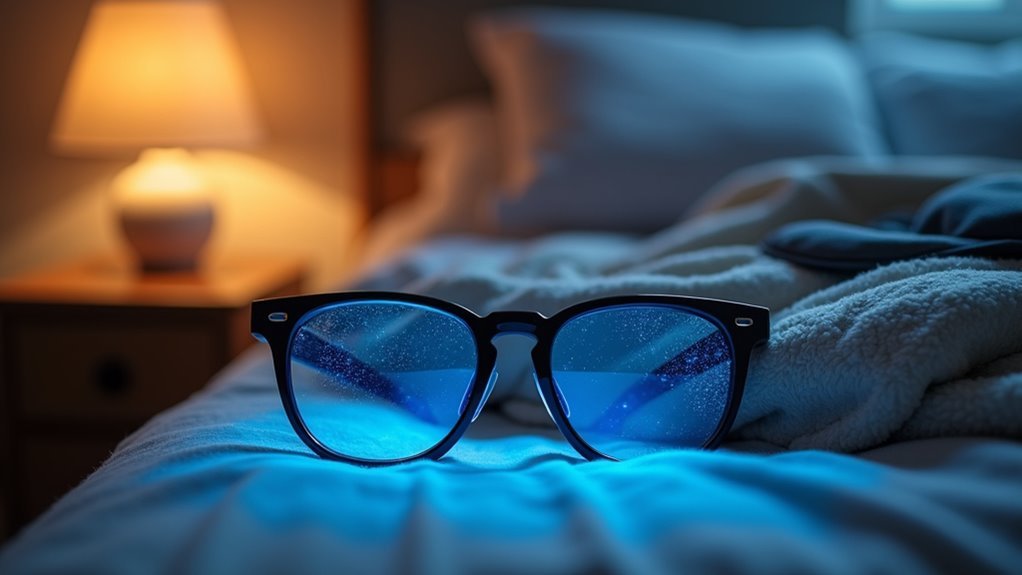
Blue light blocking glasses filter out specific wavelengths of light that interfere with your body’s natural sleep preparation.
These specialized lenses target blue light around 480 nm, which most effectively stimulates alertness and disrupts your circadian rhythm.
When you reduce blue light exposure using these glasses, you’re helping enhance melatonin production—the hormone that regulates your sleep cycles.
Here’s how the filtering process works:
- Wavelength blocking: Glasses can block 10% to 100% of blue light, with advanced options like red lenses filtering everything up to 550 nm
- Timing matters: You’ll see ideal results wearing them 2-3 hours before bedtime
- Screen freedom: You can continue using devices without greatly impacting your natural sleep rhythms
This targeted approach allows your body to naturally prepare for rest.
Research Evidence on Sleep Quality Improvements
While understanding how blue light glasses function provides valuable insight, examining the scientific evidence reveals mixed results regarding their effectiveness for sleep improvement. Research confirms that blue light exposure suppresses melatonin production by 50%, particularly during evening hours. Studies from Chronobiology International show blue-light blocking glasses can reduce sleep latency for individuals with sleep disorders when worn before bedtime.
| Study Focus | Effectiveness | Key Finding |
|---|---|---|
| General Population | Minimal Benefits | Limited evidence for widespread use |
| Sleep Disorders | Moderate Benefits | Reduced sleep latency observed |
| Pregnant Women | Potential Benefits | Specific group showing promise |
However, only glasses blocking 100% of blue light improve sleep quality effectively. While some evidence supports their use, researchers emphasize that proper sleep habits and light exposure timing remain more essential factors.
Timing Blue Light Protection for Maximum Benefits
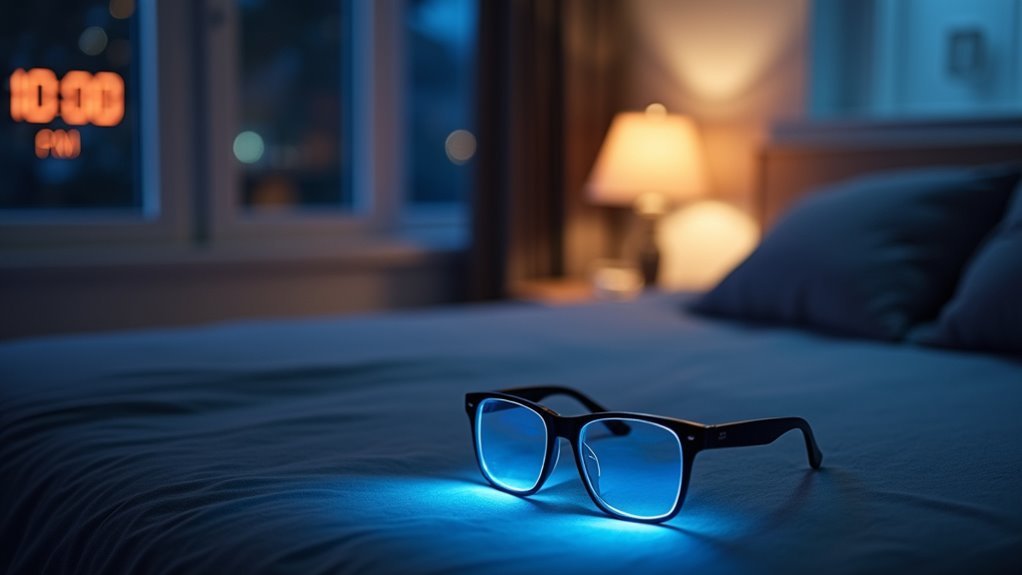
You’ll maximize your blue light glasses’ effectiveness by wearing them during specific evening hours when your body prepares for sleep.
Start using them 2-3 hours before bedtime to give your melatonin production time to increase naturally.
This strategic timing helps synchronize your sleep cycle with your body’s circadian rhythms, creating the ideal conditions for restful sleep.
Optimal Evening Protection Hours
Since your body begins its natural wind-down process hours before you actually fall asleep, timing your blue light protection becomes critical for peak sleep quality.
Understanding prime evening protection hours helps you maximize the benefits of blue light-blocking glasses.
Here’s when to wear your blue light glasses for maximum effectiveness:
- 2-3 hours before bedtime – Start wearing them when evening activities begin to support natural melatonin production.
- After sunset – Align with natural light cues as your circadian rhythms shift toward rest mode.
- During all screen time – Protect against melatonin suppression, which can be reduced by up to 50% from blue light exposure.
Consistent timing matters most.
Avoiding bright artificial light in that final hour before bed guarantees your sleep quality remains undisturbed.
Sleep Cycle Synchronization
Although blue light glasses provide protection, their true power lies in how strategically you synchronize their use with your body’s natural sleep rhythms. Your circadian rhythms depend on precise timing cues, and when you block blue light consistently during evening hours, you’re fundamentally resetting your internal clock.
This synchronization helps your body distinguish between day and night signals, allowing melatonin secretion to begin at the appropriate time.
For maximum effectiveness, you’ll want to start wearing blue light glasses approximately two to three hours before your intended bedtime. This timing aligns with your body’s natural melatonin production window, ensuring ideal sleep quality.
Comparing Different Types of Blue Light Filtering Lenses
Two main categories of blue light filtering lenses dominate the market, each designed for different times of day and levels of light exposure.
When you’re shopping for blue light-blocking glasses, you’ll encounter significant differences in effectiveness and purpose.
NightFall lenses block 100% of blue and green light up to 550nm, making them your best choice for late-night screen use.
SunDown lenses offer a lighter approach, blocking 100% of blue light while remaining suitable for early evening activities.
Here’s what you should know:
- NightFall lenses maximize sleep improvement for severe insomnia cases
- SunDown lenses provide versatile evening protection without intensity
- Standard glasses may only block 10-25% of blue light
To effectively reduce blue light exposure, choose lenses that match your specific timing needs and sleep challenges.
Blue Light Glasses vs. Other Sleep Hygiene Practices
While blue light glasses can reduce melatonin suppression from screen exposure, they’re just one piece of your sleep optimization puzzle.
Although glasses can help filter harmful wavelengths, they won’t guarantee better sleep without proper sleep hygiene practices.
Blue light glasses alone won’t solve sleep problems without implementing comprehensive sleep hygiene habits.
The most effective approach involves dimming lights and turning off screens two to three hours before bedtime. This strategy often outperforms relying solely on blue light filtering.
Your devices’ built-in night modes provide similar blue light reduction without additional equipment.
Remember that blocking blue light addresses only one sleep factor. You’ll benefit more from establishing consistent light-dark cycles and avoiding stimulating activities before bed.
Don’t let psychological attachment to glasses prevent you from adopting thorough sleep hygiene practices like calming pre-sleep routines that create lasting improvements.
Optimizing Your Nighttime Light Environment for Better Sleep
Beyond simply wearing blue light glasses, you can transform your entire nighttime environment to support natural sleep patterns.
Creating an ideal setting helps reduce exposure to disruptive artificial light that interferes with your circadian rhythms and sleep quality.
Here’s how to enhance your nighttime environment:
- Switch to warm lighting – Replace bright white bulbs with dim, warm-colored lights in the evening to signal your body it’s time to wind down.
- Enable device filters – Use night mode or blue light filters on phones, tablets, and computers to minimize harmful blue light exposure during evening hours.
- Block external light – Install blackout curtains or use eye masks to eliminate streetlights and other outside light sources that can disrupt your rest.
Consistently dimming lights one to two hours before bedtime greatly improves sleep onset and overall quality.
Frequently Asked Questions
Do Blue Light Glasses Do Anything for Sleep?
Blue light glasses can improve your sleep by blocking evening blue light exposure, which helps maintain natural melatonin production. You’ll likely see better results if you have sleep disorders or irregular schedules.


