

Travel disrupts your rest rhythm because crossing time zones misaligns your internal 24-hour circadian clock with local time, causing jet lag. Your body’s natural cycle can’t keep pace with rapid time shifts, leading to sleep disturbances and fatigue. Environmental factors like cabin pressure, dehydration, and altered light exposure worsen the disruption. Additionally, travel stress triggers cortisol release, while unfamiliar surroundings and pre-existing sleep debt amplify these effects, making adjustment even more challenging than you’d expect.
Understanding Your Body’s Internal Clock and Circadian Rhythms

When you travel across multiple time zones, you’re fundamentally asking your body to ignore millions of years of evolutionary programming. Your internal clock operates on a precise 24-hour cycle, controlling your sleep-wake cycle, hormone release, and body temperature through circadian rhythms.
This biological timekeeper relies heavily on light exposure to stay synchronized with your environment. When you rapidly cross time zones, your internal clock becomes misaligned with local time, creating the uncomfortable symptoms you know as jet lag.
Your body needs approximately one day per time zone crossed for recovery time, though factors like age and health affect this adjustment period. Understanding these circadian rhythms helps explain why travel fatigue feels so overwhelming and why readjustment takes considerable time.
The Science Behind Jet Lag and Time Zone Disruption
When you rapidly cross multiple time zones, your body’s internal circadian rhythms can’t keep pace with the sudden shift, creating the misalignment that’s recognized as jet lag.
You’ll typically experience more severe disruption when traveling eastward because you’re forcing your body to shorten its natural cycle, which goes against its tendency to follow a longer rhythm.
This disruption affects everything from your sleep patterns to your digestive system, with symptoms lasting roughly one day for each time zone you’ve crossed.
Circadian Rhythm Disruption
Although your body operates on a sophisticated internal timekeeping system, rapid travel across multiple time zones can throw this biological clock into chaos.
Your circadian rhythm relies on environmental light cues to maintain its 24-hour cycle, but when you cross multiple time zones quickly, this internal clock can’t adjust fast enough. This misalignment creates jet lag, leading to sleep disturbances, fatigue, and digestive issues that can persist for days.
You’ll likely experience more severe symptoms when traveling east since your body naturally runs on a cycle slightly longer than 24 hours.
Recovery typically requires one day per time zone crossed. Morning light exposure helps reset your internal clock by regulating melatonin production, gradually realigning your rhythm with your new environment.
Eastward Vs Westward Travel
The direction of your travel greatly impacts the severity of your jet lag experience.
Eastward travel forces your internal clock to adjust to a shorter day, creating more disruption to your circadian rhythms than westward journeys. Your body naturally runs on a cycle slightly longer than 24 hours, making westward travel easier to handle.
Key differences between travel directions include:
- Eastward travel requires advancing your sleep schedule, which feels unnatural
- Westward travel allows extending your day, aligning better with your internal clock
- Recovery time averages one day per time zone crossed regardless of direction
- Morning light exposure helps eastward travelers adjust their circadian rhythms
- Evening light exposure assists westward travelers in maintaining proper sleep timing
Understanding these patterns helps you prepare for jet lag’s varying intensity.
How Light Exposure Affects Your Sleep-Wake Cycle
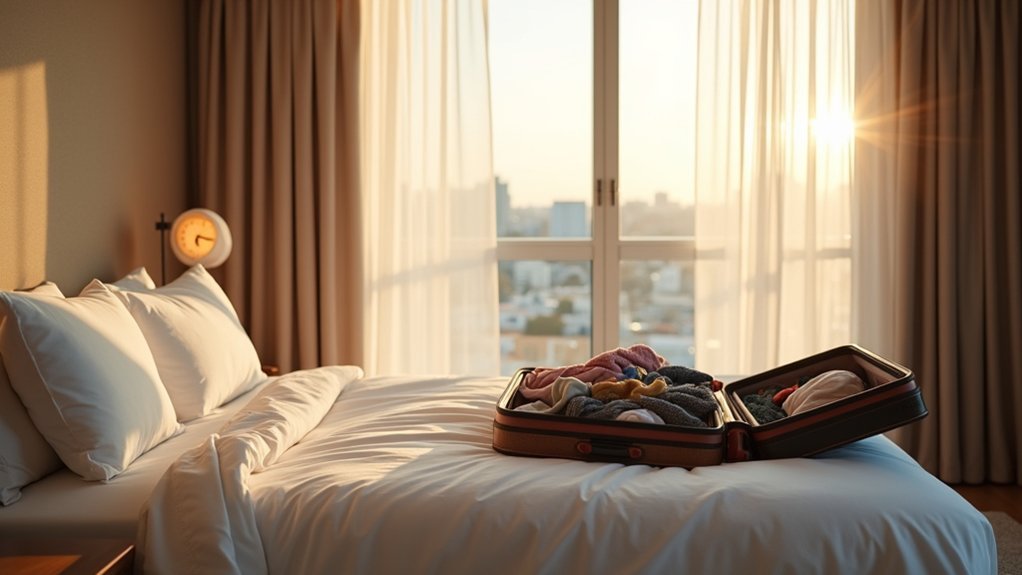
Since your body operates on an internal clock that craves consistency, light exposure becomes your most powerful tool for maintaining healthy sleep patterns.
Your circadian rhythms depend entirely on light cues to regulate melatonin production, which signals when you should sleep. Bright light during daytime hours keeps you alert and enhances mood, while dimmer evening conditions prepare your body for rest.
When you travel across time zones, disrupted light exposure throws your internal clock into chaos. Your sleep-wake cycle can’t immediately adjust to the new environment, resulting in sleep disorders like jet lag.
However, you can harness light’s power strategically. Exposing yourself to morning sunlight upon arrival helps reset your internal clock faster than any other method, allowing quicker adaptation to your destination’s schedule.
Environmental Factors That Impact Rest During Travel
When you’re traveling, your sleep gets disrupted by environmental changes that go beyond just crossing time zones.
You’ll encounter altered light exposure patterns from cabin lighting and screens that throw off your melatonin production, while the airplane’s reduced cabin pressure affects how well your body can rest.
These factors work together to make it harder for you to maintain your natural sleep-wake cycle during and after your journey.
Light Exposure Changes
Although your body’s internal clock operates on a roughly 24-hour cycle, light exposure acts as its primary reset button, and traveling disrupts this delicate synchronization in profound ways.
When traveling across time zones, you’re suddenly exposed to light at completely different times than your internal clock expects, throwing your circadian rhythms into chaos.
This light confusion directly impacts melatonin production, the hormone that signals your body when it’s time to sleep. Your sleep-wake cycles become misaligned with local time, leaving you feeling exhausted when you should be alert.
Several factors compound this disruption:
- Morning light exposure helps adjust to earlier time zones
- Evening light assists with later time zone adaptation
- Artificial light from screens worsens jet lag
- Cabin lighting during flights confuses your system
- Early morning and late afternoon light have the strongest effects
Cabin Pressure Effects
Beyond the confusion of light exposure, the physical environment inside aircraft cabins creates additional challenges for maintaining proper rest rhythms.
Cabin pressure maintained at 6,000-8,000 feet causes mild hypoxia, reducing oxygen levels that contribute to fatigue and sleep disruption.
You’ll also face humidity below 20%, leading to dehydration that severely impacts your sleep quality.
The ambient noise averaging 85 decibels makes achieving deep, restorative sleep nearly impossible.
Pressure changes during takeoff and landing create ear discomfort, preventing relaxation needed for rest.
This combination of reduced oxygen, low humidity, and constant noise disrupts your natural sleep patterns, making it difficult to maintain normal rhythms and greatly contributing to jet lag symptoms you’ll experience upon arrival.
Why Flying East Versus West Makes a Difference
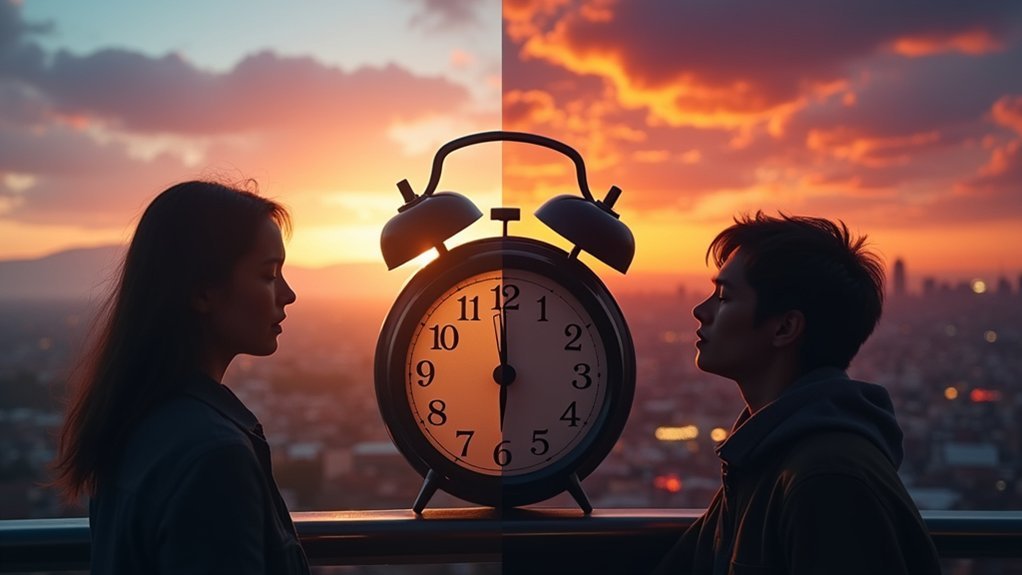
If you’ve ever noticed that flying to Europe feels worse than flying to California, you’re not imagining things.
Eastward travel creates more severe jet lag because it forces a “phase advance” on your internal clock, requiring you to sleep earlier than your circadian rhythm naturally wants.
Your body struggles more with eastward flights because:
- Each time zone crossed requires approximately one day to fully adjust
- Phase advance (going to bed earlier) is harder than phase delay (staying up later)
- Sleep problems intensify due to abrupt light exposure changes
- Insomnia and daytime fatigue worsen with multiple eastward time zones
- Your natural circadian rhythm has a longer cycle that aligns better with westward travel
This biological mismatch explains why eastward jet lag feels more punishing than westward trips.
The Role of Cabin Pressure and Altitude in Sleep Disruption
When you’re cruising at 35,000 feet, your body faces a double challenge that disrupts your sleep patterns in ways you mightn’t expect.
The cabin pressure mimics an altitude of 6,000 to 8,000 feet, reducing oxygen levels and forcing your respiratory system to work harder while you’re trying to rest.
These altitude-related changes don’t just affect your breathing—they trigger a cascade of physiological responses that interfere with your natural sleep cycles and make jet lag recovery even more difficult.
Cabin Pressure Effects
Although you mightn’t realize it during your flight, the cabin pressure aboard commercial aircraft creates conditions equivalent to being 6,000 to 8,000 feet above sea level.
This reduced pressure environment triggers several physiological responses that directly impact your sleep quality and circadian rhythms.
The cabin pressure effects include:
- Lower oxygen levels in your blood, leading to increased fatigue and difficulty achieving restful sleep
- Accelerated dehydration due to low cabin humidity, which compounds tiredness
- Disrupted natural sleep-wake cycles as your body struggles with atmospheric pressure changes
- Enhanced susceptibility to sleep disruption from noise and temperature fluctuations
- Increased sleep disturbances that persist after landing, contributing to jet lag symptoms
These combined factors create a perfect storm for sleep disruption that extends well beyond your flight.
Altitude Sleep Impact
Beyond these immediate effects, the reduced oxygen availability at simulated altitudes fundamentally alters how your body processes sleep. When cabin pressure mimics 6,000-8,000 feet elevation, your oxygen levels drop considerably, triggering physiological stress responses that prevent restful sleep.
| Altitude Effect | Physical Response | Sleep Impact |
|---|---|---|
| Reduced oxygen | Increased heart rate | Difficulty falling asleep |
| Low humidity | Dehydration symptoms | Frequent awakenings |
| Pressure changes | Altered breathing | Shallow sleep cycles |
| Combined stressors | Mild altitude sickness | Insomnia patterns |
These altitude-induced changes create a cascade of sleep disruptions. Your body can’t achieve deep sleep phases when fighting oxygen deprivation and dehydration. The resulting fatigue compounds throughout your flight, setting the stage for severe jet lag upon arrival.
Dehydration and Diet Changes That Disturb Your Rest
Since your body loses fluids faster than usual during air travel, dehydration becomes one of the most overlooked culprits behind disrupted sleep patterns. Low cabin humidity accelerates fluid loss, triggering sleep disturbances that compound jet lag effects.
Your dietary choices while traveling further compromise sleep quality through several mechanisms:
- Heavy meals and unfamiliar foods cause gastrointestinal issues like bloating and discomfort.
- Increased alcohol consumption interferes with your body’s natural sleep regulation.
- Excess caffeine disrupts established sleep patterns and worsens dehydration.
- Irregular meal timing throws off your circadian rhythm.
- Dehydration symptoms including headaches and irritability impair cognitive function.
Maintaining proper hydration and consistent eating habits becomes essential for preserving sleep quality during travel, as these factors directly influence your body’s ability to adapt to new environments.
Pre-Travel Sleep Debt and Its Amplifying Effects
When you arrive at your destination already carrying sleep debt from weeks or months of inadequate rest, you’re fundamentally starting your journey from a compromised baseline that enhances every challenge jet lag presents. Your pre-travel sleep debt creates cascading effects that compound traditional travel disruptions.
| Impact Area | Sleep Debt Effects | Recovery Time |
|---|---|---|
| Cognitive Function | Difficulty concentrating, impaired decision-making | 3-5 days longer |
| Physical Health | Weakened immune response, increased illness risk | 1-2 weeks |
| Emotional State | Heightened emotional instability, mood swings | 4-7 days |
You’ll experience intensified daytime fatigue and struggle with jet lag symptoms more severely. Your overall well-being suffers as your body fights multiple battles simultaneously. Establishing consistent sleep schedules before departure considerably reduces these amplifying effects.
Stress and Anxiety’s Impact on Travel Sleep Quality
While sleep debt creates a physical foundation for travel fatigue, psychological factors add another layer of complexity to your sleep challenges.
Stress and anxiety greatly impact your sleep quality during travel, creating a cascade of issues that disrupt your rest rhythm. Travel-related stressors trigger cortisol release, making restful sleep nearly impossible. Your body’s stress response interferes with natural sleep cycles, often leading to insomnia.
Several factors compound this problem:
- Packing deadlines and scheduling pressures heighten pre-trip anxiety
- Flight delays and transportation concerns increase tension levels
- Unfamiliar environments disrupt your comfort zones
- Fear of missing connections creates persistent worry
- Lost luggage anxieties keep your mind racing
Fortunately, you can counter these effects by practicing relaxation techniques like deep breathing and mindfulness meditation before and during travel.
Age-Related Factors in Sleep Rhythm Adjustment
Although stress and anxiety create considerable sleep challenges for travelers of all ages, your age plays an equally important role in determining how quickly you’ll adapt to new sleep rhythms.
Age-related changes affect your circadian rhythms’ flexibility, making adjustment to new time zones increasingly difficult as you get older. If you’re over 60, you’ll likely experience more frequent sleep disturbances and prolonged jet lag recovery time.
Travelers over 60 face significantly longer jet lag recovery periods due to age-related decline in circadian rhythm flexibility.
Your melatonin production naturally decreases with age, making it harder to fall asleep in unfamiliar environments.
You’ll notice increased daytime sleepiness and fatigue after long flights due to slower physiological adaptations. While younger travelers typically recover within one day per time zone crossed, your recovery time extends considerably as age impacts your body’s ability to readjust internal clocks.
Frequently Asked Questions
Does Traveling Affect Circadian Rhythm?
Yes, traveling across time zones disrupts your circadian rhythm by misaligning your internal body clock with new light-dark cycles. You’ll experience jet lag symptoms as your biological processes struggle to adjust.
How to Reset Your Circadian Rhythm After Travel?
Reset your circadian rhythm by exposing yourself to natural sunlight during the day, maintaining local meal times, staying hydrated, limiting naps to thirty minutes, and taking low-dose melatonin before bedtime.
How Long Does It Take for Your Circadian Rhythm to Fix After Traveling?
Your circadian rhythm typically takes about one day per time zone crossed to fully readjust. Eastward travel requires longer recovery than westward trips, and older adults may need additional days beyond this general rule.
Why Can’t I Sleep When I Have to Travel?
You can’t sleep when traveling because your body’s stressed from disrupted routines, unfamiliar environments, and travel anxiety. Flight conditions like pressure changes and dehydration also interfere with your natural sleep patterns.


