

Continuous white noise combines all frequencies within your hearing range at equal intensity, creating a stable auditory backdrop that masks environmental distractions and enhances your focus during work or sleep. You’ll experience 38% faster sleep onset as it blocks disruptive sounds while reducing your heart and respiratory rates for deeper relaxation. It maintains constant audio levels, preventing jarring changes that can wake you throughout the night. Discover how proper implementation can transform your sleep quality completely.
Understanding Continuous White Noise and How It Works
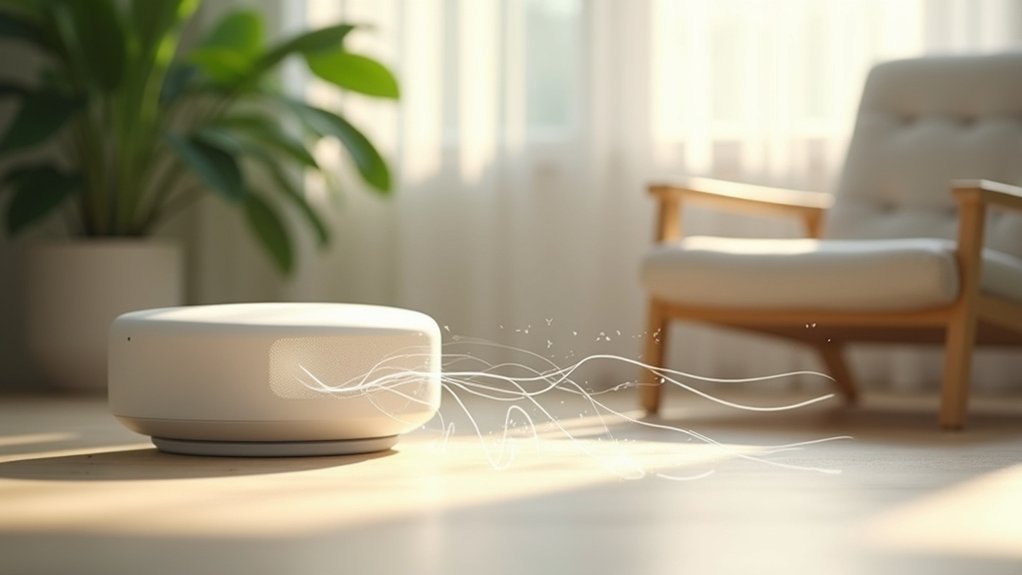
While you might associate white noise with television static or radio interference, continuous white noise actually serves as a powerful auditory tool that combines all frequencies within the human hearing range at equal intensity.
This consistent sound creates a stable auditory backdrop that helps mask environmental distractions like traffic, neighbors, or sudden noises that disrupt your peace.
The steady sound works by maintaining constant audio levels, preventing jarring changes that startle your brain.
When you’re exposed to this calming auditory environment, your mind can better improve focus during work or study sessions.
For sleep, continuous white noise helps reduce sleep onset latency, allowing you to fall asleep faster while improving overall sleep quality throughout the night.
The Science Behind White Noise and Sleep Quality
Research reveals fascinating insights into how white noise transforms your sleep patterns at a neurological level. Continuous white noise effectively masks disruptive environmental noises by blending all audible frequencies, creating an acoustic shield that protects your sleep quality.
Studies demonstrate you’ll fall asleep faster—up to 38% quicker than without white noise.
Here’s what science shows about white noise’s sleep benefits:
- Physiological Impact: White noise reduces heart rate and respiratory rates, particularly in infants, promoting deeper relaxation.
- Sleep Onset Enhancement: You’ll experience remarkably faster sleep initiation when using continuous white noise consistently.
- Volume Considerations: Maintaining appropriate volume levels is essential—excessive loudness can disrupt REM and deep sleep stages.
However, a systematic review indicates mixed results, suggesting individual responses vary. To enhance sleep effectively, you’ll need proper volume control.
Key Benefits of Running White Noise Throughout the Night
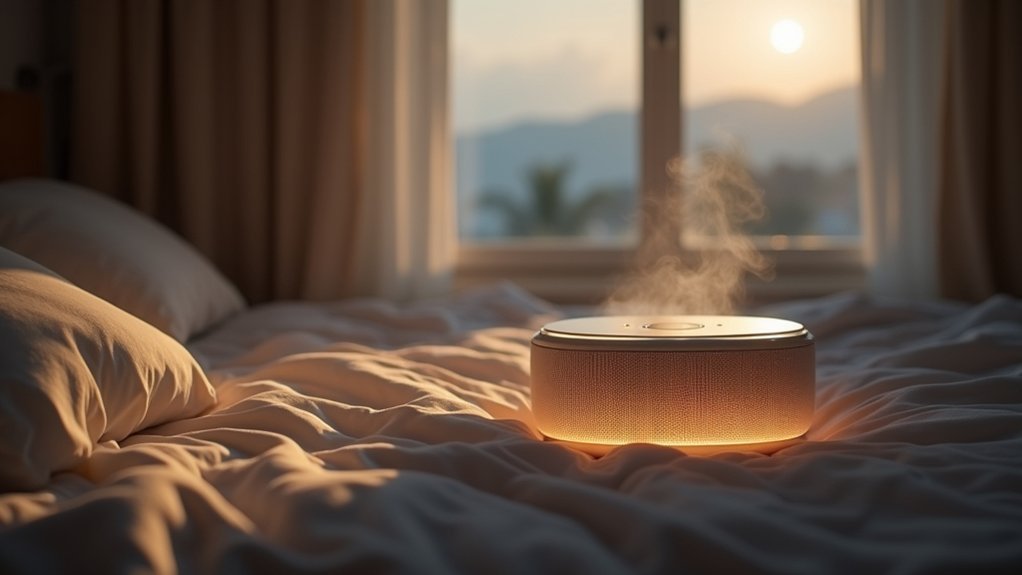
Throughout the night, continuous white noise delivers multiple sleep benefits that extend far beyond simple sound masking.
You’ll fall asleep 38% faster as the steady sound blocks disruptive environmental noises that typically keep you awake. This creates a better sleep environment where sudden sounds won’t jolt you from deeper sleep stages.
The consistent auditory backdrop helps quiet your racing thoughts, promoting enhanced relaxation and improved sleep quality.
You’ll experience reduced heart and respiratory rates, contributing to a calmer overall sleep experience. Running white noise continuously reinforces your brain’s association between the sound and sleep, helping you maintain consistent sleep patterns.
These benefits compound throughout the night, supporting deeper, more restorative sleep cycles.
How Continuous White Noise Masks Disruptive Environmental Sounds
When you’re exposed to sudden loud noises like traffic or slamming doors, white noise’s sound frequency masking mechanism prevents these disruptions from jolting you awake or breaking your concentration.
You’ll experience significant environmental noise reduction as the continuous audio signal drowns out intermittent sounds that would otherwise penetrate your awareness.
This consistent audio barrier maintains a stable sound environment that keeps your nervous system from reacting to unpredictable acoustic disturbances throughout the night.
Sound Frequency Masking Mechanism
White noise creates an effective acoustic shield by filling your auditory environment with a consistent spectrum of all audible frequencies at equal intensity.
This thorough sound coverage prevents your brain from detecting sudden changes in background noise that would normally wake you or break your concentration. The masking effect works by providing a steady auditory backdrop that drowns out disruptive sounds before they can reach your conscious awareness.
Here’s how this frequency masking helps you:
- Reduces sleep onset time – You’ll fall asleep faster when environmental disturbances can’t penetrate the white noise barrier.
- Maintains sleep continuity – Sudden noises won’t jolt you awake during deeper sleep stages.
- Enhances overall sleep quality – Your brain receives consistent auditory input that promotes relaxation and helps improve sleep patterns.
Environmental Noise Reduction
Since urban environments bombard you with unpredictable sounds throughout the day and night, continuous white noise serves as your personal acoustic barrier against these disruptive intrusions. White noise machines create a consistent auditory backdrop that effectively drowns out environmental sounds like traffic, conversations, and sudden noises.
| Sound Type | Without White Noise | With White Noise |
|---|---|---|
| Traffic | Jarring interruptions | Seamlessly masked |
| Conversations | Sleep disruptions | Barely noticeable |
| Sudden noises | Frequent awakenings | Maintained sleep |
This steady sound reduces your sensitivity to intermittent sounds, allowing you to achieve deeper restful sleep. By providing consistent frequencies across the audible spectrum, white noise helps mask external disturbances that would otherwise fragment your sleep quality throughout the night.
Consistent Audio Barrier
Millions of people struggle with sleep disruption caused by inconsistent environmental sounds that penetrate their living spaces at unpredictable intervals.
White noise creates a consistent audio barrier that transforms your sleep environment by masking disruptive sounds throughout the night. This steady sound backdrop effectively neutralizes sudden noises like traffic, construction, or neighbors that would otherwise jolt you awake.
Here’s how white noise helps improve sleep quality:
- Masks sudden disturbances – Traffic horns, sirens, and loud conversations become less noticeable
- Creates predictable sound levels – Your brain adjusts to consistent audio rather than fluctuating background noises
- Reduces sleep fragmentation – Fewer interruptions mean deeper, more restorative rest cycles
You’ll achieve better sleep when environmental sounds can’t penetrate this protective audio shield.
White Noise vs. Pink Noise vs. Brown Noise for All-Night Use
When choosing between white, pink, and brown noise for all-night use, you’ll discover that each type offers distinct characteristics that can greatly impact your sleep quality and duration. White noise contains equal intensity across all frequencies, making it excellent for masking disruptions in noisy environments. A white noise machine can help you fall asleep 38% faster. Pink noise emphasizes lower frequencies and enhances deep sleep while boosting cognitive performance. Brown noise features even deeper tones resembling distant thunder, providing superior relaxation levels for frequency-sensitive individuals.
| Feature | White Noise | Pink Noise | Brown Noise |
|---|---|---|---|
| Frequency Range | All frequencies equal | Lower frequency emphasis | Deepest tones |
| Primary Benefit | Masks disruptive sounds | Enhances deep sleep | Maximum relaxation |
| Sleep Improvement | 38% faster sleep onset | Better duration/quality | Calming environment |
| Best For | Noisy environments | Cognitive performance | Frequency sensitivity |
Optimal Volume Levels for Safe Continuous White Noise Exposure
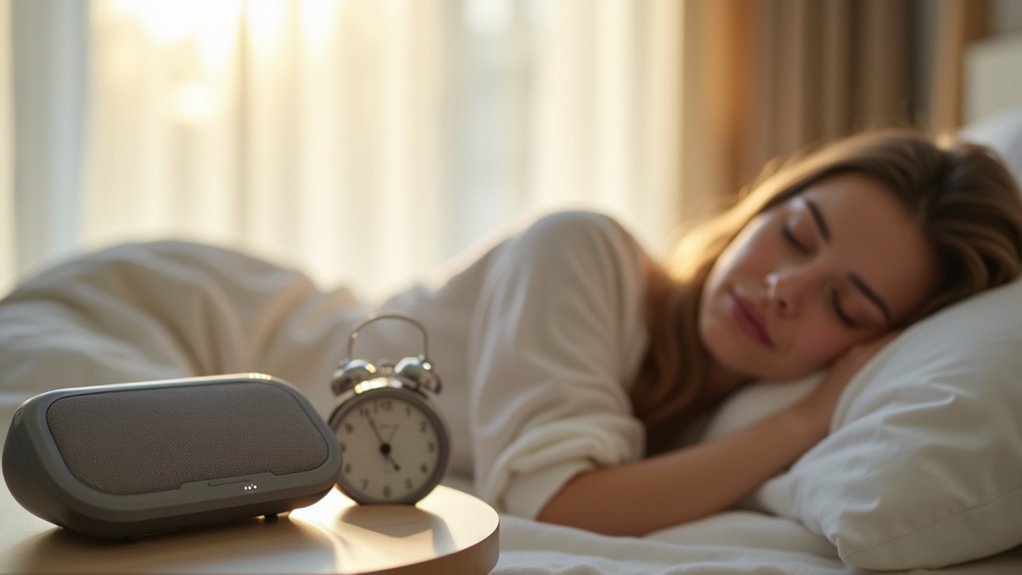
You’ll want to keep your white noise at around 46 decibels—roughly the sound of gentle rustling—to protect your hearing during all-night use.
Since 65% of infant white noise machines can exceed safe levels, you’ll need to actively monitor and adjust your device’s volume settings.
Position your machine away from your bed and regularly check that the sound remains comfortable, as prolonged exposure above 70 decibels can damage your hearing over time.
Safe Decibel Guidelines
Although white noise offers numerous benefits for sleep and concentration, maintaining proper volume levels is essential for protecting your hearing health. Understanding safe decibel guidelines guarantees you’ll maximize continuous white noise benefits without risking hearing damage.
Follow these critical safety recommendations for ideal white noise use:
- Keep volume at 46 decibels – This library-quiet level provides effective background noise while guaranteeing ideal safety for extended exposure.
- Never exceed 70 decibels – NIOSH guidelines warn that prolonged exposure above this threshold can cause hearing damage and compromise sleep quality.
- Position machines strategically – Place white noise machines in room corners, away from your bed, to maintain appropriate volume settings and create gentle rustling sounds.
Many commercial white noise machines exceed safe levels, so always monitor your device’s volume setting carefully.
Volume Setting Recommendations
Setting your white noise machine to the proper volume requires careful attention to both effectiveness and safety.
Begin with volume setting recommendations around 46 decibels, which creates a comfortable background noise level similar to a quiet room. This safe volume guarantees you won’t risk hearing damage during prolonged exposure while maintaining effectiveness for sleep or concentration.
Position your white noise machine strategically in a corner to distribute sound evenly throughout the room.
Never exceed 85 decibels, as this threshold can cause permanent hearing damage over time. Regularly adjust settings based on your personal comfort needs and environmental factors. If the sound disrupts rather than soothes, it’s too loud.
Monitor children’s exposure carefully, since many infant machines exceed safe levels.
Hearing Protection Measures
While maintaining ideal volume levels forms the foundation of safe white noise use, implementing thorough hearing protection measures requires understanding how continuous exposure affects your auditory system.
Your hearing health depends on consistent volume management and monitoring throughout extended white noise sessions.
Essential Hearing Protection Strategies:
- Monitor decibel levels regularly – Keep your white noise machine below 70 decibels to prevent hearing loss from continuous exposure, starting at the recommended 46-decibel baseline.
- Match background conversation levels – Adjust volume to mirror soft background conversation, ensuring comfortable listening without strain on your auditory system.
- Position strategically – Place your device in room corners for even sound distribution, reducing direct exposure while maintaining safe sound levels for ideal hearing protection.
Best White Noise Machines for Extended Overnight Operation
Five exceptional white noise machines stand out for their ability to deliver uninterrupted sound throughout the night, each offering unique features that cater to different sleep needs.
The Dohm Classic Natural Sound Machine creates authentic continuous white noise through its fan-based design, eliminating artificial loops.
You’ll appreciate the LectroFan Evo’s 20 sound settings and sleep timer for extended overnight operation.
For portability, the Marpac Hushh Portable White Noise Machine provides 12 hours of battery life, ensuring uninterrupted operation anywhere.
The Homestar Classic White Noise Machine combines adjustable volume with built-in timer functionality, effectively masking disruptive sounds throughout the night.
Meanwhile, the Sound+Sleep SE’s Adaptive Sound Technology automatically adjusts volume based on environmental changes, delivering personalized continuous white noise that adapts to your sleeping environment.
Health Considerations When Using White Noise All Night
While white noise can enhance your sleep quality, you’ll need to take into account several health factors when using it throughout the night.
You should maintain safe volume levels below 70 decibels to protect your hearing and prevent potential sleep disruption.
Additionally, you’ll want to monitor yourself for signs of sleep dependency and make certain you’re not masking underlying sleep disorders that require medical attention.
Volume Safety Guidelines
Although white noise can considerably improve your sleep quality, maintaining proper volume safety guidelines is vital for protecting your hearing health during extended overnight use.
Research shows 65% of white noise machines exceed recommended sound levels, potentially causing hearing damage through continuous exposure above 70 decibels.
Follow these essential volume safety practices:
- Start at 46 decibels – Begin with soft background noise levels and gradually adjust if needed for comfort and safety.
- Position strategically – Place your device at reasonable distance from your bed to maintain safe volume while ensuring effective sound masking.
- Monitor and adjust – Pay attention to monitoring personal responses and adjusting volume accordingly to prevent negative effects on sleep quality or hearing health.
Smart volume management guarantees you’ll enjoy white noise benefits without compromising your long-term auditory wellness.
Hearing Protection Concerns
Understanding the health implications of prolonged white noise exposure becomes vital when you’re using these devices throughout the night for better sleep.
NIOSH recommends limiting exposure above 85 decibels to prevent hearing damage, yet approximately 65% of infant white noise machines exceed safe sound levels. You’ll want to monitor volume settings carefully, keeping levels around 46 decibels—similar to light rustling—for ideal hearing protection.
Position your white noise machines at a distance from your bed to maintain safe sound levels during prolonged use.
Regular assessment of your comfort and any hearing issues becomes important when using these devices continuously. Adjust both volume and duration based on your body’s response to guarantee you’re not compromising your long-term auditory health.
Sleep Dependency Risks
Because your brain adapts to constant auditory stimulation, regular white noise use can create a psychological sleep dependency that makes falling asleep without it increasingly difficult.
Prolonged use establishes patterns where your mind expects specific environmental sounds to trigger sleep initiation. This dependency affects your natural sleep quality by potentially disrupting REM sleep and deep sleep stages.
Your brain becomes reliant on masking environmental sounds rather than naturally filtering them during rest cycles.
Key sleep dependency risks include:
- Reduced sleep flexibility – You’ll struggle sleeping in quiet environments or different locations without your white noise device.
- Impaired natural sleep cues – Especially problematic for those with sensory sensitivities who need environmental awareness.
- Hearing damage potential – Consistent exposure may compromise auditory health over time.
Creating the Perfect White Noise Sleep Environment
When you’re ready to transform your bedroom into a sleep sanctuary, the placement and settings of your white noise machine become essential factors in achieving restful nights.
Position your device in a corner to create a balanced sound environment while maintaining peak effectiveness. Choose a machine with adjustable volume settings, starting around 46 decibels to protect your hearing.
Incorporate the device into your bedtime routine by activating it before getting into bed, signaling sleep time to your brain. Experiment with white, pink, or brown noise to discover your personal preference for enhanced sleep quality.
Maintain a consistent sleep schedule alongside your white noise usage to maximize the benefits of this calming auditory environment and achieve better overall sleep satisfaction.
Maximizing Sleep Benefits With Consistent White Noise Routines
Beyond setting up your white noise machine properly, developing a consistent routine with your device amplifies its sleep-enhancing power greatly.
Using white noise nightly helps you establish sleep schedule patterns while masking disruptive sounds that interfere with rest. This consistent routine signals your brain it’s time to wind down, creating a soothing environment that can improve sleep quality by 38%.
Three ways to maximize your white noise routine:
- Start your routine 30 minutes before bedtime – Turn on white noise while preparing for sleep to create stronger associations.
- Use the same volume level nightly – Consistency helps reduce sensitivity to environmental changes.
- Pair white noise with other calming activities – Combine with reading or meditation for enhanced insomnia relief.
Regular use strengthens the connection between sound and sleep, enhancing sleep quality greatly.
Frequently Asked Questions
Why Do I Constantly Need White Noise?
You might constantly need white noise because you’ve developed a dependency on its consistent sound to mask distractions, manage anxiety, or maintain sleep routines that your brain now associates with relaxation and focus.
Is It Okay to Listen to White Noise All Night?
You can safely listen to white noise all night if you keep the volume around 46 decibels. It’ll help mask disruptive sounds and improve sleep quality, but monitor how it affects your deep sleep stages.
What Does White Noise Do to the Brain?
White noise affects your brain by masking distracting sounds and promoting alpha waves that enhance focus. It calms racing thoughts, reduces stress levels, and helps your brain shift into relaxed states for better sleep.
Should White Noise Be Constant?
You should keep white noise constant for maximum benefits. Consistent sound creates stable auditory masking, helps your brain establish sleep associations, and maintains focus better than intermittent noise patterns.


