
You’ll find the Brief Infant Sleep Questionnaire (BISQ) excellent for evaluating infant sleep patterns and nighttime awakenings. The Children’s Sleep Habits Questionnaire (CSHQ) effectively assesses sleep behaviors in preschoolers through detailed parent reports. For school-age children, the Adolescent Sleep Wake Scale targets sleep quality and behaviors. The Sleep Disturbance Scale for Children (SDSC) thoroughly covers ages 2-18, while actigraphy provides objective data through wearable devices. These tools’ll help you identify sleep issues and develop appropriate interventions for ideal pediatric sleep health.
Age-Appropriate Sleep Screening Instruments for Infants and Toddlers

Selecting the right sleep assessment tool requires matching the instrument to your young patient’s developmental stage and specific sleep concerns. For infants and toddlers, you’ll want age-appropriate validated tools that capture essential sleep patterns effectively.
The Brief Infant Sleep Questionnaire (BISQ) stands out as your go-to assessment for this population, focusing on sleep duration, nighttime awakenings, and daytime napping behaviors.
BISQ effectively captures essential infant sleep patterns including duration, nighttime awakenings, and daytime napping for comprehensive assessment.
You can complement these parent questionnaires with actigraphy, which provides objective sleep/wake data through wrist-worn devices.
For toddlers approaching age two, consider shifting to the Sleep Disturbance Scale for Children (SDSC) or Pediatric Sleep Questionnaire (PSQ).
These validated tools help identify sleep disturbances while accommodating developmental changes. Choose instruments that’ll give you thorough insights into your pediatric patients’ sleep challenges.
Behavioral Sleep Assessment Scales for Preschool Children
With preschoolers’ emerging behavioral patterns and communication abilities, you’ll find more specialized assessment tools become available to evaluate their sleep disturbances. Behavioral sleep assessment scales for preschool children offer thorough evaluation methods that capture complex sleep-related behaviors and patterns.
The CSHQ provides detailed analysis of sleep onset, duration, and night wakings, helping identify potential sleep disorders in this age group. As a parent-reported measure, it’s particularly effective for detecting behavioral sleep problems. The SDSC extends coverage through age 18, evaluating insomnia and parasomnias thoroughly.
| Assessment Tool | Age Range | Key Features |
|---|---|---|
| CSHQ | Preschool | Sleep onset, duration, night wakings |
| SDSC | 2-18 years | Insomnia, parasomnias, daytime sleepiness |
| PSQ | Pediatric | Sleep apnea screening |
| Actigraphy | All ages | Objective data collection |
Actigraphy complements these questionnaires by providing objective data on sleep patterns and activity levels.
Self-Report Sleep Quality Measures for School-Age Youth

As children enter school age, their developmental capacity for self-reflection enables direct assessment of their sleep experiences through validated self-report measures.
You’ll find several effective assessment tools designed specifically for evaluating sleep quality in school-age youth. The Children’s Sleep Habits Questionnaire offers thorough evaluation through 33 items targeting sleep patterns and potential sleep disorders in children aged 4-10 years.
For older students, you can utilize the Adolescent Sleep Wake Scale, which focuses on sleep-wake behaviors and quality issues. The Pittsburgh Sleep Quality Index provides detailed one-month sleep assessments, while the Sleep Self-Report engages children through straightforward questions.
These self-report instruments empower young people to actively participate in monitoring their sleep health and identifying areas needing intervention.
Comprehensive Sleep Disorder Evaluation Tools
When sleep issues require deeper investigation beyond basic self-report measures, you’ll need thorough sleep disorder evaluation tools that provide detailed physiological and behavioral data.
These extensive assessments help identify specific sleep disorders and guide targeted interventions.
Comprehensive sleep evaluations pinpoint underlying disorders and inform precise treatment strategies for effective sleep intervention planning.
The Pediatric Sleep Questionnaire effectively screens for sleep-related problems through structured parent reporting.
You’ll find the Sleep Disturbance Scale for Children particularly useful as a parent-reported questionnaire that evaluates insomnia, parasomnias, and excessive daytime sleepiness.
The Children’s Sleep Habits Questionnaire assesses sleep behaviors thoroughly, revealing significant sleep patterns for pediatric sleep management.
- Polysomnography provides gold-standard physiological monitoring of brain waves, breathing, and heart rate
- Actigraphy offers extended sleep pattern tracking through wrist-worn devices
- Validated questionnaires capture detailed behavioral sleep data from parent observations
Technology-Based Sleep Monitoring Solutions for Pediatric Populations
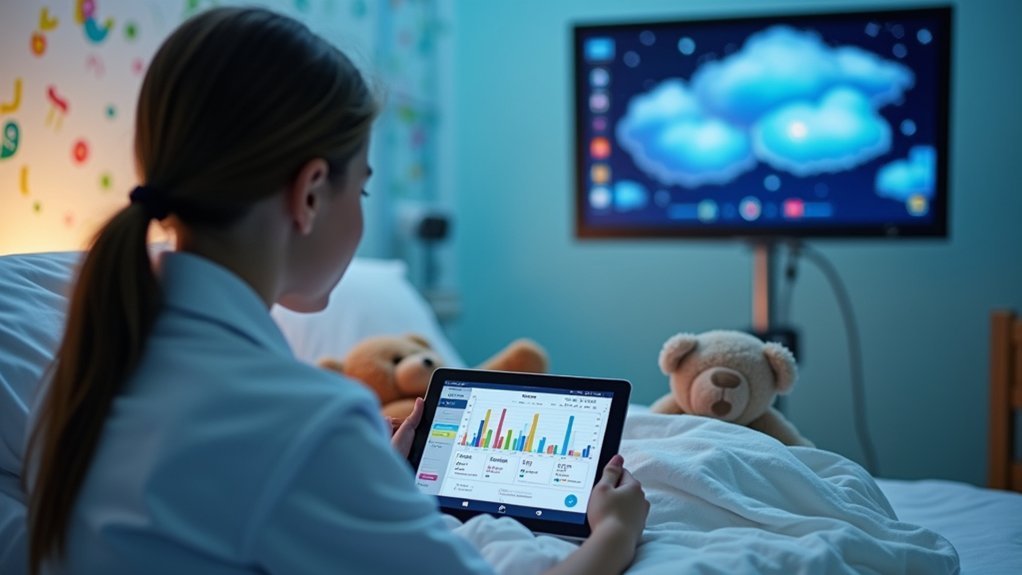
Building on traditional assessment approaches, technology-based sleep monitoring solutions revolutionize how you can track and analyze pediatric sleep patterns in real-world settings. Wearable devices like fitness trackers and smartwatches provide real-time sleep duration and quality data for pediatric populations.
Sleep apps offer extensive features including sleep diaries, sound recordings, and cycle analysis, enabling effective pattern tracking.
While polysomnography remains the diagnostic gold standard, capturing brain waves, oxygen levels, and breathing data, home sleep apnea tests provide less invasive alternatives for detecting sleep-related breathing disorders.
Advanced artificial intelligence and machine learning integration now enhances these sleep monitoring tools’ analytical capabilities. You’ll benefit from increasingly sophisticated data analysis that delivers personalized recommendations, making technology-based solutions invaluable for optimizing children’s sleep health outside clinical environments.
Frequently Asked Questions
What Is the Best Pain Assessment Tool for Children?
You’ll find the best tool depends on your child’s age and abilities. Use Wong-Baker Faces for ages 3-8, numerical scales for children 6+, FLACC for younger kids, and CRIES for infants.
What Is the Best Assessment Tool for Children?
You’ll find the BASC-3 is often considered best for thorough child assessment since it’s versatile, covering ages 2-21 and evaluating behavioral, emotional, and academic functioning through multiple informants.
Which Is an Appropriate Pain Assessment Tool for Pediatric Clients?
You’ll find the Wong-Baker Faces Scale works best for children three and older, while you should use the FLACC scale for non-verbal kids aged two months to seven years.
What Is the Pediatric Version of the Eating Assessment Tool?
You’ll use the Pediatric Eating Assessment Tool (PEAT) when evaluating children’s feeding difficulties. It’s specifically designed for caregivers to complete, examining texture preferences, food refusal, and mealtime behaviors in pediatric patients.


