
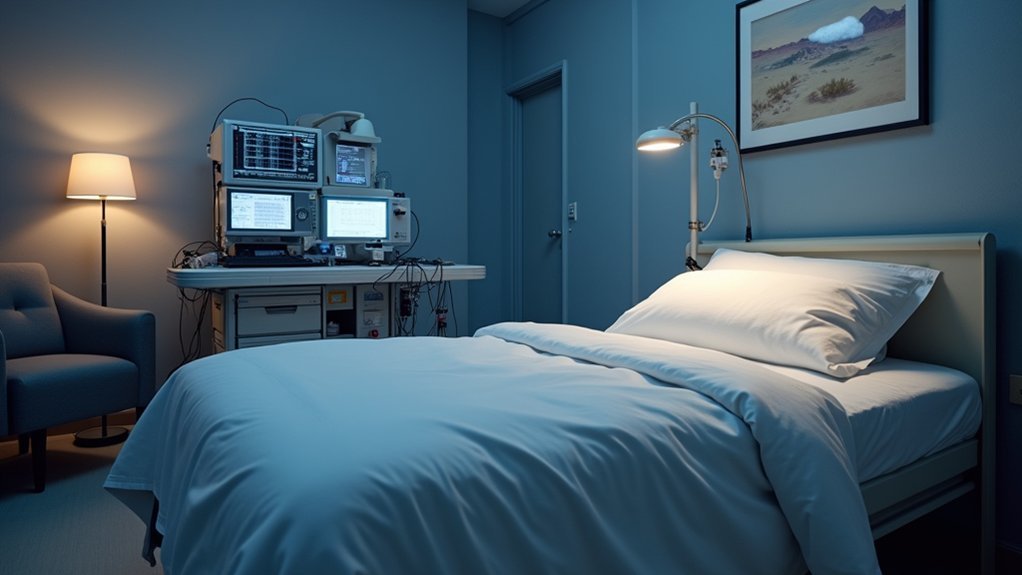
You’ll arrive at a sleep laboratory for an overnight stay in a private, hotel-like room where trained technicians will attach small electrodes and sensors to monitor your brain waves, breathing patterns, heart rate, and oxygen levels. The equipment connects to computers that track approximately 1,000 pages of data while you sleep naturally. Technicians monitor you throughout the night from a nearby room, and results become available about two weeks later. Continue below to discover detailed preparation steps and what makes the experience comfortable.
Understanding the Purpose and Importance of Polysomnography

When you’re struggling with persistent sleep problems, polysomnography serves as the gold standard diagnostic tool that can finally provide answers to your nighttime difficulties. This thorough sleep study monitors multiple physiological functions, including brain waves, heart rate, muscle activity, and oxygen levels while you sleep.
Healthcare providers use this data to identify sleep disorders like sleep apnea, narcolepsy, and insomnia that might be affecting your daily life.
The test’s importance can’t be overstated—untreated sleep conditions often lead to serious health complications such as hypertension and cardiovascular problems.
Pre-Test Preparation and Scheduling Guidelines
Before you arrive at the sleep center, proper preparation plays an essential role in ensuring accurate test results and a smooth experience.
Schedule your sleep study according to your regular sleep habits to maintain consistency. When you prepare for a sleep study, avoid caffeine and alcohol for at least eight hours beforehand, and don’t nap during the day.
Take a shower without using lotions or creams, as these interfere with sensor placement. Pack comfortable pajamas and bring your own pillow if desired for familiarity.
Create a list of all medications and supplements to review with your technician. Confirm your appointment details in advance, including any dietary restrictions.
Once you arrive at the sleep center on time, you’ll discuss the results expectations with staff.
Equipment and Sensors Used During Testing

You’ll have multiple types of sensors and monitoring devices attached to your body during polysomnography testing, each designed to track specific physiological functions while you sleep.
The placement process involves applying small electrodes, patches, and clips to various locations including your scalp, face, chest, limbs, and finger or earlobe using medical adhesives.
These monitoring devices are designed with comfort features to minimize disruption to your natural sleep patterns while accurately collecting the data your healthcare team needs.
Sensor Placement Process
Multiple sensors will be carefully attached to different areas of your body during the polysomnography setup process.
Technicians will place small sensors on your scalp and face using adhesive to enable monitoring of brain waves and muscle activity. You’ll have elastic bands positioned around your chest and abdomen to track your breathing patterns throughout the night. A clip will be attached to your finger or earlobe to measure blood oxygen levels continuously.
All sensors connect to a computer system that transmits data in real-time to the monitoring room. Before your study begins, technicians will conduct preliminary tests to guarantee proper sensor placement and verify that all equipment functions correctly.
The setup process is non-invasive and designed for your comfort.
Monitoring Device Types
While you sleep, several specialized monitoring devices work together to capture thorough data about your body’s functions. The sensors used during polysomnography include electrode sensors placed on your scalp that record brain activity and identify different sleep stages like REM and non-REM periods.
An EKG patch continuously tracks your heart rhythm throughout the night, while elastic belts around your chest and abdomen measure breathing patterns to detect irregularities.
Essential monitoring equipment includes:
- Pulse oximeter clipped to your finger measuring blood oxygen levels
- Electrode sensors recording brain waves for sleep stage analysis
- Elastic respiratory belts tracking chest and abdominal movements
- EKG patches monitoring heart rhythm and rate continuously
All data from monitoring your sleep transmits to technicians in a nearby control room for real-time observation.
Equipment Comfort Features
Although polysomnography involves multiple monitoring devices, the entire setup prioritizes your comfort throughout the night. The sensors that might initially seem overwhelming are actually lightweight and non-invasive, applied with gentle adhesive to minimize discomfort.
Elastic belts around your chest to measure respiratory effort are designed to accommodate natural movement during sleep. The monitoring equipment connects to wires that lead to another room, giving you freedom to shift positions naturally.
You’ll sleep in private sleeping rooms equipped with standard beds and comfortable bedding, creating a home-like atmosphere. Technicians remain available via intercom to address any concerns and facilitate participants can access bathrooms easily.
The entire system is engineered to make your experience as comfortable as possible while gathering accurate sleep data.
Sleep Laboratory Environment and Comfort Features

Sleep laboratories prioritize your comfort and relaxation during polysomnography testing by creating an environment that closely resembles a hotel room rather than a clinical setting.
Sleep labs create hotel-like environments rather than clinical settings to ensure patient comfort during overnight polysomnography testing.
Your private room features standard beds with quality pillows and bedding to guarantee you’ll feel at ease throughout the night. The sleep lab’s thoughtful design helps minimize anxiety while promoting natural sleep patterns.
Key comfort features include:
- Private bathroom and shower for complete convenience during your overnight stay
- Television access to help you unwind and relax before sleep monitoring begins
- Personal items welcome so you can bring comfortable pajamas and familiar belongings
- 24/7 technician support available through intercom for any assistance you need
This restful environment guarantees you’ll have the most accurate and comfortable testing experience possible.
Monitoring Process Throughout the Night
Once you’re settled and asleep, your attached sensors continuously track your brain waves, heart rate, muscle movements, and oxygen levels throughout the entire night.
A trained technologist monitors you from a nearby room, watching the real-time data streams to guarantee everything’s working properly and to detect any sleep abnormalities.
This constant supervision means you’re never truly alone during the study, and the technologist can quickly respond if any issues arise with your equipment or breathing patterns.
Continuous Sensor Monitoring
Throughout the night, multiple sensors work in tandem to capture every aspect of your sleep physiology. The sensor wires continuously monitor your brain waves through EEG electrodes, while EKG patches track your heart rate throughout each sleep cycle. A pulse oximeter measures your level of oxygen, ensuring technicians can detect any breathing irregularities immediately.
This thorough monitoring during polysomnography testing allows specialists to measure movement and assess your complete sleep patterns.
The continuous data collection includes:
- EEG electrodes monitoring brain activity and sleep stages
- EKG patches tracking heart rhythm variations
- Pulse oximeter measuring blood oxygen saturation levels
- Real-time computer analysis processing all sensor data simultaneously
Your sleep study produces approximately 1,000 pages of detailed information that a sleep specialist will analyze to identify potential disorders.
Technician Night Supervision
While the sensors capture your physiological data, trained technicians monitor your sleep study from a separate control room equipped with video and audio equipment.
They’ll track your essential signs including heart rate, respiration, and oxygen levels throughout the night, providing continuous real-time observation of your sleep patterns.
If you experience severe sleep apnea or other significant issues, technicians can intervene immediately by waking you when necessary.
They’re also available via intercom to assist with any needs, such as bathroom breaks, while maintaining comfortable study conditions.
Technicians can adjust sensors as needed and will minimize any disturbances to guarantee accurate data collection while keeping you safe and comfortable throughout the entire monitoring process.
Post-Study Procedures and Data Collection
After your polysomnography test concludes, technicians begin collecting and processing the extensive data captured throughout the night.
This thorough data collection from your polysomnography testing generates approximately 1,000 pages of detailed information about your sleep patterns, including brain waves, eye movements, and breathing patterns.
A board-certified sleep medicine specialist will analyze the results of the study over the next two weeks.
You’ll schedule follow-up appointments to review these findings and discuss personalized treatment options based on your specific sleep study data.
Key aspects of post-study procedures include:
- Thorough analysis of brain wave activity, eye movements, and breathing patterns
- Board-certified specialist evaluation requiring approximately two weeks
- Detailed review session during follow-up appointments
- Customized treatment plan development targeting your sleep quality improvement goals
Results Timeline and Follow-Up Appointments
Once your sleep study concludes, you’ll need to wait approximately two weeks before receiving your detailed results.
The results of the sleep analysis require extensive review by a sleep specialist, who must carefully examine approximately 1,000 pages of data including your brain waves, eye movements, and breathing patterns. This thorough evaluation takes about two weeks to guarantee an accurate diagnosis and appropriate treatment recommendations.
You should schedule a follow-up appointment with your healthcare provider around the two-week mark to discuss your polysomnography test findings.
During this waiting period, continue taking your medications as usual unless your physician specifically instructs otherwise. Your follow-up appointment will cover the detailed analysis and potential treatment options based on your individual sleep study results.
Frequently Asked Questions
What Not to Do During a Sleep Study?
You shouldn’t consume caffeine or alcohol eight hours beforehand, take naps that day, use lotions or hair products, change medications without approval, or wear uncomfortable clothing during your sleep study.
Can You Go to the Bathroom During a Sleep Study?
You can go to the bathroom during a sleep study. Simply use the intercom to contact technicians who’ll help unplug and reconnect wires. Keep requests minimal to maintain data integrity.
What Makes You Fail a Sleep Study?
You’ll fail a sleep study if you don’t sleep at least four hours, move excessively, ignore pre-study guidelines like avoiding caffeine, or experience severe anxiety that prevents proper rest.
Do You Wear Clothes During a Sleep Study?
You’ll wear your own comfortable pajamas or sleepwear during a sleep study. Choose clean, loose-fitting clothes without lotions that could interfere with sensor placement. You can bring personal items like pillows for added comfort.


