
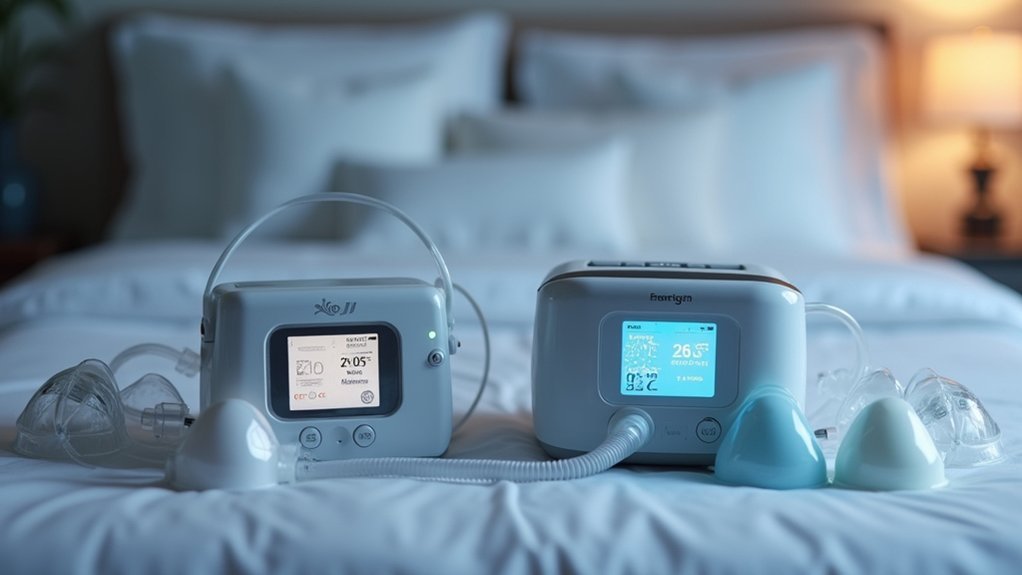
CPAP serves as the gold standard first-line treatment for obstructive sleep apnea, delivering consistent pressure that’s proven effective and more affordable at $500-$1,000. However, if you can’t tolerate CPAP’s constant pressure or have central sleep apnea, BiPAP offers superior comfort with dual pressure settings that adapt to your breathing patterns, though it costs $1,700-$3,000. Your healthcare provider will determine which option best matches your specific sleep study results and condition complexity.
Understanding CPAP Therapy for Sleep Apnea
When you’re diagnosed with obstructive sleep apnea, your doctor will likely recommend CPAP therapy as the gold standard treatment to keep your airways open throughout the night.
This positive airway pressure device delivers consistent air pressure ranging from 4 to 20 cm H2O throughout your entire breathing cycle. Your healthcare provider will determine your specific pressure settings based on sleep study results tailored to your needs.
CPAP therapy effectively reduces your apnea-hypopnea index below five, indicating successful sleep apnea management. Unlike BiPAP, which offers varying pressure levels, CPAP maintains steady breathing support.
CPAP therapy maintains consistent airway pressure to effectively reduce sleep apnea episodes and ensure steady respiratory support throughout the night.
Modern machines include comfort features like humidifiers and heated tubing to minimize airway dryness. Regular equipment maintenance guarantees ideal treatment effectiveness and prevents complications, making CPAP therapy a reliable long-term solution for managing your condition.
What Is BiPAP and How Does It Work
You’ll find that BiPAP, or Bilevel Positive Airway Pressure, represents a more sophisticated approach to treating sleep apnea than traditional CPAP therapy.
Unlike CPAP’s single pressure setting, BiPAP operates with a dual pressure mechanism that delivers two distinct pressure levels throughout your breathing cycle.
This system provides higher pressure during inhalation (IPAP) and lower pressure during exhalation (EPAP), creating a more natural and comfortable breathing experience.
BiPAP Definition Overview
BiPAP stands for Bilevel Positive Airway Pressure, a sophisticated breathing therapy that delivers two distinct pressure levels to help you breathe more effectively during sleep.
Unlike Continuous Positive Airway Pressure, BiPAP provides higher pressure during inhalation and lower expiratory positive airway pressure when you exhale. This dual-pressure approach offers superior comfort compared to CPAP’s constant pressure, making it ideal for treating obstructive sleep apnea and respiratory conditions like chronic obstructive pulmonary disease.
Your BiPAP machine’s pressure settings can automatically adjust based on your breathing patterns, enhancing therapy effectiveness.
The customizable pressure ranges from 4 to 30 cm H2O, allowing personalized treatment that adapts to your specific needs. This flexibility makes BiPAP particularly beneficial if you’ve experienced insufficient results from CPAP therapy.
Dual Pressure Mechanism
Understanding how BiPAP’s dual pressure mechanism works reveals why this therapy often succeeds where CPAP falls short.
You’ll receive two distinct pressure levels: higher pressure during inhalation (IPAP) and lower pressure during exhalation (EPAP). This system makes breathing feel more natural compared to CPAP’s constant pressure.
Your BiPAP machine automatically adjusts these pressure levels based on your breathing patterns, providing personalized support for your specific respiratory needs.
The dual pressure mechanism greatly improves oxygenation and ventilation, making it particularly effective for complex sleep apnea cases.
Unlike CPAP’s 4-20 cm H2O range, BiPAP offers 4-30 cm H2O flexibility.
This enhanced pressure range, combined with timed or spontaneous switching between levels, delivers superior breathing support during sleep.
Key Differences Between CPAP and BiPAP Machines
When you’re choosing between CPAP and BiPAP machines, you’ll encounter fundamental differences in how they deliver air pressure to keep your airways open.
CPAP provides one constant pressure throughout your breathing cycle, while BiPAP adjusts between two different pressure levels for inhalation and exhalation.
You’ll also face significant cost variations and insurance coverage differences that can impact your treatment decision.
Pressure Delivery Mechanisms
The fundamental distinction between CPAP and BiPAP machines lies in how they deliver air pressure to your airways during sleep therapy. CPAP maintains constant pressure throughout your breathing cycle, while BiPAP uses dual pressure delivery mechanisms with separate inspiratory positive airway pressure and expiratory positive airway pressure settings.
| Feature | CPAP | BiPAP |
|---|---|---|
| Pressure Type | Single constant pressure | Dual pressure settings |
| Pressure Range | 4-20 cm H2O | 4-30 cm H2O |
| Breathing Adaptation | Fixed air pressure | Adjusts to breathing patterns |
| Best For | Obstructive sleep apnea | Complex sleep disorders, chronic obstructive pulmonary disease |
| Cost | More affordable | Higher investment |
This difference makes BiPAP therapy more comfortable for patients who struggle exhaling against constant pressure during treatment.
Cost and Insurance
Cost considerations play a considerable role when choosing between CPAP and BiPAP machines for your sleep apnea treatment.
CPAP machines typically cost $500-$1,000, while BiPAP units range from $1,700-$3,000 due to their advanced dual pressure technology.
Insurance coverage differs markedly between these therapies:
- CPAP coverage is generally straightforward and widely accepted by most plans
- BiPAP requires specific documentation proving CPAP ineffectiveness or intolerance
- Out-of-pocket expenses vary greatly based on your plan’s deductibles and coverage limits
Your insurance may require you to try CPAP therapy first before approving BiPAP treatment, potentially delaying access to ideal care.
Don’t forget to factor in ongoing maintenance expenses for filters, masks, and cleaning supplies when calculating your total treatment costs.
Pressure Settings and Breathing Patterns
Understanding how CPAP and BiPAP machines deliver air pressure reveals fundamental differences that directly impact your breathing comfort and treatment effectiveness.
CPAP provides constant airflow at a single pressure between 4-20 cm H2O, maintaining open airways throughout your sleep cycle. This works well for obstructive sleep apnea cases.
CPAP delivers steady, single-pressure airflow that keeps airways open continuously, making it effective for treating obstructive sleep apnea.
BiPAP offers dual pressure settings with higher Inspiratory Positive Airway Pressure during inhalation and lower Expiratory Positive Airway Pressure during exhalation, ranging from 4-30 cm H2O.
These varying breathing patterns accommodate your natural respiratory rhythm, making BiPAP ideal for central sleep apnea and complex conditions.
If you struggle exhaling against constant pressure, BiPAP’s adaptive pressure settings provide personalized treatment that optimizes your oxygenation and ventilation needs.
Cost Comparison and Insurance Coverage
How much will your sleep apnea treatment actually cost, and what can you expect from insurance coverage? The affordability difference between these devices is significant. CPAP machines typically cost $500-$1,000, while BiPAP machines range from $1,700-$3,000 due to their advanced features.
Insurance coverage varies considerably between devices:
- CPAP coverage is generally more accessible and widely approved by most providers.
- BiPAP requires meeting specific criteria, often proving CPAP ineffectiveness or intolerance first.
- Many insurers mandate a CPAP trial period before approving BiPAP coverage.
You’ll want to consult your healthcare provider and insurance company about coverage specifics and potential out-of-pocket expenses. Understanding these costs upfront helps you make informed decisions about your sleep apnea treatment options.
Benefits and Drawbacks of CPAP Treatment
While choosing between sleep apnea treatments involves financial considerations, you’ll also need to weigh the practical advantages and limitations of CPAP therapy.
CPAP offers significant benefits for obstructive sleep apnea treatment, including its proven effectiveness and user-friendly design with simplified pressure settings. You’ll find CPAP machines easier to operate than BiPAP devices, and healthcare providers often recommend them as first-line treatment.
However, CPAP has notable drawbacks affecting comfort. The fixed pressure can make exhaling difficult, potentially causing mask leaks and sleep disruption.
If you have central or complex sleep apnea rather than standard obstructive sleep apnea, CPAP may prove inadequate. Healthcare providers might then recommend BiPAP therapy, which offers variable pressure settings for enhanced comfort and effectiveness in complex cases.
Advantages and Limitations of BiPAP Therapy
You’ll find that BiPAP therapy brings distinct advantages, especially if you’ve struggled with CPAP’s single pressure setting or need higher air pressures for effective treatment.
However, you should also consider the potential drawbacks that come with this more advanced technology.
Let’s examine both the key benefits and main limitations you’ll encounter with BiPAP therapy.
BiPAP Key Benefits
Several key advantages make BiPAP therapy an attractive option for patients who struggle with traditional CPAP treatment or have complex respiratory needs. The adjustable pressure settings deliver higher pressure for inhalation and lower pressure for exhalation, creating a more natural breathing experience that many find comfortable.
BiPAP’s treatment flexibility extends beyond basic sleep apnea management:
- Enhanced effectiveness for complex sleep apnea and central sleep apnea cases where standard CPAP fails
- Superior pressure range from 4 to 30 cm H2O, accommodating patients requiring higher therapeutic pressures
- Improved respiratory support for chronic obstructive pulmonary disease patients through better oxygenation and reduced breathing effort
This dual-pressure approach makes BiPAP particularly valuable when you’re dealing with challenging respiratory conditions that demand more sophisticated pressure delivery than traditional therapy provides.
BiPAP Main Drawbacks
| Drawback | BiPAP Challenge | User Impact |
|---|---|---|
| Complexity | Dual pressure settings | Harder adjustment period |
| Insurance coverage | Restrictive requirements | Must prove CPAP failure |
| Maintenance | More adjustments needed | Increased time commitment |
You’ll find BiPAP’s dual pressure settings more challenging to master than CPAP’s single setting. The treatment requires frequent maintenance and adjustments, making it less straightforward for obstructive sleep apnea management. Insurance coverage often demands proof that CPAP failed before approving BiPAP. Some users experience discomfort from higher inhalation pressures, especially when extensive respiratory support isn’t necessary.
Who Should Use CPAP Vs Bipap Machines
When should you choose CPAP over BiPAP, and which patients benefit most from each therapy?
CPAP works best for you if:
- You have obstructive sleep apnea (OSA) and can tolerate CPAP therapy with single pressure settings.
- You’re seeking the most accessible first-line treatment with better insurance coverage.
- You don’t experience significant discomfort during exhalation with constant airflow.
BiPAP is recommended when:
- You have central sleep apnea (CSA), complex sleep apnea, or chronic obstructive pulmonary disease (COPD).
- You can’t tolerate CPAP therapy due to difficulty exhaling against constant pressure.
- You need enhanced respiratory support with different pressure levels for inhalation and exhalation.
Your doctor will determine which therapy suits your specific condition, considering your sleep study results, underlying health conditions, and comfort preferences.
Effectiveness for Different Types of Sleep Apnea
Understanding which therapy works best requires examining how CPAP and BiPAP perform against specific sleep disorders. For obstructive sleep apnea (OSA), CPAP delivers exceptional treatment effectiveness by maintaining consistent airway pressure that prevents throat collapse.
Studies demonstrate significant reductions in apnea-hypopnea index (AHI) scores among OSA patients using CPAP therapy.
BiPAP proves superior for central sleep apnea (CSA) and complex sleep apnea cases. Its dual pressure levels accommodate breathing irregularities more effectively than single-pressure systems.
You’ll also find BiPAP beneficial if you have chronic obstructive pulmonary disease (COPD), as varying pressure levels improve oxygenation and reduce respiratory distress.
Your sleep study results determine best therapy selection. If you require high pressure levels or struggle with CPAP tolerance, BiPAP often provides better outcomes and comfort.
Choosing the Right Treatment for Your Sleep Disorder
Selecting the appropriate sleep apnea therapy depends on your specific diagnosis, severity of symptoms, and individual comfort preferences.
Your healthcare provider will recommend the best treatment based on thorough evaluation and sleep study results.
Sleep study results and comprehensive medical evaluation guide your healthcare provider in determining the most effective treatment approach for your condition.
CPAP remains the first-line therapy for obstructive sleep apnea, delivering consistent pressure settings between 4-20 cm H2O.
However, BiPAP may be more suitable if you experience discomfort with fixed pressure or have central sleep apnea requiring varying levels.
Consider these factors when choosing your therapy:
- Comfort tolerance – BiPAP’s dual pressure settings often improve compliance for patients struggling with CPAP’s constant pressure
- Insurance coverage – CPAP typically has easier approval processes than BiPAP
- Sleep disorder type – Your specific diagnosis determines which treatment will be most effective
Work closely with your healthcare provider to guarantee the best therapy selection.
Frequently Asked Questions
What Is Better for Sleep Apnea, CPAP or Bipap?
CPAP’s typically your first choice for obstructive sleep apnea since it’s effective and affordable. You’ll need BiPAP if you can’t tolerate CPAP or have central sleep apnea requiring variable pressure support.
What Are the Disadvantages of Bipap Over CPAP?
You’ll face higher costs, complex dual-pressure settings requiring frequent adjustments, restrictive insurance coverage, potential discomfort from varying pressures, and increased maintenance needs compared to CPAP’s simpler operation.
What Machine Is Best for Severe Sleep Apnea?
For severe sleep apnea, you’ll likely benefit most from BiPAP therapy. It provides higher pressure ranges and dual-level settings that better accommodate complex breathing patterns and higher pressure requirements than standard CPAP machines.
Why Switch From CPAP to Bipap?
You’d switch from CPAP to BiPAP if you’re experiencing discomfort with fixed pressure, need higher pressure settings beyond CPAP’s limits, or have central sleep apnea requiring variable pressures.


