

You need mathematical formulas to transform your subjective sleep feelings into objective data that reveals hidden patterns affecting your rest quality. Sleep efficiency calculations using (Total Sleep Time ÷ Total Time in Bed) × 100 help you identify whether you’re achieving the 85% threshold for good sleep. Tools like the Pittsburgh Sleep Quality Index and REM percentage calculations expose specific areas where your sleep architecture needs improvement, giving you measurable targets to optimize your nightly recovery and discover deeper insights into your sleep consistency.
Understanding Sleep Efficiency as a Quantifiable Metric

Sleep efficiency transforms the subjective experience of rest into concrete, measurable data.
Sleep efficiency converts the unmeasurable feeling of restfulness into hard numbers you can analyze and improve.
You’ll calculate this metric using a simple formula: divide your total sleep time by total time in bed, then multiply by 100. This percentage becomes your quality management tool for optimizing rest patterns.
When you achieve 85% or higher sleep efficiency, you’re demonstrating good sleep quality. Lower percentages signal potential issues like insomnia or fragmented sleep that require attention.
You can track these numbers over time to identify patterns affecting your rest.
Costs associated with poor sleep efficiency include decreased productivity, health problems, and impaired cognitive function.
Core Mathematical Formulas for Sleep Quality Assessment
Beyond sleep efficiency, you’ll need several mathematical formulas to create a thorough picture of your rest quality.
These commonly used calculations help transform subjective experiences into objective measurements.
The three core formulas you should understand are:
- Pittsburgh Sleep Quality Index (PSQI) – Combines seven component scores (0-3 each) for a total score of 0-21, where lower numbers indicate better sleep quality over the past month.
- Sleep Quality Index (SQI) – Incorporates sleep duration, disturbances, and daytime dysfunction into a thorough 0-21 score system for overall assessment.
- Epworth Sleepiness Scale (ESS) – Quantifies daytime drowsiness using a 0-24 scale, where higher scores reveal greater tendencies to fall asleep during daily activities.
These formulas work together to provide measurable insights into your sleep patterns.
Measuring Sleep Duration and Fragmentation Patterns
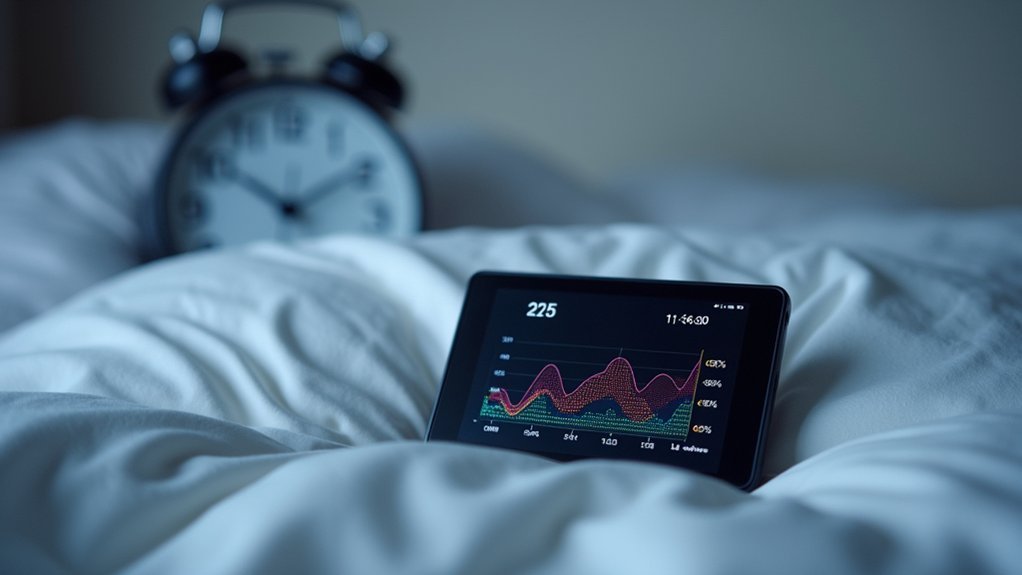
While these standardized assessment tools provide valuable baseline measurements, you’ll want to examine the specific components that drive sleep quality scores.
Sleep duration forms the foundation of your assessment, requiring 7-9 hours nightly for ideal adult health. You can track this precisely using actigraphy devices that monitor your sleep-wake cycles through continuous data collection.
Optimal sleep requires 7-9 hours nightly, with actigraphy devices providing precise tracking through continuous sleep-wake cycle monitoring.
Fragmentation patterns reveal equally critical insights. You’ll calculate the number and duration of nighttime awakenings to understand how disruptions affect your restorative processes. These interruptions break your natural sleep cycles, reducing overall rest quality even when total duration appears adequate.
Mathematical analysis transforms raw data into actionable metrics. You can quantify sleep efficiency by dividing total sleep time by time spent in bed, creating a percentage that reflects how effectively you’re using your sleep opportunity.
Calculating Deep Sleep Percentage and REM Cycles
Although sleep efficiency provides a solid foundation for quality assessment, you’ll need to dive deeper into specific sleep stages to understand your rest’s true restorative value.
Deep sleep percentage reveals how much time you’re spending in the most physically restorative stage, while REM cycle tracking shows your brain’s recovery patterns.
You can calculate these metrics using data from sleep tracking devices:
- Deep Sleep Percentage = (Deep Sleep Duration ÷ Total Sleep Duration) × 100 – aim for ideal physical recovery
- REM Cycle Count = Track 90-minute intervals throughout the night, noting longer cycles as sleep progresses
- REM Sleep Percentage = Should constitute 20-25% of total sleep time for healthy cognitive function
These calculations provide precise insights into your sleep architecture and overall rest quality.
Statistical Analysis of Sleep Consistency Over Time

You’ll want to track your sleep patterns over weeks and months to identify meaningful trends in your rest quality.
Statistical tools like standard deviation help you measure how much your sleep duration, onset time, and wake periods vary from night to night.
These variance measurements reveal whether you’re maintaining consistent sleep habits or if external factors are disrupting your natural rhythm.
Sleep Pattern Trending
Anyone can transform their sleep data into actionable insights through statistical analysis of sleep patterns over time. By tracking your sleep duration and quality metrics, you’ll identify meaningful trends that reveal how your rest patterns evolve.
Time series analysis enables you to monitor changes across weeks or months, connecting sleep variations to lifestyle modifications.
Statistical trending helps you recognize:
- Seasonal variations – identifying how daylight changes, temperature shifts, or holiday periods affect your sleep consistency
- Weekly patterns – discovering whether weekdays versus weekends show significant sleep duration or quality differences
- Long-term improvements – measuring the effectiveness of sleep interventions like exercise routines, dietary changes, or stress management techniques
This data-driven approach transforms subjective feelings about sleep into objective measurements, empowering you to make informed decisions about your rest optimization strategies.
Variance Measurement Techniques
While tracking sleep trends reveals the big picture of your rest patterns, measuring variance in your sleep data uncovers the stability and predictability of your nightly rest.
You’ll calculate standard deviation of sleep duration and quality scores to assess consistency over time. ANOVA helps you analyze differences across multiple nights or conditions, revealing overall rest effectiveness.
You can quantitatively measure variance in sleep onset latency, total sleep time, and wake after sleep onset for targeted sleep hygiene improvements.
Control charts visualize your sleep quality variability, helping identify trends and anomalies in patterns.
Regression analysis correlates your sleep quality with external factors like stress levels or environmental conditions, showing their impact on rest consistency and enabling data-driven adjustments.
Integrating Heart Rate Variability and Movement Data
When you combine heart rate variability measurements with movement data from your daily activities, you create a powerful framework for understanding your body’s recovery patterns.
This integration reveals how your physical activity directly impacts your rest quality and stress levels.
Mathematical formulas help you quantify these relationships, making it easier to spot trends and enhance your recovery strategies.
You’ll discover when your body needs more rest or when light movement might actually improve your HRV scores.
Key benefits of this integrated approach include:
- Pattern Recognition – Identify ideal timing for intense workouts versus recovery periods
- Personalized Thresholds – Calculate your individual activity limits that maintain healthy HRV levels
- Predictive Analytics – Forecast recovery needs based on movement volume and intensity data
This thorough analysis enables precise adjustments to your routine.
Frequently Asked Questions
What Is the Purpose of Mathematical Formulas?
You’ll use mathematical formulas to quantify complex variables, solve problems systematically, simplify calculations, predict trends from data, and guarantee consistent, reliable measurements that you can reproduce and verify across different applications.
Do Mathematical Models Depend on the Quality of Data for Accuracy?
You’ll find mathematical models are absolutely dependent on data quality for accuracy. When you input poor or incomplete data, you’re guaranteed to get unreliable results that won’t reflect true patterns or relationships.
What Is the Importance of Knowing Various Calculation Formulas?
You’ll guarantee precise dietary recommendations by mastering calculation formulas. They help you determine accurate caloric intake, compare nutrients effectively, minimize errors in planning, and make informed decisions for ideal pet health outcomes.
Which Formula Is Used to Quantify Quality?
You’ll use the formula Q = P / E to quantify quality, where Q represents quality, P signifies performance, and E denotes client expectations. This formula helps you measure service effectiveness.


