
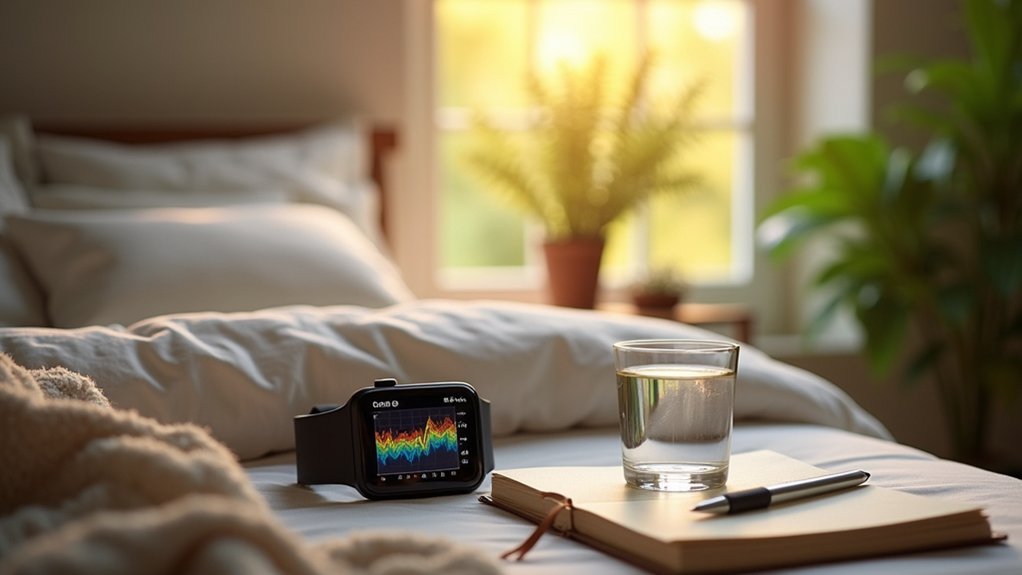
You’ll want to track these five essential metrics to optimize your rest quality: sleep efficiency percentage (aim for 85% or higher), REM and deep sleep distribution (20-25% REM, 15-20% deep sleep), sleep onset latency and wake after sleep onset (both under 20-30 minutes), heart rate variability during sleep cycles (indicating recovery quality), and sleep consistency with circadian rhythm alignment. These metrics reveal whether you’re achieving truly restorative sleep and highlight areas needing improvement for better overall health and daytime performance.
Sleep Efficiency Percentage and Total Sleep Duration
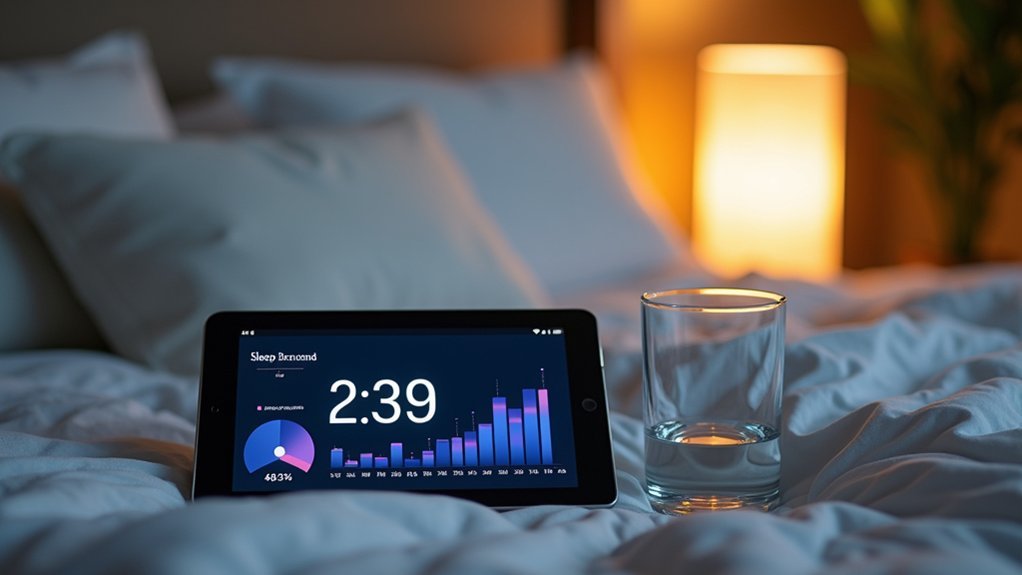
Understanding your sleep’s true effectiveness begins with two fundamental measurements that reveal how well your body actually rests during the night.
Your sleep efficiency percentage calculates the ratio of actual sleep time to total time in bed—aim for 85% or higher for healthy sleep quality. Anything below 80% may signal insomnia or poor sleep habits requiring attention.
Total sleep duration measures your actual sleeping hours, with adults needing 7-9 hours for ideal health.
Sleep studies consistently show both metrics are essential for evaluating restorative quality. You can’t rely on duration alone; efficiency matters equally.
Tracking these sleep patterns helps identify when lifestyle changes are necessary, giving you concrete data to improve your rest’s overall effectiveness and long-term wellness.
REM and Deep Sleep Stage Distribution
While sleep efficiency and duration provide valuable baseline measurements, the quality of your rest depends heavily on how much time you spend in each sleep stage.
REM and deep sleep distribution are essential metrics for evaluating true sleep quality.
Your sleep cycles repeat approximately every 90 minutes throughout the night, with ideal distribution being:
- REM sleep: 20-25% of total sleep time for memory consolidation
- Deep sleep: 15-20% for physical recovery and restoration
- Age distribution: Infants need 50% REM, while older adults experience reduced deep sleep
- Sleep disorders: Can greatly disrupt normal stage percentages
- Cycle progression: REM episodes lengthen as the night advances
Tracking these sleep stages helps identify whether you’re getting restorative rest or if lifestyle factors and stress are compromising your sleep architecture.
Sleep Onset Latency and Wake After Sleep Onset

Beyond tracking sleep stages, two additional metrics reveal essential insights about your sleep quality: Sleep Onset Latency (SOL) and Wake After Sleep Onset (WASO).
Sleep onset latency measures how long you take to fall asleep, with 10-20 minutes being normal. If you’re consistently taking over 30 minutes, you might be experiencing insomnia.
Wake after sleep onset tracks time spent awake after initially falling asleep. Ideally, this should be under 20 minutes for ideal sleep continuity.
These monitoring metrics are important for identifying sleep disorders. When SOL exceeds 30 minutes or WASO surpasses 30 minutes, you’ll likely experience daytime sleepiness and impaired functioning.
Healthcare providers use these measurements to diagnose issues and recommend improved sleep hygiene practices.
Heart Rate Variability During Sleep Cycles
Heart rate variability (HRV) during sleep provides a window into your autonomic nervous system’s performance throughout the night. This metric reveals the balance between your sympathetic and parasympathetic systems across different sleep cycles.
Higher HRV during deep sleep indicates better recovery and cardiovascular health, while disrupted patterns can signal underlying health conditions or poor sleep quality.
Monitoring your HRV throughout sleep cycles offers valuable insights for holistic health assessments:
- Track stress levels and recovery needs
- Identify potential cardiovascular risks early
- Assess sleep quality objectively
- Monitor autonomic nervous system balance
- Evaluate overall health status trends
Your HRV typically ranges from 20-200 milliseconds, varying with age, fitness, and stress.
Lower variability during REM sleep often indicates compromised recovery, making HRV monitoring essential for optimizing your rest quality.
Sleep Consistency and Circadian Rhythm Alignment

Across your sleep journey, maintaining consistent bedtimes and wake times creates the foundation for ideal circadian rhythm alignment. Sleep consistency directly impacts your sleep quality by stabilizing your body’s internal clock.
Consistent sleep schedules form the cornerstone of optimal circadian rhythm function and superior sleep quality through internal clock stabilization.
When you follow regular patterns, you’ll experience improved cognitive function and enhanced melatonin production, which initiates restorative sleep phases.
Your circadian rhythm responds strongly to environmental cues. Prioritize daylight exposure during morning hours while minimizing blue light from screens before bedtime. These practices reinforce natural physiological processes that govern your sleep-wake cycle.
Irregular sleep patterns disrupt this delicate system, leading to poor health outcomes including increased risks of obesity, diabetes, and cardiovascular disease.
Tracking your sleep consistency provides valuable insights into rhythm stability and helps identify areas for improvement in your overall rest quality.
Frequently Asked Questions
What Are the 4 Quality Metrics?
You’ll measure REST API quality using four primary metrics: availability percentage, response time in milliseconds, error rate as failed request percentage, and throughput measured in requests per minute for performance assessment.
How to Measure Rest API Performance?
You’ll measure REST API performance by tracking response time under 200ms, monitoring error rates for non-200 status codes, evaluating requests per minute capacity, maintaining 99.9% uptime, and assessing time to first byte.
Which Are the Best Metrics to Measure Visit Quality?
You’ll want to track bounce rate, time spent on pages, pages per session, conversion rates, and user engagement metrics. These indicators reveal how visitors interact with your content and whether they’re finding value in their experience.
What Is the KPI for Quality?
You’ll measure quality through key performance indicators like error rate percentage, average response time, and uptime percentage. These KPIs directly reflect your system’s reliability, performance, and user satisfaction levels effectively.


