
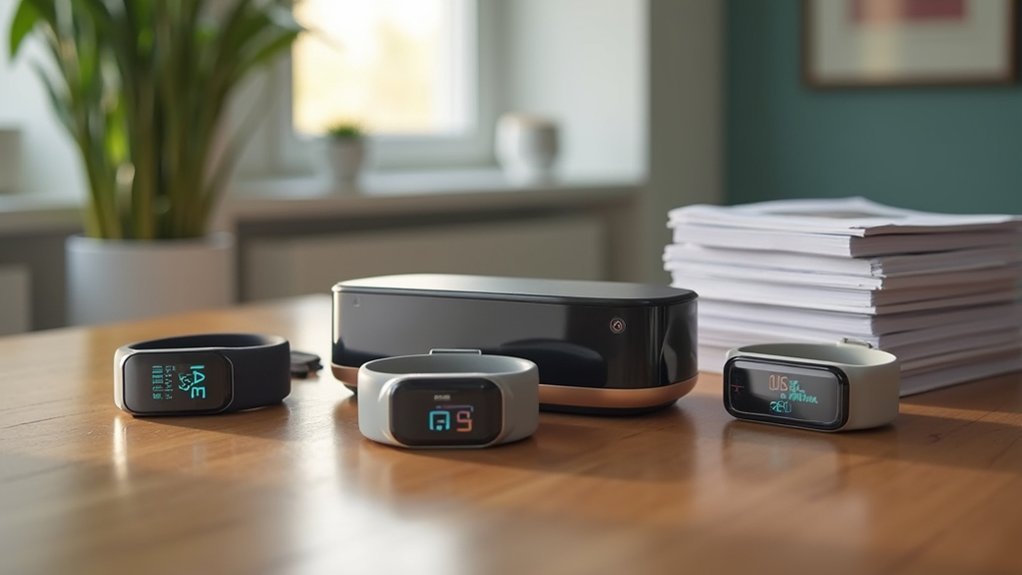
When choosing actigraphy devices for long-term monitoring, you’ll need to prioritize battery life above all else—look for devices offering 22+ weeks of operation like Fibion SENS rather than standard 7-14 day models. You should select research-grade devices with validated algorithms against polysomnography, 3-axis accelerometers for accurate movement detection, and IP67 waterproofing for durability. Consider lightweight designs for participant compliance, sufficient data storage capacity, and integrated analysis software. Below, we’ll explore each specification in detail to guarantee your study’s success.
Understanding Long-Term Monitoring Requirements for Sleep Research
When conducting long-term sleep research, you’ll need actigraphy devices that can sustain weeks or even months of continuous data collection without compromising accuracy or participant compliance.
Your actigraphy device selection should prioritize extended battery life—ideally lasting several weeks to prevent data interruption. Devices like the Fibion SENS offer up to 22 weeks of operation on a single charge.
Extended battery life is paramount for actigraphy research—devices should operate continuously for weeks without requiring participant intervention or data loss.
Accuracy becomes critical when tracking sleep patterns over extended periods. You’ll want validated algorithms, such as those found in the Fibion Krono, to guarantee reliable longitudinal data.
Participant comfort directly impacts compliance rates, so choose lightweight, non-intrusive designs. Additionally, robust data storage and seamless transfer capabilities are essential for managing large datasets, while additional sensors for light and temperature provide thorough insights into environmental factors affecting sleep quality during long-term monitoring.
Essential Technical Specifications for Extended Actigraphy Studies
When you’re planning extended actigraphy studies, you’ll need devices that can operate continuously for weeks or months without interruption.
Battery life becomes your most critical specification—you can’t afford devices that die mid-study and compromise your data collection.
You’ll also need substantial data storage capacity to handle the massive amounts of movement data generated over long monitoring periods.
Battery Life Requirements
Battery life stands as perhaps the most critical specification you’ll evaluate when selecting actigraphy devices for extended monitoring periods. For uninterrupted data collection, you’ll want devices like Fibion SENS, which delivers up to 22 weeks on a single charge. This extended capacity guarantees compliance by eliminating frequent recharging interruptions that could compromise your study’s integrity.
Consider your study duration carefully. While Fibion Flash operates for 900 hours on replaceable batteries, devices like Fibion Krono offer only 10-15 days, and ActiGraph LEAP provides just several days of operation.
Longer battery life directly reduces participant intervention requirements, enhancing data accuracy by minimizing device handling and potential data loss during critical monitoring phases.
Data Storage Capacity
Data storage capacity directly impacts your study’s success by determining how much movement data you can collect before requiring data offloads or device maintenance.
You’ll need sufficient storage to match your monitoring duration and data collection frequency. Research-grade devices offer varying capacities—the Fibion Flash provides 128MB storage for extended monitoring, while the ActiGraph LEAP supports even longer continuous data collection periods spanning weeks or months.
When selecting your actigraphy device, calculate storage requirements based on your study’s anticipated length and sampling intervals.
Devices with larger capacities prevent interruptions during critical monitoring phases. Additionally, prioritize devices offering seamless data transfer capabilities, enabling efficient data management throughout your research.
This guarantees you can access and analyze collected information without delays that could compromise your study’s timeline.
Battery Life and Power Management Considerations
When selecting actigraphy devices for extended studies, you’ll need to prioritize battery duration specifications that align with your monitoring timeline—devices like the Fibion SENS offer up to 22 weeks of operation, while research-grade options typically last 10-15 days.
You should evaluate power optimization strategies including sleep modes and low-power settings that can greatly extend operational periods without compromising data quality.
Consider devices with replaceable batteries for maximum flexibility, as they’ll allow you to maintain continuous monitoring without interrupting your study protocols.
Battery Duration Specifications
Since long-term actigraphy studies can span weeks or months, you’ll need to carefully evaluate each device’s battery specifications before making your selection. Understanding battery duration helps you plan data collection schedules and minimize interruptions that could compromise your research integrity.
| Device | Battery Duration | Power Source |
|---|---|---|
| Fibion SENS | Up to 22 weeks | Rechargeable |
| Fibion Krono | 10-15 days | Rechargeable |
| Fibion Flash | 900 hours | Replaceable |
| Standard devices | 7-14 days | Rechargeable |
When evaluating battery life for long-term monitoring, consider how device capabilities affect power consumption. Advanced features like real-time data transmission and high-frequency sampling drain batteries faster. You’ll find that devices with sophisticated power management systems extend operational time while maintaining essential functions, reducing maintenance requirements throughout your study period.
Power Optimization Strategies
Beyond selecting devices with inherently long battery life, you’ll want to implement specific power optimization strategies that can extend operational periods even further.
Look for devices that incorporate power management features like sleep modes or low-power states during inactivity periods. These features automatically conserve energy when movement isn’t detected.
Consider how sensor technology affects power consumption. Advanced algorithms that optimize data capture can enhance battery efficiency while maintaining accuracy.
You’ll need to evaluate the trade-off between functionality and longevity—devices with additional sensors like heart rate monitors provide richer data but consume more power.
Choose models with replaceable batteries when possible. The Fibion Flash’s 900-hour operation on a CR2025 battery exemplifies how replaceable power sources enable uninterrupted monitoring without recharging downtime.
Data Storage Capacity and Transfer Capabilities
Although actigraphy devices vary widely in their technical specifications, data storage capacity stands as one of the most critical factors you’ll need to evaluate when selecting equipment for long-term monitoring studies. You’ll want devices that can retain several days to weeks of data without loss, depending on your study requirements.
| Feature | Basic Devices | Advanced Devices |
|---|---|---|
| Storage Duration | Days to weeks | Months |
| Transfer Method | Manual download | Automated (Bluetooth/Wi-Fi) |
| Data Access | Delayed | Real-time |
| System Compatibility | Limited | Extensive |
Seamless data transfer capabilities enhance your research workflow considerably. Look for devices offering automated connectivity options that’ll upload data directly to analysis software or cloud storage. This eliminates manual transfer delays and reduces technical hurdles during long-term monitoring protocols.
Device Durability and Weather Resistance Features
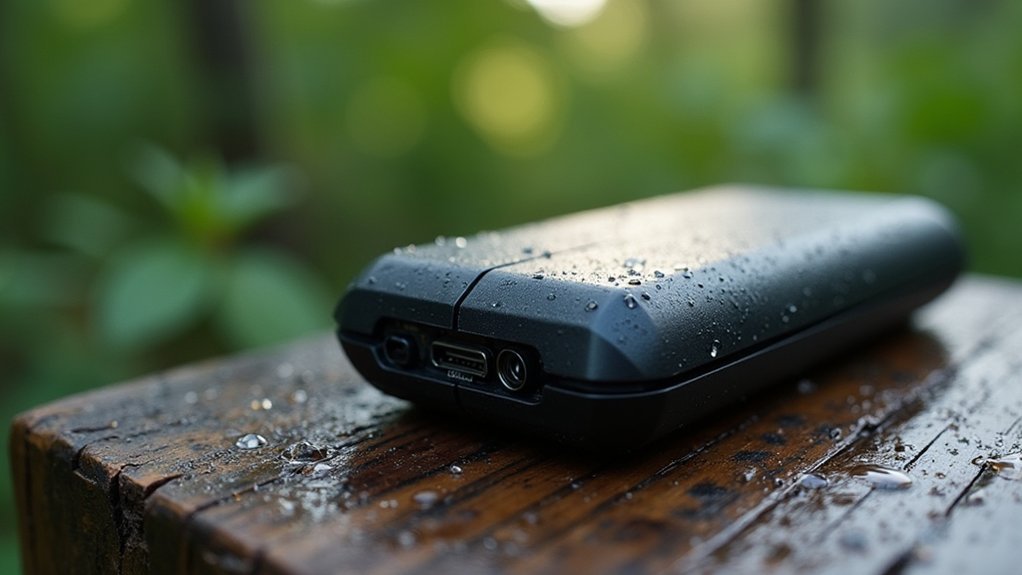
While sophisticated data management capabilities form the foundation of effective long-term monitoring, your actigraphy device must physically endure the demands of extended wear to deliver reliable results.
You’ll need robust build quality that withstands daily wear and tear throughout your study period. Look for weather resistance features like IP67 waterproofing ratings, enabling accurate data collection during outdoor activities and exposure to sweat or moisture.
Research-grade devices such as the Fibion SENS offer exceptional durability and long battery life, with some models operating up to 22 weeks on a single charge.
Verify your chosen device handles temperature fluctuations and humidity variations, as these environmental factors can compromise data integrity in longitudinal studies requiring consistent performance.
Participant Comfort and Compliance Factors
Since participant compliance directly determines the success of your long-term actigraphy study, you’ll need to prioritize devices that maximize wearer comfort and minimize daily disruption.
Choose lightweight, non-intrusive designs that won’t interfere with sleep or daily activities. Participant comfort greatly impacts compliance rates, so select devices with smooth edges and breathable materials that participants can comfortably wear 24/7.
Prioritize lightweight actigraphy devices with smooth edges and breathable materials to ensure maximum participant comfort and sustained compliance rates.
Look for intuitive interfaces that make operation straightforward for participants. Complex devices often lead to user frustration and reduced adherence.
Extended battery life is essential – devices requiring frequent recharging disrupt compliance and create data gaps. Aim for devices offering at least seven days of continuous monitoring.
Finally, provide thorough instructions and ongoing support to enhance participants’ comfort level with the technology, ensuring consistent wear throughout your study period.
Sensor Technology and Movement Detection Accuracy
Beyond comfort considerations, the sensor technology powering your actigraphy device determines the quality and reliability of your collected data.
Modern actigraphy devices rely on advanced sensor configurations to achieve ideal movement detection accuracy.
You’ll find these key sensor features in quality devices:
- 3-axis accelerometers that capture movement in all directions for thorough motion tracking
- High precision and sensitivity enabling detection of subtle movements critical for sleep stage determination
- Additional sensors like light detectors and heart rate monitors for extensive health analysis
- Research-grade validation standards ensuring superior accuracy compared to consumer wearables
Your device’s movement detection accuracy directly impacts its ability to identify behavioral changes and sleep disturbances.
Research-grade actigraphy devices consistently outperform consumer alternatives through rigorous algorithm validation and superior sensor technology.
Software Integration and Data Analysis Tools
Once you’ve selected the appropriate sensor technology, your actigraphy device’s software integration capabilities determine how effectively you’ll manage and analyze your collected data.
Look for devices offering proprietary software solutions with advanced data analysis tools that generate detailed reports on sleep patterns, physical activity, and circadian rhythms. Cloud-based platforms enable remote access and enhance collaboration among researchers while tracking data over extended periods.
Proprietary software with advanced analytics enables comprehensive sleep and activity reporting while cloud platforms facilitate researcher collaboration and long-term data tracking.
Consider devices like the Fibion SENS and Flash, which feature user-friendly interfaces that simplify data upload and analysis, promoting higher compliance during long-term studies.
Integration with third-party applications and APIs enhances interpretation capabilities, allowing you to combine actigraphy data with other health metrics for thorough assessments.
Seamless data management guarantees efficient research workflows and reliable results.
Cost-Effectiveness and Budget Planning Strategies
When planning your actigraphy study budget, you’ll need to strategically allocate funds across device costs, software licensing, and ongoing maintenance expenses.
You should analyze the long-term investment potential by weighing initial costs against device durability and feature sets that prevent costly replacements down the road.
Don’t overlook bulk purchase discounts from manufacturers, as ordering multiple devices can greatly reduce your per-unit costs and maximize your research budget’s effectiveness.
Budget Allocation Planning
Effective budget allocation requires you to balance immediate costs against long-term value when selecting actigraphy devices for extended monitoring studies.
Smart planning helps you navigate budget constraints while maximizing your investment’s return through strategic device selection.
Consider these key allocation priorities:
- Initial hardware investment – Budget €135-$1,095 per device depending on features, with basic Fibion SENS offering excellent value for standard monitoring needs.
- Extended battery life benefits – Prioritize devices like Fibion SENS with 22-week battery life to minimize replacement and maintenance expenses.
- Software and analytics costs – Account for additional fees from models like Fibion Krono that charge extra for advanced data analysis capabilities.
- Bulk purchasing opportunities – Negotiate volume discounts for multiple units, particularly beneficial for large-scale studies requiring numerous devices.
Long-Term Investment Analysis
While initial sticker prices might trigger budget concerns, smart long-term investment analysis reveals how premium actigraphy devices often deliver superior cost-effectiveness through reduced operational expenses and extended lifecycles.
You’ll save money by choosing devices with exceptional battery life, like Fibion SENS lasting 22 weeks per charge, which minimizes recharging costs and staff time.
Cost-effective devices such as Fibion SENS (€135) and Fibion Helix (€199) prove ideal for long-term studies without sacrificing data quality.
You should calculate total ownership costs including maintenance, software licenses, and upgrades rather than focusing solely on purchase prices.
Leverage bulk purchase discounts from manufacturers to reduce overall expenses while securing durable equipment that’ll serve your research needs reliably for years.
Bulk Purchase Discounts
Beyond calculating individual device costs, strategic bulk purchasing transforms your research budget from a constraint into an opportunity.
When you’re planning large-scale studies, manufacturers typically offer substantial cost savings through volume discounts.
Here’s what you can expect from bulk purchasing:
- Discount ranges – Most suppliers provide 10-30% price reductions on orders of 50+ units
- Additional perks – Extended warranties, complimentary software, and enhanced support often accompany large orders
- Real savings – A €135 device pricing drops to €120 per unit with bulk orders
- Competitive advantages – Compare multiple vendors’ bulk offers to maximize value
You’ll maximize cost savings by evaluating suppliers based on total value, not just unit price, ensuring your bulk purchasing strategy aligns with your study’s quality requirements.
Clinical Vs Consumer Device Trade-Offs
When evaluating actigraphy devices for long-term monitoring, you’ll face a fundamental choice between clinical-grade precision and consumer-friendly convenience.
Clinical devices offer superior accuracy through validated algorithms and extensive data outputs suitable for diagnosing sleep disorders, but they’ll cost you $200-$600 per unit.
Clinical-grade actigraphy devices deliver validated accuracy and comprehensive data analysis capabilities, though they require a significant investment of $200-$600 per unit.
Consumer devices provide appealing features like extended battery life and intuitive interfaces at $50-$300, yet they often lack rigorous validation and clinical-grade reliability.
You’ll need to weigh your priorities carefully. If you require precise data for medical applications, clinical devices deliver the detailed results you need.
However, if you’re monitoring general health trends and prefer user-friendly operation, consumer devices might suffice.
Consider that some consumer brands are pursuing FDA clearance, potentially bridging this gap.
Validation and Regulatory Compliance Standards
Since accuracy forms the foundation of meaningful long-term monitoring, you’ll want to understand how actigraphy devices earn their credibility through rigorous validation processes.
Research-grade devices undergo extensive validation against polysomnography (PSG), the gold standard for sleep measurement. This comparison guarantees their algorithms accurately capture sleep patterns and activity levels over extended periods.
For medical applications, regulatory compliance becomes essential:
- FDA clearance – Devices must demonstrate clinical efficacy and safety through rigorous testing
- Peer-reviewed validation – Published studies verify algorithm accuracy and metric reliability
- PSG comparison studies – Direct validation against established sleep monitoring standards
- ISO/IEC 17025 compliance – International laboratory standards enhance data reliability
When selecting devices for long-term studies, prioritize those with published validation data and appropriate regulatory approval for your specific research or clinical application.
Frequently Asked Questions
What Are the Different Types of Actigraphy?
You’ll find two main actigraphy types: research-grade devices offering high precision with advanced sensors for clinical studies, and consumer wearables providing affordable, user-friendly health tracking with potentially less rigorous validation.
What Actigraphy Devices Are FDA Approved?
You’ll find FDA-approved actigraphy devices include ActiGraph wGT3X-BT for activity monitoring, SleepImage for sleep apnea detection, Zio XT Patch combining ECG monitoring, and Embletta X100 integrating polysomnography capabilities.
What Is the Difference Between Actigraph and Smartwatch?
You’ll find actigraphs offer research-grade precision with validated algorithms and raw data access, while smartwatches provide consumer-friendly features but less accurate sleep tracking and limited analytical capabilities for scientific studies.
What Are the Disadvantages of Actigraphy?
You’ll face overestimated sleep duration from movement-only data, poor daytime sleep detection, missed sleep stages without brain monitoring, compliance issues from device discomfort, and you can’t diagnose disorders without additional testing.


