

As you age, your circadian rhythm undergoes seven key changes that disrupt your sleep. You’ll experience phase advance, making you sleepy by 7-8 p.m. and waking around 3-4 a.m. Your eyes become less sensitive to light cues, weakening circadian synchronization. You’ll spend less time in deep sleep and REM stages, leading to fragmented rest. Your internal clock genes lose rhythmicity, while aging eyes filter essential light signals. These changes result in shorter sleep duration and frequent night wakings—understanding these patterns can help you optimize your rest.
Phase Advance – Earlier Bedtimes and Wake Times

As you reach your 60s and beyond, your internal biological clock begins shifting earlier, causing you to feel drowsy around 7 or 8 p.m. and wake naturally between 3 and 4 a.m. This phenomenon, called phase advance, fundamentally alters your circadian rhythms as you age.
Your body’s internal clock naturally shifts earlier with age, making 3 a.m. wake-ups completely normal after 60.
You’ll likely notice these earlier bedtimes feel natural, yet many older adults resist this shift, leading to fragmented sleep patterns.
The phase advance directly impacts your sleep quality, reducing time spent in deep and REM sleep stages. Your body’s decreased melatonin production compounds these changes, making it harder to maintain consistent rest.
Environmental factors like reduced sunlight exposure, especially if you spend more time indoors, can worsen these circadian disruptions. Understanding these normal age-related wake times helps you adapt your sleep schedule accordingly.
Reduced Effectiveness of External Light Cues
As you age, your eyes naturally filter and reduce the amount of light that reaches your brain, making it harder for your circadian system to detect the environmental cues it needs to stay synchronized.
You’ll likely find that spending most of your time indoors under dim artificial lighting further weakens these vital light signals that once kept your sleep-wake cycle on track.
The communication pathway between light exposure and your brain’s master clock becomes less efficient over time, reducing your body’s ability to respond appropriately to natural daylight patterns.
Aging Eyes Filter Light
One of the most significant factors affecting circadian rhythms in older adults involves changes to the eyes themselves. As you age, your eyes become less efficient at filtering light, particularly the short-wave light that’s essential for regulating circadian rhythms.
This aging process often leads to cataracts, which further reduce the amount of light entering your eyes and disrupt your sleep-wake cycles.
You’ll likely spend more time indoors under weak artificial lighting, which worsens the effects of reduced light exposure on circadian regulation. This decreased light exposure causes phase advances in your circadian rhythms, making you naturally inclined to sleep earlier.
However, cataract surgery can improve your sleep quality by allowing more light to reach your eyes, enhancing overall circadian function.
Indoor Living Impacts Rhythms
Beyond the physical changes affecting your eyes, your living environment plays an equally important role in disrupting circadian rhythms. When you spend most of your time indoors, you’re limiting your exposure to natural light, which serves as the primary cue for circadian regulation.
This indoor living pattern greatly impacts aging on circadian patterns, as your body relies heavily on these external light cues to maintain proper sleep-wake cycles.
Limited outdoor sunlight exposure becomes particularly problematic in care facilities, where you’ll often experience poor sleep due to insufficient natural lighting and reduced physical activity.
The institutional environment compounds these issues through noise and artificial lighting that interfere with your circadian rhythms, creating a cycle of sleep disruption that’s difficult to break.
Weakened Light-Brain Communication
While indoor living restricts your light exposure, your aging brain simultaneously becomes less responsive to the light cues it does receive. As you age, your eyes filter out vital short-wave light necessary for circadian rhythms synchronization. This creates a double burden where weakened light-brain communication disrupts your natural sleep-wake cycles.
| Aging Effect | Impact on Sleep |
|---|---|
| Reduced light sensitivity | Weaker rhythm synchronization |
| Less short-wave light absorption | Disrupted sleep patterns |
| Diminished response to morning light | Delayed circadian adjustment |
| Increased artificial light dependence | Poor regulatory benefits |
You’ll need considerably more morning light exposure than younger individuals to maintain proper circadian rhythms. This weakened communication between light cues and your brain can worsen sleep disorders and impair cognitive function, making effective light therapy increasingly important for older adults.
Decreased Deep Sleep and REM Sleep Stages
As you age, you’ll notice your sleep becomes dominated by lighter stages while your precious REM sleep markedly decreases.
Your brain spends less time in the deep, restorative phases that once recharged your mind and body effectively.
This shift means you’re getting more fragmented, less revitalizing sleep even when you think you’re sleeping through the night.
REM Sleep Reduction
One of the most significant changes you’ll experience as you age involves the dramatic reduction of your deep sleep and REM sleep stages. Your circadian clock undergoes fundamental shifts that disrupt your natural sleep architecture, causing you to spend more time in light sleep phases.
As an older adult, you’ll likely notice increased fragmented sleep with multiple nighttime awakenings, reducing the restorative benefits of quality rest.
This REM sleep reduction directly impacts your cognitive function, potentially causing fatigue and confusion that mimics dementia symptoms. Research shows that severe disruptions in your circadian rhythms, particularly decreased REM sleep, may indicate early Alzheimer’s disease development.
Your sleep duration typically drops to 6.5-7 hours nightly, falling below recommended amounts and compromising your overall health and mental clarity.
Light Sleep Dominance
Beyond the reduction in REM sleep, you’ll find yourself trapped in mainly light sleep stages that leave you vulnerable to constant disruptions throughout the night.
As older adults, your deep sleep drops dramatically to just 10-15% compared to younger adults’ 20-25%, while light sleep dominates your circadian rhythm patterns.
This shift creates three critical problems:
- Fragmented sleep – You’ll wake multiple times, preventing restorative rest
- Reduced sleep quality – Your 6.5-7 hour sleep duration falls below ideal levels
- Daytime consequences – Fatigue and confusion mimic cognitive decline symptoms
These light sleep disruptions can lead to misdiagnosis, as sleep-related cognitive symptoms often resemble dementia.
Your brain needs deep sleep and REM sleep for proper restoration, making this dominance of light sleep particularly problematic for maintaining mental sharpness.
Weakened Internal Clock Gene Expression

While your circadian rhythms naturally shift throughout life, aging creates a fundamental breakdown in the molecular machinery that governs your internal clock. Weakened internal clock gene expression disrupts the precise timing mechanisms that once regulated your sleep patterns effectively.
As you age, specific clock genes lose their natural rhythmicity, while others attempt compensation, creating irregular sleep-wake cycles. Your body’s ability to respond to light cues diminishes considerably, compounding circadian disruption.
Aging also reduces melatonin production, the hormone critical for sleep regulation. These molecular changes particularly affect your prefrontal cortex, where altered rhythms contribute to cognitive decline and mood changes.
The weakening of internal clock gene expression represents a core mechanism behind many sleep and health challenges you’ll face as you grow older.
Light Sensitivity Changes Due to Aging Eyes
These molecular disruptions work hand-in-hand with physical changes in your aging eyes that further compromise your circadian system.
As you age, your eyes become less sensitive to light, especially short-wave light that’s essential for regulating circadian rhythms. Your lens becomes cloudier, reducing light exposure to your retina and weakening natural light’s impact on your sleep-wake cycle.
Three key factors worsen light sensitivity in elderly adults:
- Decreased lens transparency blocks vital light signals from reaching your retina.
- Increased indoor time under dim artificial lighting reduces overall light exposure.
- Weakened light detection makes it harder for your brain to process timing cues.
Fortunately, cataract surgery can restore light sensitivity, often improving sleep quality by allowing more natural light to regulate your circadian rhythms effectively.
Increased Sleep Fragmentation and Night Wakings
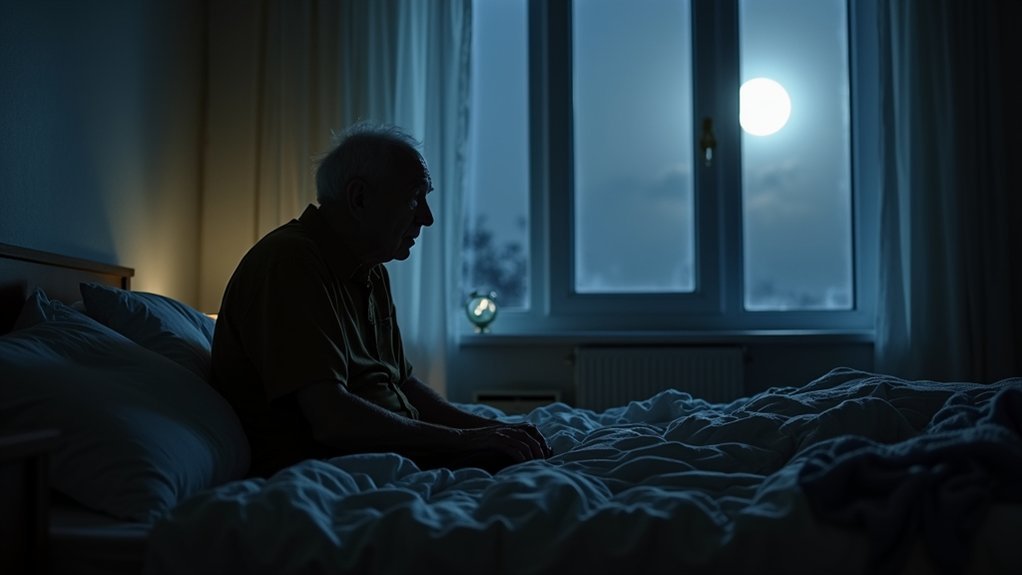
As your circadian rhythms weaken with age, you’ll likely notice your sleep becomes increasingly fragmented, with multiple awakenings disrupting your rest throughout the night.
This sleep fragmentation affects most older adults and considerably impacts your overall sleep quality. You’ll typically get around 6.5 to 7 hours of sleep, below recommended levels, leaving you feeling fatigued and confused.
Your reduced circadian amplitude makes maintaining continuous nighttime sleep more challenging.
Environmental factors like noise and light disturbances worsen these night wakings, especially if you live in shared spaces like care homes.
Age-related changes in both your circadian and homeostatic sleep mechanisms increase your susceptibility to sleep disturbances, making daytime napping more appealing and frequent.
Shortened Overall Sleep Duration
Most older adults sleep only 6.5 to 7 hours per night, falling short of the recommended duration needed for ideal health and well-being.
This shortened overall sleep duration stems from changes in your circadian system, which shifts your sleep timing dramatically as you age.
Your new sleep schedule often involves:
- Earlier bedtimes – Going to sleep around 7 p.m. or 8 p.m.
- Earlier wake times – Rising at 3 a.m. or 4 a.m.
- Resisting natural tendencies – Fighting age-related decline in sleep patterns
When you resist these natural changes, you’ll experience fragmented sleep and increased nighttime awakenings.
Sleep deprivation from this pattern can cause fatigue, confusion, and depression that may mimic symptoms of cognitive disorders, making proper sleep timing essential for older adults.
Frequently Asked Questions
How Does the Circadian Rhythm Change in the Elderly?
You’ll experience earlier bedtimes around 7-8 p.m. and wake between 3-4 a.m. Your sleep becomes more fragmented, you’ll prefer morning activities, and external light cues won’t regulate your internal clock effectively.
What Are the Symptoms of a Circadian Rhythm Disruption?
You’ll experience difficulty falling asleep, frequent nighttime awakenings, excessive daytime sleepiness, mood changes, concentration problems, and feeling tired despite adequate sleep time, which can considerably impact your daily functioning.
What Causes a Change in Circadian Rhythm?
Your circadian rhythm changes when you’re exposed to irregular light patterns, shift work schedules, jet lag, medications, caffeine, alcohol, stress, medical conditions, or aging processes that affect your body’s internal clock.
What Mood Disorder Is Associated With Circadian Rhythm?
You’ll commonly experience depression when your circadian rhythm’s disrupted. Sleep-wake cycle disturbances directly affect mood regulation, making you more vulnerable to depressive episodes, anxiety disorders, and seasonal affective disorder throughout life.
In Summary
You’ve learned how aging transforms your sleep patterns through seven distinct circadian changes. Your internal clock shifts earlier, weakens against external cues, and shortens your deep sleep phases. Your aging eyes can’t process light effectively, while your clock genes lose their strength. You’ll experience more nighttime interruptions and overall reduced sleep duration. Understanding these changes helps you adapt your sleep habits and seek appropriate interventions for better rest.


