
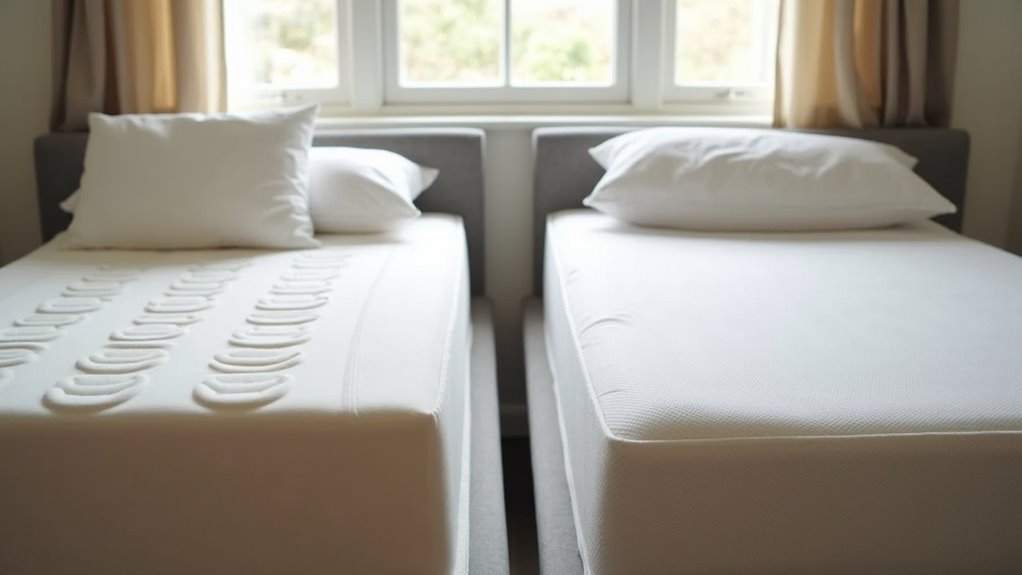
Neither memory foam nor latex is universally better—it depends on your sleep priorities. Memory foam excels at pressure relief and motion isolation, making it ideal for couples and side sleepers, but it retains heat and costs less upfront. Latex offers superior durability (15-20 years), better temperature regulation, and responsive support, though it’s pricier initially. Consider your budget, temperature preferences, and desired lifespan when choosing, as exploring each material’s specific benefits will help you make the right decision.
What Is Memory Foam?
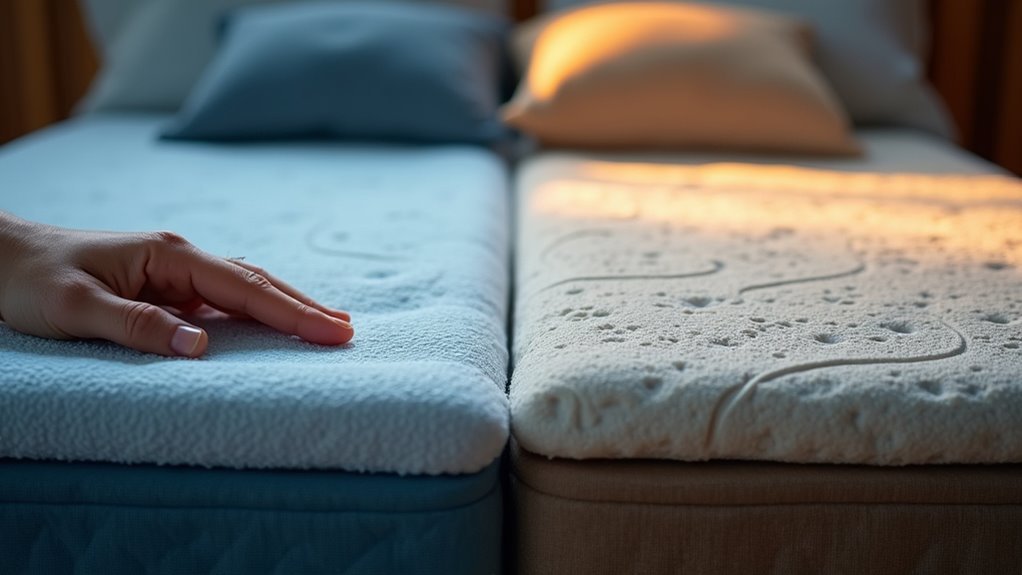
Memory foam, also known as viscoelastic polyurethane foam, originated from NASA’s 1960s research into shock-absorbing materials for spacecraft seating.
NASA’s 1960s spacecraft research gave birth to memory foam, revolutionizing how we think about comfort and pressure relief.
This innovative material responds to your body heat, softening to create a customized fit that contours perfectly to your shape. Once you remove pressure, it returns to its original form.
You’ll appreciate memory foam’s exceptional pressure relief capabilities, as it molds closely to your body and alleviates discomfort in sensitive areas.
It’s particularly beneficial for couples since it provides excellent motion isolation, minimizing sleep disruptions from your partner’s movements.
However, you should consider that memory foam retains heat, potentially causing discomfort.
Additionally, it may emit chemical odors from volatile organic compounds when first unboxed.
What Is Latex Foam?
While memory foam dominates many mattress discussions, latex foam offers a distinctly different sleep experience that’s worth exploring.
You’ll find latex foam derives from rubber tree sap, available in natural, synthetic, or blended varieties. Natural latex mattresses cost more but deliver superior durability and eco-friendliness.
Two manufacturing processes create distinct feels: Dunlop latex produces denser bottoms with softer tops, while Talalay creates lighter, more consistent comfort throughout.
You’ll experience buoyant responsiveness rather than deep sinkage, providing gentle support without that “stuck” feeling.
Latex foam’s air-filled cells maintain excellent temperature neutrality and breathability, preventing heat buildup.
You’re investing in longevity too—quality latex mattresses typically last 15-20 years, making the higher upfront cost worthwhile for long-term value.
Construction and Manufacturing Differences
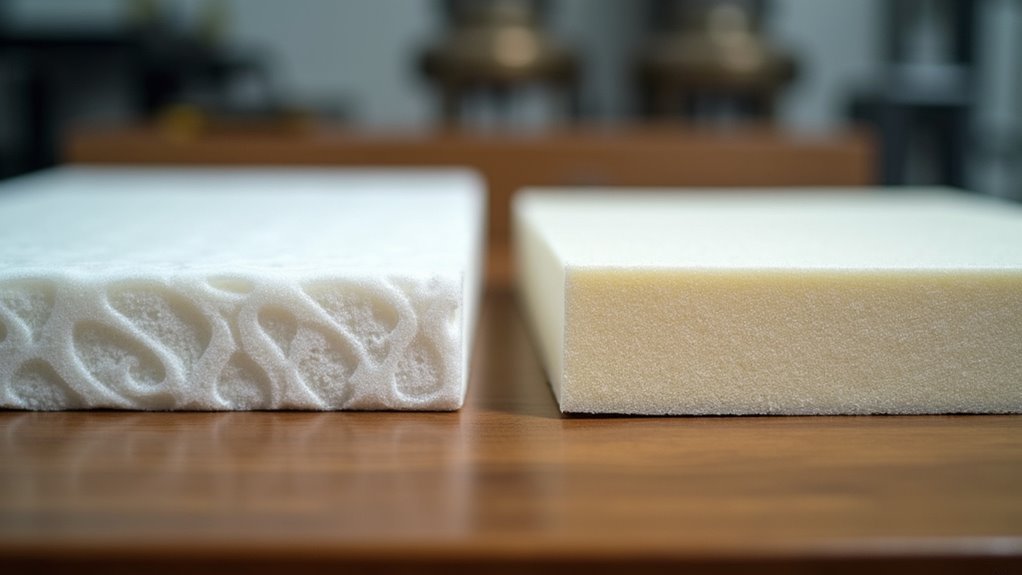
Since both materials share the “foam” designation, you might assume they’re created similarly—but their construction methods couldn’t be more different.
Memory foam’s construction involves combining polyurethane with additional chemicals to create its signature viscoelastic properties, allowing it to slowly conform to your body’s shape under pressure.
Latex manufacturing takes two distinct approaches. The Dunlop process creates a denser bottom layer with a softer top, while Talalay manufacturing produces more consistent density by partially filling molds during production. Natural latex comes from rubber tree sap, though synthetic versions exist.
These different construction techniques directly impact performance. Memory foam’s dense composition creates slower response times, while latex’s elastic structure provides immediate bounce and faster recovery when you move.
Feel and Comfort Comparison
Nothing influences your sleep experience more than how a mattress actually feels beneath your body. The feel of memory foam creates a deep, body-hugging sensation with pronounced contouring that cradles pressure points. You’ll sink into memory foam as it slowly molds to your shape, providing exceptional pressure relief but potentially creating a “stuck” feeling.
Latex offers a completely different experience with bouncy, responsive support and generalized compression. You’ll find easier movement and quicker response times with latex’s springier surface.
| Aspect | Memory Foam | Latex |
|---|---|---|
| Response Time | Slow, gradual contouring | Quick, immediate bounce-back |
| Movement | Deep sinkage, potential “stuck” feeling | Easy repositioning, responsive surface |
| Temperature | Heat retention due to close conforming | Cooler sleeping from breathable structure |
This comfort comparison between latex and memory foam reveals distinctly different sleep experiences tailored to different preferences.
Temperature Regulation and Cooling
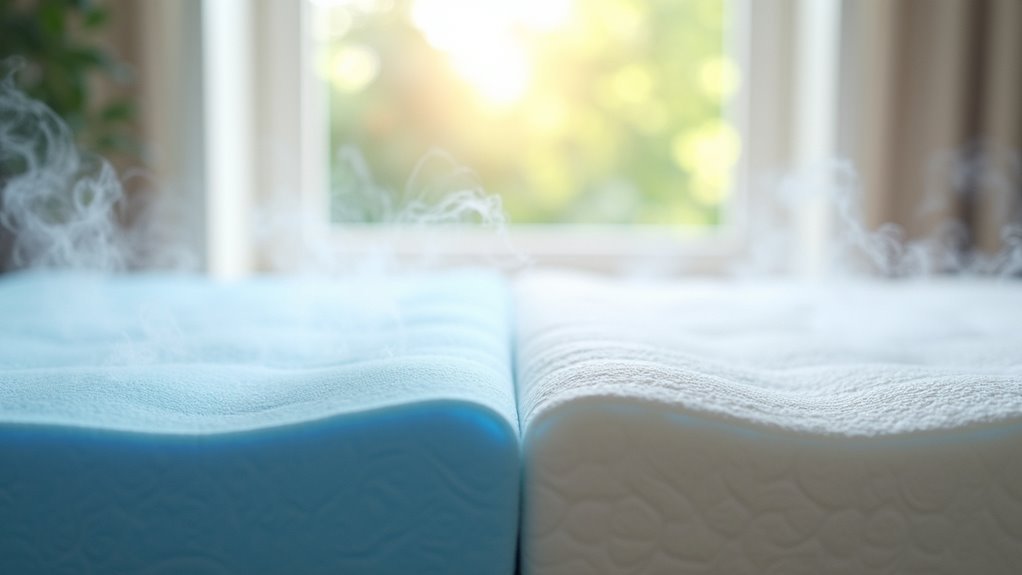
Beyond the tactile differences in feel, temperature regulation plays a major role in determining your overall sleep quality and comfort throughout the night.
Memory foam’s deep contouring creates heat retention issues that’ll leave you feeling uncomfortably warm, especially if you’re naturally heat-sensitive. The material’s dense structure traps body heat and restricts airflow around your body.
Latex foam delivers superior cooling performance through its naturally aerated structure. You’ll experience better breathability and moisture-wicking properties that actively regulate your body temperature.
While memory foam manufacturers add gel layers and cooling fabrics to combat overheating, these solutions can’t match latex’s inherent temperature regulation capabilities.
If you prioritize staying cool during sleep, latex foam consistently outperforms memory foam in thermal comfort.
Support and Pressure Relief
When choosing between memory foam and latex, you’ll find each material takes a distinctly different approach to supporting your body and relieving pressure points. Memory foam excels at contouring to your body shape, providing deep pressure relief that’s particularly beneficial if you’re under 230 pounds. However, latex offers more generalized compression without that “stuck” feeling, making it ideal for active sleepers who shift positions frequently.
| Feature | Memory Foam | Latex |
|---|---|---|
| Pressure Relief Rating | 8.6/10 | 9.4/10 |
| Best For | Under 230 lbs | Heavier sleepers |
| Support Type | Deep contouring | Generalized compression |
| Long-term Support | Good | Superior |
While both materials maintain spinal alignment, latex provides stronger long-term support, ensuring consistent comfort throughout the night.
Durability and Lifespan
Although both materials offer solid construction, latex greatly outperforms memory foam when it comes to longevity and durability.
You’ll typically get 6-7 years from memory foam mattresses, while high-quality latex can last 10-20 years with proper care. Natural latex maintains its shape and support longer due to resilient properties, making it exceptionally durable.
Even synthetic latex versions last 7.5-10 years, still exceeding most memory foam options.
If you’re over 230 pounds, you’ll notice memory foam sags more quickly under heavier weight, while latex maintains its structure better over time.
Though latex costs more upfront, its extended lifespan makes it a superior long-term investment. You’re fundamentally buying fewer mattresses over your lifetime when choosing latex over memory foam.
Motion Isolation Performance
If you’re sharing your bed with a partner, motion isolation becomes essential for uninterrupted sleep.
Memory foam excels in this area with its slow response time that absorbs and dampens movement, earning an impressive 8.6 out of 10 for motion isolation.
Latex foam’s bouncier nature and quicker response time result in more motion transfer, scoring 7.5 out of 10.
Memory Foam Isolation
Memory foam delivers exceptional motion isolation performance, earning an impressive 8.6 score on performance scales by effectively minimizing disturbances from your partner’s nighttime movements.
The viscoelastic properties of memory foam create superior absorption and dampening capabilities that make it ideal for couples sharing a bed. When your partner shifts or gets up during the night, the material’s unique composition prevents these movements from transferring across the mattress surface.
Memory foam’s close body contouring contributes greatly to this isolation advantage.
While latex foam performs respectably with a 7.5 motion isolation score, it can’t match memory foam’s absorption effectiveness due to its naturally bouncier characteristics.
If you’re sensitive to movement or prioritize uninterrupted sleep, memory foam consistently outperforms latex in creating a stable, disturbance-free sleeping environment.
Latex Motion Transfer
While latex foam offers respectable motion isolation with a 7.5 performance score, its naturally responsive and bouncy characteristics create more noticeable motion transfer across the mattress surface.
You’ll experience more movement disturbances compared to memory foam’s superior 8.6 rating. The natural elasticity that makes latex responsive also means your partner’s movements travel more easily across the bed.
Key factors affecting latex motion isolation:
- Natural bounciness reduces absorption of partner movements
- Firmer feel doesn’t dampen motion as effectively as softer surfaces
- Responsive material transfers energy rather than absorbing it
- Heavier sleepers create more noticeable disturbances on latex mattress surfaces
- Overall performance lags behind memory foam’s motion-dampening capabilities
If minimizing sleep disruptions is your priority, memory foam excels at absorbing and isolating movement more effectively than latex alternatives.
Price and Value Analysis
You’ll find that latex mattresses typically cost around $1,500 or more, roughly double what you’d pay for memory foam options.
However, you’re investing in superior longevity since latex lasts up to 15 years compared to memory foam’s 8-12 year lifespan, potentially equalizing the long-term value.
You can still find budget-friendly choices in both categories, especially when shopping online for promotional deals and discounts.
Initial Cost Comparison
Two distinct price points separate these mattress types, with latex options typically starting around $1,500 while memory foam mattresses offer more budget-friendly entry costs.
You’ll find memory foam considerably more accessible if you’re working with a tight budget, as these mattresses are widely available at various price ranges.
The initial cost difference becomes clear when comparing average prices:
- Latex mattresses cost roughly twice as much as memory foam options
- Memory foam offers broader price accessibility across retailers
- Entry-level latex starts where mid-range memory foam ends
- Budget constraints often favor memory foam purchases
- Premium latex materials drive higher manufacturing costs
However, don’t let sticker shock discourage you from considering latex.
While you’ll pay more upfront for latex mattresses, this investment reflects superior material quality and construction methods that justify the premium pricing.
Long-Term Value Assessment
Beyond initial sticker prices, the true financial picture emerges when you calculate cost per year of ownership.
Latex mattresses deliver superior long-term value despite their higher upfront investment. While you’ll spend around $1,500 initially, their 15-year lifespan translates to roughly $100 per year of use.
Memory foam mattresses appear budget-friendly at first, but their 8-12 year lifespan means you’ll likely purchase multiple replacements over latex’s single lifespan. This durability advantage makes latex mattresses more cost-effective over time.
You’ll also benefit from latex’s longer warranties, which reflect manufacturers’ confidence in their longevity.
The reduced replacement frequency and lower maintenance costs of latex mattresses offset their initial premium, making them a smart investment for quality-conscious buyers seeking maximum value.
Budget-Friendly Options Available
- Shopping online for exclusive discounts and coupon codes
- Comparing multiple retailers for competitive pricing
- Looking for seasonal sales and clearance events
- Considering direct-to-consumer brands that eliminate middleman costs
- Exploring financing options for higher-priced latex models
While latex mattresses offer limited budget options, online shopping can reveal surprising deals that make natural latex more accessible than traditional retail prices suggest.
Which Material Should You Choose?
Since both memory foam and latex offer distinct advantages, your choice depends on your specific sleep preferences and priorities.
If you’re comparing memory foam vs latex foam and value deep pressure relief and motion isolation, memory foam’s contouring properties make it ideal. You’ll appreciate how it hugs your body and minimizes partner disturbances during sleep.
However, if you prioritize longevity and temperature regulation, latex foam becomes the better investment. It’ll last up to 15 years compared to memory foam’s 6-10 years, while keeping you cooler throughout the night.
Consider your budget too—memory foam offers more affordable options, while latex requires a higher upfront investment starting around $1,500.
Ultimately, test both materials to determine which feels right for your body.
Frequently Asked Questions
Is Latex or Memory Foam Better?
You’ll find latex offers superior durability and temperature regulation, lasting up to fifteen years, while memory foam provides better pressure relief and motion isolation at lower costs, making your choice dependent on personal priorities.
Is Latex or Memory Foam Mattress Pad Better?
You’ll find latex mattress pads better if you sleep hot, want durability, and have allergies. Choose memory foam if you prefer deep contouring, pressure relief, and don’t mind replacing it sooner.
Which Lasts Longer, Memory Foam or Latex?
Latex lasts longer than memory foam. You’ll get up to 15 years from latex compared to 6-10 years from memory foam. Latex won’t develop indentations and maintains better support over time.
What Are the Disadvantages of a Memory Foam Mattress?
You’ll face heat retention from deep sinkage, strong chemical odors when new, slower response times creating a stuck feeling, shorter lifespan around six years, and inadequate support if you’re heavier.


