

You’ll need memory foam or hybrid mattresses for ideal adjustable bed compatibility, as they flex seamlessly during position changes. Choose mattresses between 10-14 inches thick to guarantee proper bending without exceeding weight limits. Select firmness levels based on your sleep position: medium-soft for side sleepers, medium-firm for back sleepers, and firm for stomach sleepers. Prioritize motion isolation, temperature regulation features, and CertiPUR-US certification for safety. Look for 90+ night trial periods to test compatibility. These essential guidelines will help you discover the perfect mattress-bed pairing.
Memory Foam and Hybrid Mattresses Offer Superior Flexibility
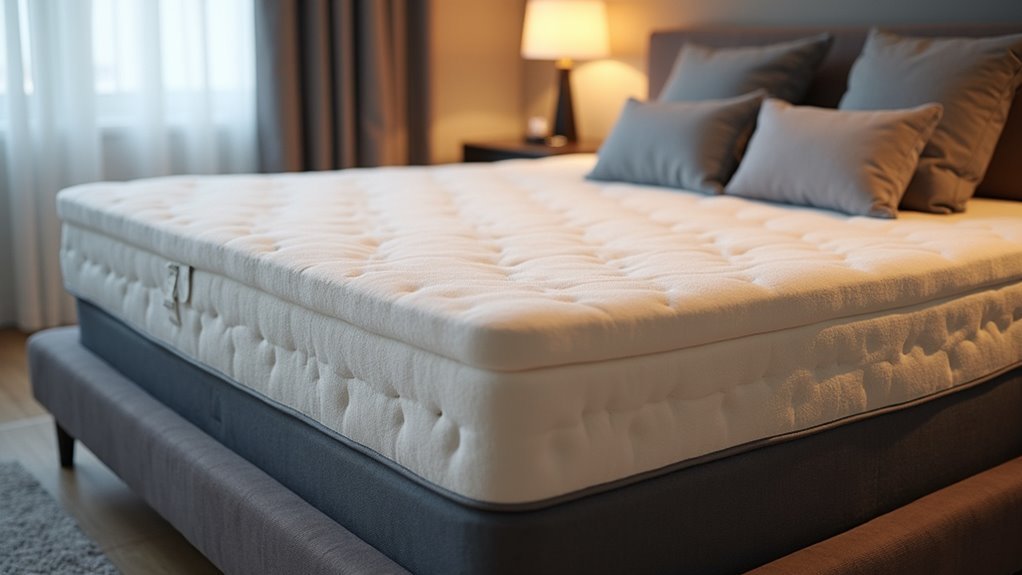
When choosing a mattress for your adjustable bed, memory foam and hybrid options deliver the flexibility you need for seamless position changes.
These mattresses bend easily without compromising support, making them perfectly compatible with adjustable bases. Memory foam’s unique construction provides exceptional adaptability while maintaining proper spinal alignment and pressure relief in elevated positions.
Related guide: Best Adjustable Pillows You Can Customize for Perfect Sleep
Hybrid mattresses combine foam comfort with individually wrapped coils, offering enhanced responsiveness for varied sleep positions. Both types typically measure 10-14 inches in height, ensuring ideal compatibility with most adjustable frames.
Hybrid mattresses deliver the perfect balance of foam comfort and coil responsiveness for adjustable bed compatibility.
Consumer testing consistently shows these mattresses excel in motion isolation and pressure relief, making them top choices for adjustable bed users seeking comfort and functionality.
Optimal Mattress Thickness Range for Adjustable Base Performance
Beyond selecting the right mattress type, you’ll need to evaluate thickness specifications to maximize your adjustable bed’s performance.
Related guide: Best Adjustable Air Mattresses for Personalized Comfort That Actually Deliver
The ideal mattress thickness for adjustable bases ranges from 10 to 14 inches, providing excellent flexibility and support during position changes. You can also consider mattresses between 8 to 12 inches, which offer adequate bending capabilities while maintaining structural integrity.
Avoid mattresses exceeding 14 inches, as they’ll restrict your base’s range of motion and create compatibility issues. Staying within recommended thickness parameters guarantees you won’t exceed your adjustable frame’s weight limits, which vary by model.
Most importantly, proper thickness selection enhances pressure relief and overall comfort when utilizing your bed’s adjustable features, maximizing both functionality and sleep quality.
Firmness Level Considerations for Different Sleep Positions

Your sleep position greatly influences the firmness level you’ll need for ideal comfort and spinal alignment on an adjustable bed.
Side sleepers should choose medium to medium-soft mattresses (4-6 firmness scale) for maximum pressure relief at shoulders and hips.
Back sleepers typically require medium-firm support (6-7 firmness) to maintain natural spine curvature while ensuring comfort.
Stomach sleepers need firmer surfaces (7-8 firmness) preventing hip sinkage that causes spinal misalignment.
Those with chronic pain often benefit from medium-firm to firm mattresses (6-8 firmness) combining support with pressure relief.
Consider your body weight when selecting firmness—lighter individuals generally prefer softer options, while heavier sleepers require firmer mattresses for adequate support on adjustable bed frames.
Material Construction Impact on Bed Frame Compatibility
While firmness determines comfort levels, the material construction of your mattress plays an equally essential role in determining compatibility with adjustable bed frames.
Memory foam offers exceptional flexibility, conforming seamlessly to various positions while maintaining support and pressure relief.
Memory foam’s superior flexibility allows it to adapt effortlessly to any adjustable bed position while preserving essential support and comfort.
Latex mattresses provide excellent durability and cooling properties, remaining compatible with adjustable bases when properly designed.
Hybrid mattresses combining foam with pocketed coils can work effectively, but you’ll need flexible coil systems that accommodate movement without resistance.
Innerspring mattresses present the biggest compatibility challenges due to their rigid construction, which can damage under frequent adjustments.
When selecting mattress materials, consider mattress thickness between 8-12 inches to guarantee peak performance without exceeding your adjustable bed frames’ weight limits.
Motion Isolation Requirements for Partner Sleep Quality

When sharing an adjustable bed with a partner, motion isolation becomes critical for maintaining quality sleep throughout the night.
You’ll want to prioritize mattresses that minimize sleep disruptions caused by your partner’s movements. Foam mattresses consistently excel in this area, with consumer tests showing they outperform traditional innerspring options.
Hybrid models also deliver superior motion isolation through individually wrapped coils combined with foam layers.
Selecting a mattress with excellent motion isolation becomes especially important when you and your partner have different sleep schedules or experience restlessness.
High-density materials effectively absorb movement transfer, preventing disturbances from reaching your side of the bed.
This enhanced partner sleep quality translates to improved restfulness for both sleepers, making motion isolation a key compatibility factor for adjustable beds.
Edge Support Standards for Adjustable Base Functionality
Beyond motion isolation, edge support plays a vital role in maximizing your adjustable bed’s functionality and safety. Strong edge support prevents mattress sagging during adjustments and guarantees you won’t feel like you’re rolling off when sitting or lying near the perimeter.
For ideal compatibility with your adjustable bed, consider these edge support standards:
- Foam and hybrid mattresses typically offer superior edge support compared to traditional innerspring models.
- Reinforced perimeter construction maintains stability during elevation and positioning changes.
- Enhanced weight distribution reduces wear and tear on your adjustable base mechanisms.
- Mobility-friendly design provides secure seating support for easier bed entry and exit.
When evaluating mattresses, prioritize models that specifically highlight their edge support capabilities. This guarantees long-term performance and maximizes your adjustable bed investment.
Temperature Regulation Features for Enhanced Comfort
When you’re choosing a mattress for your adjustable bed, you’ll want to prioritize temperature regulation features that work effectively across all sleeping positions.
Look for cooling gel technology that actively dissipates heat, breathable materials that promote airflow, and specialized design features that prevent heat buildup even when your bed’s elevated or angled.
These cooling elements become especially important since adjustable positioning can sometimes trap warm air around your body.
Cooling Gel Technology
Although traditional mattresses often trap heat and cause uncomfortable night sweats, cooling gel technology transforms your sleep experience by actively regulating temperature throughout the night.
This innovative feature enhances breathability in memory foam and hybrid mattresses, preventing moisture retention that leads to discomfort.
You’ll find several key benefits when choosing mattresses with cooling gel technology:
- Heat dissipation through specialized gel layers that draw warmth away from your body
- Phase change materials that actively absorb and release heat as needed
- Reduced night sweats and temperature-related sleep disruptions
- Enhanced comfort for hot sleepers and temperature-sensitive individuals
This temperature regulation directly improves your sleep quality by maintaining an ideal sleeping environment.
Consumer reviews consistently praise these cooling features for delivering better sleep health and overall comfort throughout the night.
Breathable Material Construction
Modern breathable material construction takes temperature regulation several steps further by engineering airflow directly into the mattress structure itself.
You’ll find that breathable materials like latex and hybrid constructions create natural ventilation channels that maintain a comfortable sleep environment throughout the night. These open-cell structures work alongside cooling gel layers to maximize heat dispersion, making them ideal for adjustable bed compatibility.
When selecting your mattress, look for moisture-wicking fabrics in the cover that actively draw sweat away from your body.
Advanced designs combine multiple breathable materials to create superior airflow pathways. This thorough approach to temperature regulation guarantees you’ll stay cool and comfortable, regardless of your sleeping position or the adjustability features you’re using during the night.
Airflow Design Features
Strategic airflow design features transform how your mattress handles heat buildup during sleep.
These breathable materials and advanced technologies work together to create superior temperature regulation for better rest.
Effective airflow design features include:
- Open-cell foam construction – Creates pathways for air circulation while maintaining support.
- Gel-infused memory foam layers – Provides enhanced cooling properties that dissipate heat more effectively.
- Hybrid mattresses with pocketed coils – Allows air to flow freely between springs, reducing heat retention.
- Phase-change materials (PCMs) – Actively absorbs and releases heat based on your body temperature.
You’ll experience improved sleep quality when your mattress promotes proper airflow.
These design elements create restful sleep cycles by maintaining a cooler sleep environment throughout the night, helping you wake up refreshed.
Certification Standards for Safe Adjustable Bed Use
When selecting a mattress for your adjustable bed, you’ll want to verify it meets established safety and quality standards that protect your health and assure peak performance.
Look for CertiPUR-US certification, which guarantees foam mattresses contain no harmful substances and promote safer indoor air quality.
OEKO-TEX Standard 100 tests fabric components for dangerous chemicals, providing essential protection for safe adjustable bed use.
GOTS certification indicates the entire production process meets strict organic standards, perfect for environmentally conscious consumers.
GOLS specifically guarantees organic latex without harmful chemicals.
GREENGUARD certification guarantees your mattress meets rigorous chemical emission limits, creating healthier indoor environments.
These certification standards collectively assure that your adjustable bed mattress won’t compromise your health through dangerous off-gassing or toxic materials.
Trial Period and Return Policy Evaluation Guidelines
Since adjustable bed compatibility can only be truly assessed through extended use, evaluating trial periods and return policies becomes essential before making your purchase.
Most brands offer 90 to 365-night trial periods, letting you test mattress compatibility with your adjustable base thoroughly.
When evaluating return policies for ideal comfort needs, consider these guidelines:
- Trial Length: Look for at least 90 nights to properly assess mattress compatibility with your adjustable bed
- Break-in Period: Check if there’s a mandatory break-in period before you can initiate returns
- Free Shipping: Verify the company offers free shipping and return services during the trial
- Accessories: Confirm whether mattress protector and foundation purchases affect your refund eligibility
Always read specific conditions carefully to guarantee you’re protected if the mattress doesn’t meet your compatibility expectations.
Price-to-Performance Ratio Assessment for Long-Term Value
Beyond securing favorable return terms, you’ll need to evaluate how well your mattress investment performs over time relative to its cost. The price-to-performance ratio for adjustable bed mattress options varies considerably across categories.
Budget-friendly hybrid mattresses like the Allswell Luxe at $387 often outperform pricier models in consumer tests, combining memory foam with individually wrapped coils for exceptional comfort.
Budget-friendly hybrid mattresses frequently deliver superior comfort and performance compared to expensive alternatives in independent consumer testing.
Meanwhile, premium options like the Tempur-Pedic TEMPUR-Cloud at $1,999 justify higher costs through superior pressure relief and durability.
Trial periods become essential when evaluating long-term value—the Nolah Original’s 120-day trial supports its $1,087 price point for back pain relief.
Consider features, services, and expected lifespan when determining which mattress delivers ideal value for your specific needs.
Frequently Asked Questions
How to Know if a Mattress Is Compatible With an Adjustable Base?
You’ll know if your mattress works with an adjustable base by checking it’s memory foam, latex, or hybrid, measures 8-12 inches thick, has medium firmness, and bends smoothly without damage.
What Type of Mattress Works Best With an Adjustable Bed?
You’ll find memory foam mattresses work best with adjustable beds because they’re flexible and conform to different positions. Latex and hybrid mattresses also work well, offering durability and responsiveness for various adjustments.
What Mattresses Are Not Compatible With an Adjustable Base?
You can’t use inflatable mattresses, traditional innerspring mattresses, or water beds with adjustable bases. These won’t flex properly and may get damaged. Some pillow top mattresses also don’t fit correctly.
What Is the Best Thickness of Mattress for an Adjustable Bed?
You’ll want a mattress between 10-12 inches thick for your adjustable bed. This range provides ideal flexibility and support while ensuring the base moves properly without exceeding weight limits or hindering adjustment mechanisms.


