

You’ll avoid costly mattress shopping mistakes by prioritizing quality over price, as cheap options often sag quickly and require earlier replacement. Don’t skip testing mattresses in-store or taking advantage of home trial periods that let you experience real sleep conditions. Choose the right firmness for your sleep position—side sleepers need softer surfaces while stomach sleepers require firmer support. Research brand reputations, read customer reviews carefully, and understand warranty terms before purchasing. These strategies will guide you toward better sleep investment decisions.
Prioritizing Price Over Quality and Comfort
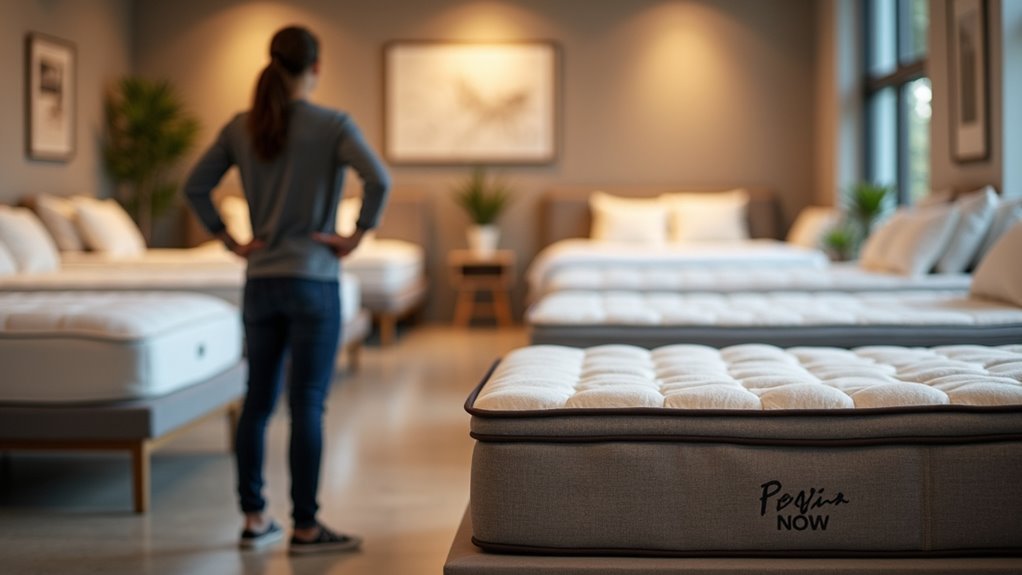
While it’s natural to focus on budget constraints when making major purchases, prioritizing price over quality and comfort when buying a mattress can backfire considerably.
Cheap mattresses often compromise on materials and construction, leading to quicker sagging and reduced lifespan that negates initial savings. When you choose affordability over comfort and support, you’re risking poor sleep experiences that can impact your health and well-being.
Related guide: Best Wedge Mattress Toppers for Anti‑Snore Positioning
Investing in a quality mattress prevents costly replacements while protecting your sleep health and overall well-being.
A mattress that causes discomfort will affect your sleep quality regardless of how much you saved. Instead, view your mattress as an investment in your health.
Consider financing options that allow you to purchase quality without breaking your budget. You’ll save money long-term through fewer replacements while enjoying better sleep and improved health outcomes.
Not Testing the Mattress Before Making a Purchase
You can’t truly know if a mattress will work for your body without lying on it first, yet many shoppers make the mistake of buying online without any physical testing.
Related guide: Best Temperature-Regulating Mattress Covers That Work Without Water
While online purchases might seem convenient and often come with trial periods, you’re missing the vital opportunity to compare multiple models side by side and get immediate feedback on comfort and support.
This approach puts you at risk for costly returns and weeks of poor sleep while you figure out what actually works for your specific needs.
In-Store Testing Benefits
One of the biggest mistakes mattress shoppers make is skipping the in-store testing phase and relying solely on online reviews or product descriptions. In-store testing allows you to immediately evaluate comfort and support based on your personal preferences. A quick lie-down helps identify pressure points and overall feel that you can’t gauge through online descriptions.
Related guide: Best Bamboo Mattress Toppers for Eco-Friendly Sleep
| What You Get | What You Miss Online |
|---|---|
| Immediate comfort feedback | Guessing from descriptions |
| Side-by-side comparisons | Isolated product views |
| Pressure point identification | Unknown comfort issues |
| Expert guidance from staff | Generic online reviews |
| Real-time preference testing | Assumption-based decisions |
Showroom staff provide expert guidance, clarifying features and benefits that influence your decision before committing to a purchase.
Online Purchase Risks
Although online mattress shopping offers convenience and competitive pricing, it creates significant risks when you can’t physically test the product beforehand.
You’re fundamentally gambling on comfort based solely on descriptions and reviews that may not reflect your personal comfort preferences. What feels perfect to another sleeper might leave you tossing and turning nightly.
These online purchase risks extend beyond initial selection. While many brands offer generous trial periods, returning a mattress involves scheduling pickup, repackaging, and waiting for refunds—a process that discourages many customers from exchanging unsuitable beds.
Without physically experiencing firmness levels, support zones, and temperature regulation, you’re missing vital insights that a simple showroom test could provide, potentially leading to months of poor sleep.
Choosing the Wrong Firmness Level for Your Sleep Position

Since your sleep position directly influences spinal alignment and pressure point relief, selecting the wrong mattress firmness can transform restful nights into uncomfortable experiences filled with tossing, turning, and morning aches.
One of the most common mistakes shoppers make is choosing firmness based on initial comfort rather than their primary sleep position.
Here’s what you need to know:
- Side sleepers require soft to medium firmness to cushion shoulders and hips while maintaining proper spinal alignment.
- Back sleepers benefit from medium-firm support that preserves the spine’s natural curvature without creating lumbar pressure.
- Stomach sleepers need firmer surfaces to prevent hip sinking and spinal misalignment.
Don’t rely solely on brief in-store testing.
Consider consulting a sleep expert who can assess your specific needs and recommend the ideal firmness level.
Ignoring Material Construction and Cooling Properties
You can’t judge a mattress by its cover alone—the internal construction and materials determine whether you’ll sleep comfortably or wake up overheated and restless.
Memory foam might cradle your body perfectly but trap heat like a furnace, while latex naturally breathes better but feels different under pressure.
Before you buy, examine the foam types, cooling technologies, and airflow features that’ll make the difference between sweet dreams and sweaty nights.
Understanding Foam Types
When choosing a mattress, many shoppers focus solely on how soft or firm the surface feels without considering the foam’s density, quality, or thermal properties.
This oversight can lead to poor sleep quality and premature replacement costs.
Here are three key foam types you should understand:
- Memory foam – Higher density versions offer better support and longevity, while gel-infused options combat heat retention for hot sleepers.
- Latex mattresses – Particularly 100% natural latex provides superior breathability and cooling compared to synthetic alternatives, plus responsive bounce.
- Hybrid mattresses – Combine foam comfort layers with innerspring coils, delivering both pressure relief and enhanced airflow for temperature regulation.
Don’t let initial softness fool you—lower-density foams may feel comfortable initially but often sag quickly, compromising long-term support and comfort.
Heat Retention Issues
Although mattress stores often emphasize comfort and support, they frequently downplay or ignore heat retention issues that can turn your dream bed into a nightly furnace. Understanding cooling properties across different mattress types is vital for avoiding sleepless, sweaty nights.
| Material Type | Heat Retention | Cooling Rating |
|---|---|---|
| Traditional Memory Foam | High | Poor |
| Gel-Infused Foam | Medium | Good |
| Latex | Low | Excellent |
| Hybrid | Low | Excellent |
| Innerspring | Very Low | Excellent |
You’ll want to test mattresses thoroughly, as some feel comfortable initially but heat up considerably overnight. Traditional memory foam traps body heat, while latex and gel-infused options promote better airflow. Hybrid mattresses combining foam and springs typically offer superior temperature regulation than all-foam alternatives.
Cooling Technology Features
Why do mattress manufacturers invest heavily in cooling technology features when basic materials could handle temperature regulation?
You’ll find that advanced cooling technologies go beyond standard materials to actively manage your body temperature throughout the night. These innovations target hot sleepers who need more than passive breathability.
When evaluating cooling technology features, look for these advanced options:
- Phase change materials – These actively absorb and release heat to maintain ideal sleeping temperature.
- Gel-infused foam layers – They provide superior heat dissipation compared to traditional memory foam.
- Moisture-wicking fabric covers – These breathable materials enhance airflow and prevent surface heat buildup.
Don’t overlook mattresses specifically labeled as “cooling” or “temperature-regulating” if you’re a hot sleeper seeking consistent overnight comfort.
Selecting an Inappropriate Mattress Size
How often do you find yourself tossing and turning because there’s simply not enough room to get comfortable?
Selecting an inappropriate mattress size ranks among the most common shopping mistakes that’ll impact your sleep quality for years. Understanding standard mattress sizes prevents costly errors: Twin (38″ x 75″), Full (54″ x 75″), Queen (60″ x 80″), and King (76″ x 80″).
Choosing the wrong mattress size is a costly mistake that will compromise your sleep comfort for years to come.
Measure your bedroom space first, then consider who’s sharing the bed. Guest rooms work fine with Twin or Full sizes, but master bedrooms benefit from Queen or King dimensions.
Don’t forget that brand measurements can vary, especially with international manufacturers.
Budget for matching accessories like bed frames and bedding since finding a mattress that suits your space means coordinating everything properly.
Overlooking Edge Support and Motion Transfer

You might focus so much on firmness and comfort that you forget to evaluate how well your mattress performs at the edges and handles movement.
Edge support determines whether you’ll feel secure sitting on the side or sleeping near the perimeter, while motion transfer affects how much your partner’s movements will disturb your sleep.
Testing both features in-store can save you from discovering these issues after you’ve already made your purchase.
Edge Support Basics
While most shoppers focus on firmness and comfort, edge support often gets overlooked despite being essential for maximizing your mattress’s usable surface area. This feature determines how well your mattress maintains its shape along the perimeter, preventing that sinking feeling when you sit or sleep near the edges.
Strong edge support provides three key benefits:
- Easier bed entry and exit – You won’t feel like you’re rolling off when getting in or out.
- Maximized sleep space – You can use the entire mattress surface without fear of sagging edges.
- Better sitting comfort – The edge won’t compress excessively when you sit to put on shoes or read.
Your comfort level depends greatly on how stable the mattress feels around its borders, especially if you share your bed with a partner.
Motion Transfer Issues
Beyond edge support lies another critical factor that can make or break your sleep quality: motion transfer. When you share your bed, poor edge support amplifies motion transfer problems. As edges sag, movements become more pronounced throughout the mattress surface, disturbing your partner’s sleep every time you shift positions.
You’ll want to test motion transfer in-store by having someone move on one side while you lie on the other.
Memory foam mattresses typically excel here due to their contouring properties, which absorb and isolate movement effectively. Look for mattresses with reinforced edges or hybrid constructions that combine stability with motion isolation.
These designs prevent sagging borders that would otherwise reduce your usable sleep surface and create more disturbance when either partner moves during the night.
Testing Both Features
Most shoppers make the mistake of testing edge support and motion transfer separately, missing how these features work together in real-world use.
When testing the mattress in-store, you’ll want to evaluate both characteristics simultaneously to understand your bed’s true performance.
Here’s how to test both features effectively:
- Sit on the edge while your partner moves – Have someone shift positions on the opposite side while you’re seated on the mattress edge to assess how well it maintains stability during motion transfer scenarios.
- Lie near the perimeter during movement tests – Position yourself close to the edge while testing motion isolation to see if poor edge support amplifies disturbances.
- Switch positions frequently – Test getting in and out of bed from different angles while your partner remains still, then reverse roles.
Neglecting Personal Sleep Needs and Health Requirements
You might assume that any comfortable mattress will work for your needs, but this approach overlooks the essential reality that sleep requirements differ dramatically from person to person.
Your sleeping position, body type, and health conditions should guide your personal preferences when selecting a mattress. If you’re a side sleeper, you’ll need softer surfaces to relieve pressure points, while back and stomach sleepers require firmer options for proper spinal alignment.
Don’t ignore specific health requirements like back pain, which demands orthopedic support to enhance sleep quality.
Consider your temperature sensitivity and allergies, as neglecting these factors leads to poor choices.
Couples should explore hybrid or adjustable options to accommodate different firmness levels and guarantee both partners sleep comfortably.
Relying Solely on In-Store Testing Without Home Trials
Why would spending just ten minutes lying on a mattress in a brightly lit showroom give you an accurate picture of how you’ll sleep for the next decade?
In-store testing provides only superficial comfort impressions that don’t reflect real sleep conditions. Your comfort preferences can actually change after prolonged use, making those brief showroom moments misleading.
Smart mattress shopping requires taking advantage of home trials:
Skip the showroom theatrics and demand a real home trial before committing to your next mattress purchase.
- Test in your actual sleep environment – Your bedroom temperature, pillow, and sleep partner all affect comfort
- Evaluate over multiple nights – Some mattresses need time to break in or may cause discomfort after extended use
- Assess your specific sleep habits – Side sleeping, back pain, or restless movement patterns only emerge during real sleep
Don’t let in-store testing fool you into costly mistakes.
Dismissing Online Options and Customer Reviews
You’re making a costly error if you automatically dismiss online mattress brands without considering their unique advantages like competitive pricing, innovative features, and direct-to-consumer savings.
Ignoring thousands of detailed customer reviews means you’ll miss valuable insights about real-world performance, durability issues, and comfort levels that you can’t assess during a brief store visit.
Don’t overlook the generous trial periods that online companies offer – they’re often much longer than traditional retailers and let you test the mattress in your actual sleeping environment.
Overlooking Online Brand Benefits
How often do shoppers dismiss online mattress brands without considering their substantial advantages over traditional retail experiences?
Online reviews reveal these common pitfalls cost buyers access to superior value and innovation. When you overlook online options, you’re missing opportunities to benefit from a king-size selection of cutting-edge materials and technologies.
Consider these online brand advantages:
- Extended sleep trials and free delivery – Most online brands offer 90-365 night trials with hassle-free returns, letting you test mattresses in your actual sleeping environment.
- Innovative materials – Access cooling gel-infused foams, eco-friendly options, and advanced technologies often unavailable in traditional stores.
- Comprehensive comparisons – Browse wider variety of mattress types and price ranges with detailed specifications and authentic customer feedback.
Don’t let preconceptions about online shopping prevent you from discovering your ideal mattress.
Ignoring Real User Experiences
When did customer reviews become optional research for major purchases?
You’re making a costly mistake if you’re skipping online reviews when mattress shopping. Around 70% of shoppers read at least one review before buying, and there’s good reason why. Real user experiences reveal essential details about comfort over time that you’ll never discover during a quick store test.
Online reviews highlight potential durability issues, sleep temperature problems, and long-term comfort changes that marketing materials conveniently omit.
These authentic experiences help you understand how a mattress performs after months of use, not just the first night.
You’re also missing out on exclusive online brands with unique materials unavailable in physical stores, plus valuable perks like free delivery and extended sleep trials.
Missing Trial Period Opportunities
Beyond overlooking valuable feedback, you’re also ignoring one of the biggest advantages modern mattress shopping offers: generous trial periods that let you test your purchase for months, not minutes.
When you dismiss online options, you’re missing out on trial periods ranging from 90 to 365 nights. This means you can actually sleep on the mattress in your own bedroom environment before committing.
Here’s what you gain by exploring these opportunities:
- Extended testing time – Replace that awkward 5-minute store test with months of real sleep data.
- Risk-free exploration – Many online retailers offer free shipping and hassle-free returns.
- Access to innovation – Online brands often feature cutting-edge materials and competitive pricing unavailable in traditional stores.
Customer reviews combined with generous trial periods create the perfect research-and-test combination for finding your ideal mattress.
Failing to Research Brand Reputation and Warranties
Although price and comfort often dominate mattress shopping decisions, you’re setting yourself up for disappointment if you skip researching brand reputation and warranty terms. Established brands typically have proven track records for quality, durability, and reliable customer service.
Don’t rely on single sources—read reviews across multiple platforms to understand real-world performance and identify potential issues.
Pay close attention to warranty details, including coverage duration and conditions that might void protection. Brands offering longer warranties usually demonstrate greater confidence in their products’ longevity.
Compare warranty terms between manufacturers, as significant differences exist in return periods, restocking fees, and coverage specifics. This research safeguards your investment and guarantees you’ll receive proper support if problems arise with your mattress.
Forgetting About Essential Accessories and Hidden Costs
Since mattress prices often represent just the starting point of your total investment, overlooking essential accessories and hidden costs can derail your budget and leave you scrambling for additional purchases.
A mattress is only the beginning—smart shoppers budget for the complete sleep system, not just the sticker price.
You’ll need to factor in several additional expenses:
- Essential accessories – A mattress protector isn’t optional; it prevents stains and protects your warranty. You’ll also need appropriate bed frames, box springs, or specialized foundations.
- Hidden costs – Delivery fees and old mattress disposal charges can add unexpected expenses to your final bill.
- Bedding compatibility – International brands may have size discrepancies, requiring new sheets and pillows that match your mattress dimensions.
Plan for these costs upfront to avoid budget surprises and guarantee you’re getting the complete sleep setup you need.
Not Understanding Return Policies and Trial Periods
Why rush into a mattress purchase when most brands offer generous trial periods that let you test your choice at home? These trial periods typically range from 90 to 365 days, giving you ample time to determine if the mattress suits your needs.
However, don’t assume all return policies are created equal. Some companies impose restocking fees or require pristine condition for full refunds. You’ll also encounter minimum sleep requirements before initiating returns, usually 30 to 60 days.
Before buying, read customer reviews specifically about the return process to understand potential difficulties. Additionally, examine warranty terms carefully, as they often extend 10+ years but can become void due to stains or improper care.
Accepting Poor Sleep Quality Instead of Seeking Solutions
Understanding return policies sets you up for success, but many people never reach that point because they’ve already resigned themselves to restless nights.
You’re not alone—70% of adults experience sleep problems, yet continue using unsuitable mattresses. Don’t accept this cycle when solutions exist.
Poor sleep quality increases your risk of obesity, diabetes, and cardiovascular diseases.
Here’s what you should know:
- A good mattress tailored to your sleeping position can reduce sleep disturbances by 60%
- Your sleep environment—including mattress comfort and materials—directly impacts rest quality
- Proactive steps toward better sleep enhance overall well-being and productivity
The right mattress can provide significant health improvements.
Don’t settle for discomfort when you can make the right choice for your sleep needs.
Rushing the Decision Without Adequate Comparison Shopping
While you might feel pressure to buy quickly during a sale or when your old mattress becomes unbearable, rushing the decision often leads to buyer’s remorse and years of poor sleep.
Adequate comparison shopping is essential for mattress shopping success. Taking time to compare multiple brands reveals vital differences in firmness, materials, warranties, and pricing that directly impact your satisfaction.
You’ll discover that some affordable options outperform expensive models in durability and comfort. Thorough research helps you identify the best value within your budget while avoiding mattresses that don’t match your sleep position or health needs.
Use online resources and customer reviews during your comparison process. Real-world performance insights from actual users provide valuable information that marketing materials can’t offer, leading to more educated purchasing decisions.
Frequently Asked Questions
How to Properly Shop for a Mattress?
You’ll want to identify your sleep position first, then test different mattress types in-store. Don’t rush—lie down for several minutes. Check return policies and consider trial periods before purchasing.
How to Not Get Ripped off Buying a Mattress?
You’ll avoid getting ripped off by researching prices beforehand, understanding return policies completely, testing mattresses thoroughly in-store, reading genuine customer reviews, and factoring in accessory costs when budgeting.
How Do You Know if You Bought the Wrong Mattress?
You’ll know you’ve bought the wrong mattress if you’re waking up with aches, experiencing poor sleep quality, noticing sagging, overheating at night, or constantly tossing and turning.
What Consideration Is Most Important When Purchasing a Mattress?
You should prioritize personal comfort above all else when buying a mattress. Since firmness preferences vary based on your sleeping position and body type, focus on what feels most supportive and comfortable for you.


