
Your hypnogram reveals the hidden architecture of your sleep, showing whether you’re cycling properly through the four essential stages every 90 minutes. It displays if you’re getting the vital 20-25% REM sleep needed for memory consolidation and emotional regulation, plus adequate deep sleep for physical restoration. The visualization exposes frequent awakenings, sleep efficiency below 90%, and irregular patterns that signal potential disorders like sleep apnea or insomnia—insights that’ll transform how you approach optimizing your nightly recovery.
Understanding Sleep Stage Architecture Through Hypnogram Visualization
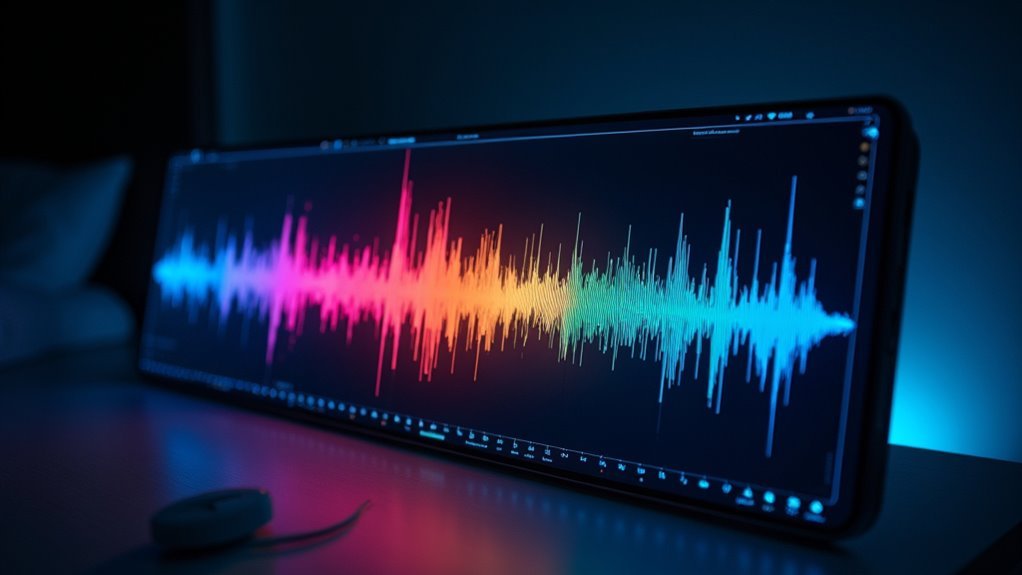
Sleep unfolds in a predictable pattern each night, and hypnograms capture this intricate dance through visual storytelling.
When you examine your hypnogram, you’re seeing your sleep architecture laid bare—a detailed map showing how you shift between awake periods, light sleep, deep sleep, and REM sleep throughout the night.
These visual charts reveal your body’s natural rhythm across 4-6 sleep cycles, each lasting approximately 90 minutes.
You’ll notice deep sleep dominates your first half of slumber, while REM sleep becomes more prominent later.
This sleep analysis tool helps you understand whether you’re achieving the recommended 20-25% REM sleep needed for ideal cognitive function and emotional regulation.
Your hypnogram fundamentally becomes your personal sleep fingerprint.
Decoding Normal vs. Disrupted Sleep Patterns in Your Data
When you examine your hypnogram data, you’ll notice that healthy sleep architecture follows predictable patterns with consistent cycles of deep, light, and REM sleep stages.
Your sleep quality can reveal telltale signs of disorders through fragmented patterns, excessive awakenings, or disproportionate time spent in lighter sleep stages.
Understanding how your age and environmental factors influence these patterns helps you identify whether disruptions stem from natural aging processes or controllable external influences.
Healthy Sleep Architecture Patterns
Your hypnogram reveals a detailed story about your nightly rest, and understanding what healthy sleep architecture looks like can help you identify patterns that support or hinder recovery.
Ideal sleep stages follow predictable patterns that promote restoration and mental clarity. A well-structured hypnogram shows balanced distribution across all sleep stages.
You’ll typically see 20-25% of total sleep time dedicated to REM sleep stages and Deep Sleep respectively. Your sleep cycle should complete approximately every 90 minutes, cycling 4-6 times nightly without frequent interruptions.
- Balanced stage distribution: 20-25% each for REM and Deep Sleep phases
- Consistent 90-minute cycles: 4-6 complete progressions through sleep stages
- Minimal awakenings: Few sleep disturbances maintaining cycle integrity
- Adequate Deep Sleep: Sufficient restorative periods early in night
- Regular REM periods: Consistent dream sleep supporting memory consolidation
Signs of Sleep Disorders
How can you distinguish between normal sleep variations and patterns that signal potential disorders? Your hypnogram reveals critical warning signs when sleep architecture becomes disrupted.
If you’re spending less than 20% of your sleep in REM sleep, this suggests potential sleep disorders affecting your rest quality. Frequent awakenings scattered throughout your hypnogram indicate possible sleep apnea or insomnia.
You’ll notice problematic patterns when light NREM sleep dominates while deep sleep remains minimal, signaling compromised sleep quality. Prolonged wakefulness periods or abnormal shifts between sleep stages point to specific sleep disorders requiring intervention.
Your hypnogram becomes a diagnostic tool, highlighting whether irregular patterns stem from environmental factors, lifestyle choices, or underlying medical conditions that warrant professional evaluation and targeted treatment.
Age and Environmental Factors
As you age, your hypnogram naturally evolves, showing distinct patterns that differ significantly from younger adults’ sleep data.
You’ll notice reduced REM sleep and less time in deeper sleep stages, while experiencing more fragmented sleep patterns with frequent awakenings. Your sleep becomes lighter and less restorative compared to younger years.
Environmental factors considerably impact your hypnogram regardless of age. Room temperature, noise, and light exposure can disrupt your natural sleep architecture, creating irregular patterns in your data.
- Temperature control: Keep your bedroom between 65-68°F for ideal sleep stages
- Noise reduction: Use earplugs or white noise to minimize sleep disruptions
- Light management: Block blue light before bedtime to maintain healthy sleep patterns
- Hormonal awareness: Understand that age-related hormonal changes affect your hypnogram
- Lifestyle choices: Regular exercise and proper diet improve sleep stage distribution
Identifying Sleep Disorders Through Hypnogram Analysis
Your hypnogram acts as a diagnostic window, revealing telltale signs of sleep disorders that might otherwise go undetected.
When you examine disrupted sleep patterns in your data, you’ll notice irregular awakenings, insufficient deep sleep phases, or abnormal stage distributions that signal conditions like insomnia or restless legs syndrome.
You can also spot breathing disorders such as sleep apnea through characteristic interruptions in your sleep architecture, where repeated awakenings create distinctive patterns throughout the night.
Disrupted Sleep Pattern Recognition
When sleep disorders disrupt your nightly rest, hypnograms become powerful diagnostic tools that reveal telltale patterns hiding beneath the surface. Your disrupted sleep creates distinct signatures in hypnogram data that trained specialists can interpret to identify underlying conditions affecting your sleep quality.
These visual representations of your sleep architecture expose irregularities that might otherwise go unnoticed, helping pinpoint specific sleep disorders through characteristic pattern recognition.
- Fragmented sleep stages appear as jagged lines instead of smooth changes
- Reduced deep sleep shows as shortened or absent slow-wave periods
- Frequent awakenings create spikes throughout the night’s recording
- Abnormal REM patterns reveal timing and duration irregularities
- Stage change disruptions indicate potential breathing or movement disorders
Breathing Disorder Detection
Breathing disorders leave unmistakable fingerprints across your hypnogram’s landscape, creating characteristic patterns that sleep specialists can quickly identify and analyze.
When you experience sleep-disordered breathing events like obstructive sleep apnea, your hypnogram reveals frequent awakenings and shifts to lighter sleep stages throughout the night. These disruptions fragment your sleep architecture, preventing you from maintaining deep, restorative sleep cycles.
Your polysomnography data captures these respiratory disturbances as they occur, allowing doctors to calculate your apnea-hypopnea index—a critical measurement of breathing interruption frequency.
Each time your breathing stops or becomes shallow, your brain briefly awakens you to restore normal airflow. This pattern creates a jagged, fragmented hypnogram that contrasts sharply with healthy sleep’s smooth progression through different stages.
Key Metrics and Measurements That Impact Sleep Quality

Five key metrics transform your hypnogram from a colorful chart into actionable sleep intelligence. These measurements reveal whether you’re getting restorative rest or struggling with sleep disruption.
Transform sleep data into actionable insights that reveal whether you’re achieving truly restorative rest or facing hidden disruptions.
Your hypnogram tracks critical data points that determine sleep quality:
- Sleep efficiency – Time asleep divided by total time in bed (aim for 90%+)
- REM sleep percentage – Should comprise 20-25% of total sleep time
- Deep sleep duration – Target 20-25% for physical restoration during NREM stages
- Sleep cycles completion – 4-6 complete 90-minute cycles per night
- Awakening frequency – Fewer interruptions mean better sleep stages continuity
When you understand these metrics, you’ll spot patterns affecting your rest.
Poor sleep efficiency or insufficient REM sleep often explains why you wake up tired despite spending enough time in bed.
Optimizing Sleep Environment Based on Hypnogram Insights
Your hypnogram reveals more than sleep stage patterns—it’s a diagnostic tool that exposes environmental factors sabotaging your rest. When your data shows frequent awakenings or excessive light sleep, it’s signaling that your room’s temperature, noise levels, or lighting need adjustment.
If you’re not achieving sufficient deep sleep (20-25% of total sleep time), consider implementing blackout curtains and white noise machines for optimizing sleep environment conditions.
Track environmental variables like air quality, humidity, and sound alongside your hypnogram to identify correlations affecting your sleep stages. Regular hypnogram analysis allows you to fine-tune your sleep setting systematically.
Tracking Progress and Implementing Targeted Sleep Improvements

Once you’ve optimized your sleep environment, consistent hypnogram monitoring becomes your roadmap for measurable improvement. Your sleep data reveals how interventions impact sleep architecture over time.
Track changes in deep and REM sleep stages to gauge whether your strategies are working. SleepScore Labs analyzes your hypnogram patterns and delivers personalized recommendations through targeted advice.
Compare your current hypnogram with similar sleep profiles to identify effective practices worth adopting. This comparison reinforces positive changes in your sleep habits.
- Monitor weekly hypnogram trends to spot sleep architecture improvements
- Implement Sleep Guide recommendations based on your specific data patterns
- Track sleep efficiency metrics and reduced wake times consistently
- Compare hypnograms with successful sleep profiles for inspiration
- Celebrate measurable sleep improvements to maintain motivation for continued progress
Frequently Asked Questions
What Does a Hypnogram Show?
A hypnogram shows you’re progressing through different sleep stages throughout the night. You’ll see when you’re awake, in light sleep, deep sleep, or REM sleep, revealing your sleep patterns and quality.
Is 21% REM Sleep Good?
Yes, 21% REM sleep is good for you. You’re within the healthy adult range of 20-25%, which means you’re getting adequate REM for proper memory consolidation and emotional regulation.
What Does a Healthy Hypnogram Look Like?
Your healthy hypnogram shows balanced sleep stages: 20-25% REM and deep sleep each, minimal awakenings, 4-6 ninety-minute cycles, deep sleep dominating early night, REM increasing later, totaling seven-nine hours nightly.
What Is a Normal Healthy Sleep Pattern?
You’ll sleep best with 7-9 hours nightly, cycling through stages every 90 minutes. You’ll spend 20-25% in REM sleep and 20-25% in deep sleep, with minimal awakenings for ideal restoration.


