

CPAP and BiPAP both effectively treat sleep apnea, but your specific condition determines which works better. If you have obstructive sleep apnea, CPAP’s constant pressure typically provides excellent results at a lower cost ($500-$1,000). However, if you’re dealing with central sleep apnea, complex sleep disorders, or need pressure above 15 cm H2O, BiPAP’s dual-pressure system offers superior comfort and effectiveness, though it costs more ($1,700-$3,000). Understanding these key differences will help you make the most informed decision for your sleep health.
Understanding CPAP and BiPAP Technology
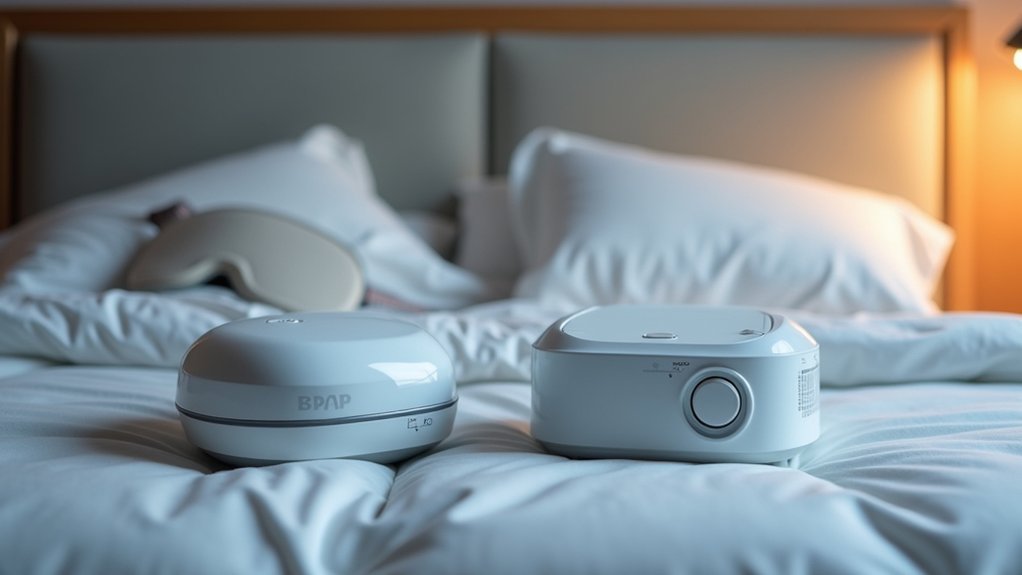
Sleep apnea treatment hinges on two primary technologies that work differently to address breathing interruptions during sleep.
CPAP delivers constant airflow at a single pressure level, maintaining open airways throughout your sleep cycle. This technology effectively treats obstructive sleep apnea by preventing airway collapse.
CPAP maintains consistent airway pressure throughout sleep, effectively preventing the airway collapse that characterizes obstructive sleep apnea episodes.
BiPAP operates with dual pressure settings, providing higher inspiratory positive airway pressure during inhalation and lower expiratory positive airway pressure during exhalation. You’ll find BiPAP particularly beneficial if you have central sleep apnea or chronic obstructive pulmonary disease, as it accommodates varying respiratory needs.
Both technologies maintain airway patency, but their pressure delivery mechanisms differ considerably.
CPAP’s simplicity makes it ideal for straightforward obstructive sleep apnea treatment, while BiPAP’s advanced pressure settings offer customized therapy for complex respiratory conditions requiring variable pressure support.
Key Differences Between CPAP and BiPAP Machines
Understanding how these technologies work sets the foundation for recognizing their distinct operational characteristics.
CPAP delivers constant pressure throughout your breathing cycle, while BiPAP offers dual pressure settings—higher during inhalation and lower during exhalation.
CPAP’s pressure range spans 4-20 cm H2O, but BiPAP extends to 30 cm H2O for patients requiring elevated pressures.
You’ll find CPAP primarily treats obstructive sleep apnea, whereas BiPAP handles central sleep apnea and complex cases more effectively.
Cost differences are significant: CPAP machines range $500-$1,000 compared to BiPAP’s $1,700-$3,000.
Insurance coverage favors CPAP treatment, while BiPAP approval often requires proof of CPAP ineffectiveness or specific medical conditions.
Pressure Settings and Breathing Mechanisms
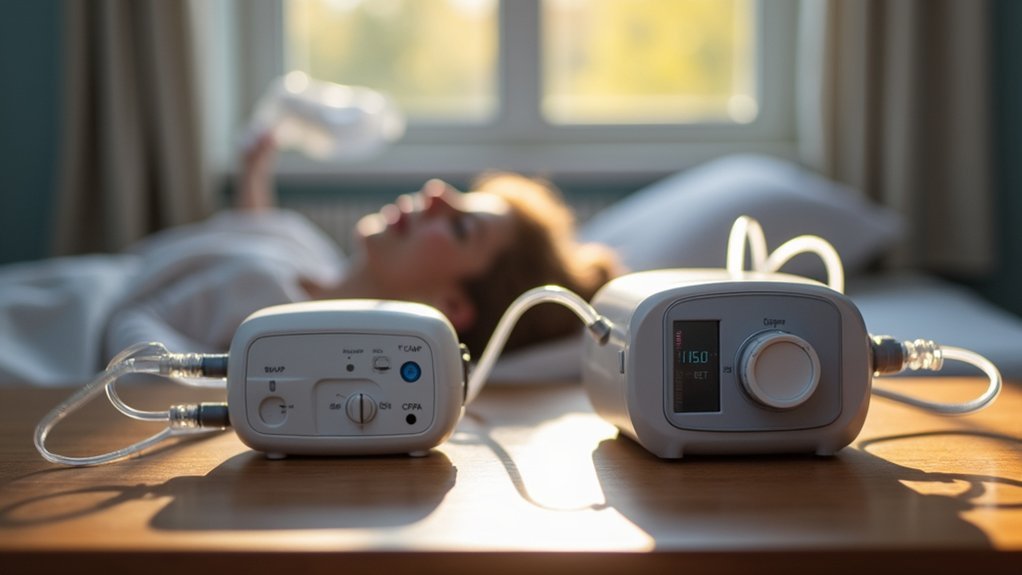
While both devices deliver positive airway pressure, their breathing mechanisms differ fundamentally in how they support your respiratory cycle.
CPAP maintains constant pressure settings between 4-20 cm H2O throughout inhalation and exhalation, effectively treating obstructive sleep apnea by keeping airways open. However, you might find breathing out against this fixed pressure uncomfortable.
BiPAP’s dual pressure settings offer greater flexibility with higher IPAP for inhalation and lower EPAP for exhalation, ranging from 4-30 cm H2O. This breathing mechanism allows you to exhale more comfortably while receiving adequate pressure during inhalation.
BiPAP therapy proves particularly beneficial if you have central sleep apnea or complex respiratory conditions requiring higher pressures, making it an ideal alternative when CPAP becomes ineffective or intolerable.
Cost Comparison and Insurance Coverage
When you’re choosing between CPAP and BiPAP machines, you’ll find significant price differences that can impact your budget and treatment decisions.
Your insurance coverage requirements will vary dramatically between these devices, with CPAP generally receiving easier approval while BiPAP often requires additional medical documentation.
You’ll also need to contemplate the long-term treatment costs, including maintenance, supplies, and potential equipment upgrades over the years.
Machine Purchase Prices
Machine purchase prices represent one of the most notable factors you’ll consider when choosing between CPAP and BiPAP therapy. CPAP machines typically cost between $500 and $1,000, making them considerably more affordable than BiPAP machines, which range from $1,700 to $3,000.
This substantial price difference reflects the advanced technology and dual-pressure capabilities of BiPAP devices designed for complex respiratory conditions.
- CPAP machines offer budget-friendly entry points for sleep apnea treatment
- BiPAP machines cost 2-3 times more due to sophisticated dual-pressure technology
- Insurance coverage varies notably between device types and medical documentation requirements
- Accessories and maintenance costs add ongoing financial commitment beyond initial purchase
You’ll find that CPAP’s lower upfront cost makes it accessible for most patients, while BiPAP’s higher price point typically requires stronger insurance coverage justification.
Insurance Coverage Requirements
Beyond the upfront machine costs, insurance coverage requirements create another layer of complexity in your decision between CPAP and BiPAP therapy.
Insurance coverage for CPAP is typically straightforward since it’s the recognized first-line treatment for obstructive sleep apnea. However, BiPAP approval requires extensive documentation proving CPAP intolerance or ineffectiveness from your healthcare providers.
Most insurers mandate a trial period on CPAP before considering BiPAP coverage. You’ll need thorough documentation showing treatment outcomes and medical necessity. Prior authorizations are often required for BiPAP, adding time to your approval process.
Coverage varies greatly between plans, affecting your out-of-pocket costs for equipment and supplies. Some states have specific guidelines for sleep apnea treatments, so consult your insurance provider for personalized coverage information.
Long-term Treatment Costs
While upfront costs matter, the long-term financial commitment of sleep apnea therapy extends far beyond your initial machine purchase. Your average out-of-pocket expense varies considerably between treatments, with CPAP therapy typically proving more economical than BiPAP therapy over time.
Consider these ongoing expenses:
- Equipment replacement: CPAP machines last 5-7 years versus BiPAP machines requiring more frequent servicing.
- Accessories and maintenance: Monthly mask replacements, filters, and tubing cost less for CPAP systems.
- Insurance coverage adjustments: Your plan may change, affecting reimbursement rates differently for each therapy.
- Medical monitoring: Patient response determines follow-up frequency and potential equipment modifications.
Your treatment costs accumulate through regular maintenance, medical visits, and equipment updates. CPAP’s simpler design generally translates to lower long-term expenses, while BiPAP’s complexity increases ongoing financial obligations.
Benefits and Drawbacks of CPAP Therapy
CPAP therapy stands as the gold standard for treating obstructive sleep apnea, offering you a reliable and cost-effective solution that typically ranges from $500 to $1,000.
This continuous positive airway pressure system maintains steady airflow between 4 to 20 cm H2O, effectively preventing airway collapse and reducing snoring.
The benefits of CPAP include its straightforward operation with minimal settings, making it user-friendly for most patients.
However, the drawbacks of CPAP become apparent when you experience discomfort during exhalation due to fixed pressure levels.
Additionally, CPAP’s efficacy diminishes for central sleep apnea cases, where BiPAP’s dual pressure settings provide superior comfort and treatment outcomes for complex conditions.
Benefits and Drawbacks of BiPAP Therapy
BiPAP therapy offers significant comfort advantages with its dual-pressure system, making it easier for you to breathe naturally compared to CPAP’s single pressure setting.
However, you’ll face substantially higher costs ranging from $1,700 to $3,000, plus potential insurance hurdles that often require proving CPAP failure first.
You’ll also need to manage more complex operations and maintenance requirements that can make BiPAP therapy more demanding than traditional CPAP treatment.
BiPAP Comfort Advantages
When you’re struggling with the constant pressure from a CPAP machine, BiPAP therapy can offer remarkable comfort advantages through its dual-pressure system. Unlike CPAP’s fixed pressure, BiPAP provides higher pressure during inhalation and lower pressure during exhalation, making breathing feel more natural. This adjustment considerably reduces the discomfort you might experience when exhaling against high pressure.
BiPAP’s comfort advantages include:
- Easier exhalation – Lower pressure during breathing out reduces strain and effort
- Natural breathing patterns – Dual pressure levels mimic your body’s respiratory rhythm
- Better oxygenation – Enhanced airflow support for complex respiratory challenges
- Improved sleep adherence – Greater comfort leads to consistent nightly use
For sleep apnea patients requiring higher pressure levels or those with additional respiratory challenges, BiPAP’s comfort benefits often outweigh its higher cost.
Higher Costs Considerations
Although BiPAP therapy offers superior comfort benefits, you’ll face considerably higher costs that can impact your treatment decision.
BiPAP machines typically cost $1,700-$3,000 compared to CPAP machines’ $500-$1,000 range. These higher costs reflect advanced features like dual pressure settings designed for complex respiratory conditions.
Insurance coverage for BiPAP can be more restrictive, often requiring proof that CPAP therapy failed or specific medical criteria like central sleep apnea.
You’ll need to demonstrate medical necessity to qualify for coverage.
Despite the significant upfront investment, BiPAP may provide better comfort and efficacy for certain patients.
However, you should factor in maintenance costs and accessories when calculating the overall expense.
Consider whether BiPAP’s benefits justify the substantially higher financial commitment compared to standard CPAP therapy.
Complex Operation Challenges
While CPAP machines operate with straightforward single-pressure settings, you’ll encounter considerably more complexity when using BiPAP therapy. BiPAP’s dual pressure settings require separate adjustments for IPAP during inhalation and EPAP during exhalation, matching your natural breathing cycle.
This complexity becomes particularly challenging if you have complex sleep apnea or need higher pressure requirements.
Key operation challenges you’ll face include:
- Adjustment difficulties – Patient adjustment takes longer due to varying pressure levels throughout each breath
- Increased maintenance – More frequent calibration and monitoring compared to simple CPAP systems
- Technical complexity – Dual pressure settings require additional fine-tuning and professional oversight
- Insurance hurdles – Restrictive insurance coverage often demands proof of CPAP failure before approval
Despite offering enhanced comfort for specific conditions, BiPAP’s operational complexity can create barriers to successful therapy implementation.
Ideal Candidates for Each Treatment Type
Your sleep specialist will evaluate several key factors to determine whether CPAP or BiPAP is right for you.
If you have obstructive sleep apnea, CPAP typically serves as the first-line treatment, delivering constant pressure to keep your airways open effectively.
However, you’ll likely benefit from BiPAP if you have central sleep apnea or complex sleep apnea syndrome. BiPAP’s dual pressure settings make breathing more comfortable and natural.
BiPAP’s dual pressure system provides more natural breathing patterns for patients with central or complex sleep apnea conditions.
You’re also an ideal BiPAP candidate if you require pressure settings above 15 cm H2O or have chronic obstructive pulmonary disease.
If you can’t tolerate CPAP therapy due to exhalation discomfort or pressure intolerance, BiPAP offers a gentler alternative.
Your sleep specialist will analyze your sleep study results and guarantee you receive the most effective treatment.
Effectiveness for Different Sleep Apnea Conditions
When treating obstructive sleep apnea, CPAP demonstrates superior effectiveness by delivering consistent airway pressure that prevents the soft tissue collapse responsible for breathing interruptions.
However, BiPAP proves more effective for central sleep apnea and complex conditions due to its dual pressure settings that accommodate irregular breathing patterns.
- OSA treatment: CPAP’s continuous pressure (4-20 cm H2O) effectively maintains open airways
- CSA management: BiPAP’s variable pressure settings (4-30 cm H2O) better support spontaneous breathing
- COPD patients: BiPAP’s lower expiratory pressure reduces breathing effort and improves comfort
- Severe cases: BiPAP’s higher pressure range treats advanced sleep apnea when CPAP fails
Your treatment effectiveness depends on your specific sleep apnea type, with CPAP excelling for obstructive cases while BiPAP handles central and complex conditions more successfully.
Choosing the Right Treatment for Your Needs
Selecting the appropriate sleep apnea treatment requires careful evaluation of your specific condition, financial considerations, and comfort preferences.
For obstructive sleep apnea, CPAP typically serves as the first-line treatment option, offering effective therapy at lower costs ($500-$1,000) with broader insurance coverage.
However, if you have central sleep apnea or find CPAP’s fixed pressure uncomfortable, BiPAP’s dual pressure settings may provide better comfort and treatment outcomes.
BiPAP’s dual pressure settings offer superior comfort and treatment outcomes for central sleep apnea patients who struggle with CPAP therapy.
BiPAP costs more ($1,700-$3,000) and requires additional documentation for insurance coverage.
You’ll need to work with a sleep specialist who can analyze your sleep study results and medical history to determine whether CPAP or BiPAP best addresses your specific sleep apnea condition and treatment needs.
Frequently Asked Questions
What Is Better for Sleep Apnea, CPAP or Bipap?
CPAP’s typically your first choice for obstructive sleep apnea since it’s effective and widely covered by insurance. However, you’ll need BiPAP if you have central sleep apnea or can’t tolerate CPAP’s constant pressure.
What Are the Disadvantages of Bipap Over CPAP?
You’ll face higher costs, complex operation, restrictive insurance coverage, potential discomfort from dual pressures, and increased maintenance requirements. BiPAP’s complexity can overwhelm you compared to CPAP’s straightforward design.
What Machine Is Best for Severe Sleep Apnea?
For severe sleep apnea, you’ll likely need BiPAP since it delivers higher pressures up to 30 cm H2O and handles complex cases better than CPAP’s 20 cm H2O maximum.
Why Switch From CPAP to Bipap?
You’d switch from CPAP to BiPAP if you’re struggling with exhaling against constant pressure, need higher pressure settings, have central sleep apnea, or aren’t getting effective treatment results.



Leave a Reply