

Caffeine blocks your brain’s adenosine receptors, which normally signal when you’re tired and ready for sleep. This interference delays REM sleep onset by up to two hours and fragments your sleep cycles throughout the night. Even when you fall asleep, caffeine’s five-hour half-life means it’s still disrupting your deep sleep stages, leaving you with unrestorative rest. The compound effects create chronic sleep deprivation that worsens over time, but strategic timing can help protect your cycles.
How Caffeine Blocks Adenosine and Disrupts Natural Sleep Architecture

When you drink that afternoon coffee, caffeine immediately begins blocking adenosine receptors in your brain, preventing this essential neurotransmitter from signaling your body’s natural need for sleep.
This disruption fundamentally alters your sleep architecture, creating a cascade of problems that extend far beyond simple wakefulness.
Your caffeine consumption interferes with the natural progression of sleep cycles, particularly affecting REM sleep onset.
The stimulant effects can delay your ability to fall asleep by up to two hours, throwing off your entire sleep schedule.
As adenosine accumulation gets blocked, your brain can’t properly navigate through deep sleep stages.
This disruption reduces both the duration and sleep quality of restorative phases, leaving you with fragmented, unsatisfying rest that fails to provide the rejuvenation your body desperately needs.
The Science Behind REM Sleep Delays and Shortened Cycles
When caffeine blocks adenosine receptors in your brain, it prevents this natural sleep-inducing chemical from signaling that you’re ready for rest.
This interference pushes back your REM sleep onset by up to two hours, fundamentally altering when your most restorative sleep phase begins.
You’ll find that caffeine’s adenosine-blocking action doesn’t just delay REM sleep—it creates a cascade effect that shortens and fragments your entire sleep cycle.
Adenosine Blocking Mechanism
As caffeine enters your bloodstream, it immediately begins competing with adenosine for binding sites in your brain’s receptors. This neurotransmitter normally signals when you’re ready for sleep, but caffeine’s stimulant properties block this natural process entirely.
When adenosine can’t reach its receptors, your brain regulation system fails to trigger sleep onset properly.
Here’s how this mechanism destroys your sleep quality:
- Adenosine accumulation gets masked, preventing natural drowsiness
- Your brain’s sleep-wake cycle timing becomes severely disrupted
- REM sleep stages get markedly shortened and fragmented
- Restorative sleep phases become nearly impossible to achieve
- Sleep deprivation cycles worsen as caffeine effects compound
This blocking mechanism doesn’t just delay sleep—it fundamentally alters your brain’s ability to recognize when rest is needed.
REM Onset Delays
Once caffeine blocks those adenosine receptors, your brain’s natural shift into REM sleep becomes severely compromised. The stimulant properties of caffeine create delayed sleep onset, pushing back your REM cycles by up to two hours.
This timing disruption doesn’t just affect when you enter REM sleep—it fundamentally alters your sleep architecture.
When you’re chronically consuming caffeine, especially within hours of bedtime, you’ll experience significant disruptions in your sleep quality. Your total sleep time decreases by approximately 45 minutes, directly impacting REM duration and intensity.
The adenosine blocking mechanism prevents your brain from recognizing natural sleep signals, creating a domino effect throughout your sleep cycles. This delay in REM onset ultimately compromises your overall sleep quality and cognitive restoration.
Brain Blood Flow Changes During Caffeine-Affected Sleep Phases
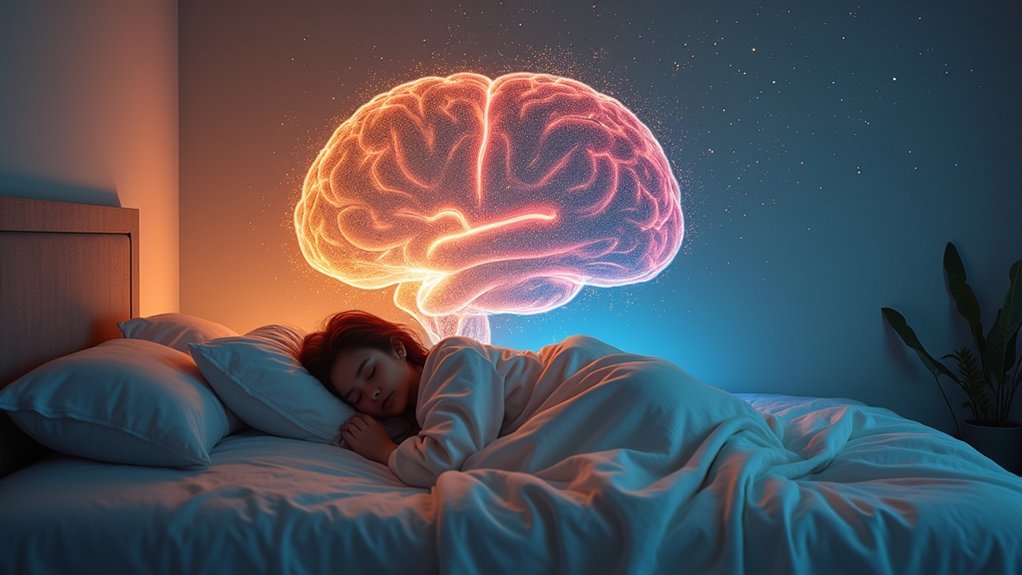
Your brain’s blood flow responds dramatically to caffeine in ways that seem contradictory at first glance.
While chronic caffeine use actually reduces blood circulation during your waking hours, it markedly enhances blood flow during sleep phases, particularly REM sleep.
This enhanced circulation during REM occurs despite the absence of physical movement, creating a unique physiological state where your brain receives increased blood supply precisely when it’s most active during dreams.
Reduced Awake Blood Flow
While caffeine boosts your alertness and energy levels, it paradoxically reduces blood flow to your brain during waking hours.
This reduction in brain blood flow during awake states creates a fascinating contradiction in how caffeine affects your cognitive function and sleep patterns.
The decreased circulation impacts your brain’s performance in several ways:
- Your brain receives less oxygen and nutrients despite feeling more alert
- Waste removal processes become less efficient during waking hours
- Sleep onset can be delayed by up to two hours, disrupting natural rhythms
- REM sleep quality suffers from the accumulated effects of reduced daytime flow
- Long-term sleep hygiene deteriorates without proper neuroprotective effects
This vascular restriction during consciousness sets the stage for more complex sleep disruptions later.
Enhanced Sleep Circulation
Although caffeine restricts blood flow during your waking hours, it creates the opposite effect once you fall asleep. Your brain blood flow considerably increases during both non-REM and REM sleep phases when caffeine’s in your system. This enhanced circulation occurs despite the typical inactivity associated with these sleep phases, creating an unusual physiological response.
While this increased blood flow during REM sleep might seem beneficial for neuroprotective effects and waste clearance, it disrupts your natural sleep patterns. Chronic caffeine consumption alters these blood flow patterns permanently, reducing circulation while you’re awake but promoting it during sleep phases.
This disruption affects your sleep quality by interfering with the normal restorative effects your brain needs during REM cycles, ultimately compromising the regenerative processes essential for ideal brain function.
REM Flow Amplification
When caffeine enters your bloodstream, it triggers a paradoxical shift in brain circulation that becomes most pronounced during REM sleep phases.
While chronic caffeine reduces brain blood flow during wakefulness, it dramatically increases circulation during sleep cycles, creating heightened brain activity when you’re supposed to be recovering.
This REM flow amplification affects your sleep dynamics in complex ways:
- Increased waste clearance – Enhanced blood flow helps remove brain toxins during REM sleep
- Delayed onset – REM phases start later, disrupting natural sleep progression
- Compensatory mechanism – Higher circulation may offset some sleep deprivation effects
- Altered sleep quality – Natural sleep cycle timing becomes irregular
- Contradictory effects – Reduced waking flow versus amplified sleeping circulation
This disruption fundamentally changes how your brain processes sleep.
Why Your Deep Sleep Quality Suffers Even When You Fall Asleep

Despite successfully falling asleep after consuming caffeine, you’re likely experiencing compromised sleep architecture that robs you of truly restorative rest.
The stimulant properties of caffeine don’t simply vanish once you drift off—they continue undermining your sleep quality throughout the night. Your REM sleep onset gets delayed by up to two hours, while deep sleep phases become considerably reduced. This interference with slow-wave sleep patterns directly impacts your physical recovery and cognitive function restoration processes.
Even when you think you’ve slept adequately, caffeine consumption creates a deceptive cycle. You’ll wake feeling less refreshed because your brain hasn’t received proper restorative deep sleep.
Your sleep satisfaction plummets as caffeine’s five-hour half-life continues disrupting critical sleep stages, leaving you vulnerable to cumulative sleep debt despite appearing to maintain normal sleep schedules.
The Half-Life Problem: How Long Caffeine Actually Affects Your Brain
This sleep disruption stems from caffeine’s remarkably persistent presence in your system. Understanding caffeine’s half-life reveals why your sleep cycles suffer long after consumption.
With a five-hour half-life, considerable amounts remain active in your bloodstream, continuing to disrupt brain activity and REM sleep quality.
Caffeine’s five-hour half-life means it continues disrupting your brain and sleep quality hours after consumption.
Here’s how caffeine’s half-life affects your sleep:
- Peak levels hit within 30-60 minutes, immediately impacting brain function
- Half remains active after five hours, continuing to disrupt sleep cycles
- Consumption within 12 hours of bedtime markedly reduces REM sleep duration
- Individual metabolism varies widely, prolonging effects for some people
- Even afternoon caffeine can interfere with nighttime sleep quality
This persistence explains why limiting caffeine intake hours before bedtime is essential for protecting your REM sleep and maintaining healthy sleep patterns.
Timing Your Last Cup: Optimal Caffeine Cutoff Hours for REM Protection
Since caffeine’s effects persist far longer than most people realize, strategic timing becomes your most powerful tool for protecting REM sleep.
You should stop caffeine consumption at least 4-6 hours before bedtime to prevent disruption of your sleep cycles. If you typically sleep at 10 p.m., your ideal timing means avoiding caffeine after 2 p.m.
Research shows caffeine taken just 0, 3, or 6 hours before bed can considerably disrupt sleep quality. Since caffeine’s half-life spans approximately five hours, your afternoon coffee will still affect your brain when you’re trying to reach deep sleep stages.
Monitor your caffeine intake carefully and adjust cutoff times based on your personal sensitivity to achieve better REM protection.
Breaking the Cycle: Reversing Caffeine-Induced Sleep Pattern Damage
Although breaking free from caffeine’s grip on your sleep cycles requires patience and strategy, you can restore natural sleep patterns with the right approach. Your body needs time to readjust, but implementing these evidence-based strategies will help you regain healthy REM sleep:
- Gradual reduction: Slowly decrease your caffeine intake rather than stopping abruptly to minimize withdrawal symptoms.
- Track patterns: Monitor your caffeine consumption and sleep quality to identify your ideal cutoff times.
- Enhance sleep hygiene: Establish a consistent bedtime routine with relaxing activities before sleep.
- Optimize light exposure: Get morning light exposure to regulate your circadian rhythm naturally.
- Add regular exercise: Incorporate physical activity to improve daytime alertness and nighttime sleep quality.
These combined efforts will systematically reverse caffeine-induced damage to your sleep cycles.
Frequently Asked Questions
Does Caffeine Affect Your REM Cycle?
Yes, caffeine greatly affects your REM cycle by delaying its onset up to two hours, reducing total REM duration, and disrupting your brain’s natural shift into this critical sleep stage.
Why Does Caffeine Reduce Blood Flow to the Brain?
Caffeine blocks adenosine receptors in your brain’s blood vessels. When you consume caffeine, it constricts these vessels, reducing blood flow during waking hours and limiting oxygen delivery to your brain tissues.
Does Caffeine Mess up Your Circadian Rhythm?
Yes, caffeine disrupts your circadian rhythm by delaying sleep onset up to two hours and blocking adenosine receptors. When you consume it within twelve hours of bedtime, you’ll experience misaligned sleep-wake cycles.
Can Caffeine Suppress Dreams?
Yes, caffeine can suppress your dreams by disrupting REM sleep cycles. When you consume caffeine, especially near bedtime, it delays REM onset and reduces dream frequency, making you less likely to remember vivid dreams.
In Summary
You’re sabotaging your sleep quality every time you drink coffee too late in the day. Caffeine’s blocking your adenosine receptors for up to 12 hours, crushing your REM cycles when your brain needs them most. You can’t cheat biology – even if you fall asleep, you’re missing the deep, restorative phases that keep you sharp. Cut off caffeine by 2 PM and watch your sleep architecture rebuild itself naturally.




Leave a Reply