

For back sleepers, you’ll want a mattress firmness between 6 and 7 on the 10-point scale, with 6.5 being the sweet spot for most people. This medium-firm range supports your spine’s natural S-curve while preventing excessive sinking. If you’re under 130 pounds, you can go slightly softer, while sleepers over 230 pounds need firmer options around 7 or higher. Your body weight greatly affects how firm a mattress feels, making personalized selection essential for ideal spinal alignment and comfortable sleep.
Understanding the Firmness Scale for Back Sleepers
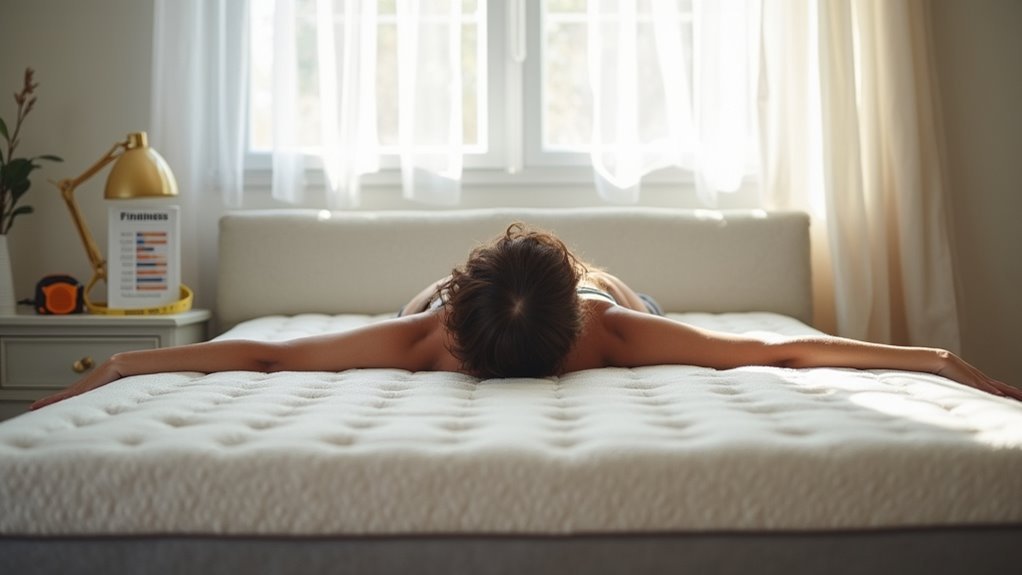
When shopping for a new mattress as a back sleeper, you’ll encounter the firmness scale that ranges from 1 (softest) to 10 (firmest), with your sweet spot typically falling between 6 and 7. This medium-firm range provides the ideal balance you need to maintain your spine’s natural S-curve while you sleep.
The firmness scale helps you understand how a mattress will feel and perform. For back sleepers, a rating around 6.5 delivers excellent support without sacrificing comfort. This level guarantees proper spinal alignment by preventing your midsection from sinking too deeply while still offering pressure relief for your lower back.
Remember that your body weight affects firmness perception. If you’re heavier, you’ll likely need a slightly firmer mattress to achieve adequate support and maintain healthy sleep posture.
Medium-Firm Mattresses: The Sweet Spot for Spinal Alignment
When you sleep on your back, a medium-firm mattress creates the perfect foundation for keeping your spine in its natural alignment throughout the night.
You’ll find that this firmness level prevents your hips from sinking too deeply while still cushioning pressure points along your shoulders and lower back.
This balanced approach means you won’t wake up with the stiffness that comes from a mattress that’s either too soft or too firm for your sleeping position.
Optimal Spine Positioning
Although mattress preferences vary among individuals, back sleepers consistently find their best sleep on medium-firm mattresses rated around 6.5 on the firmness scale.
This firmness level creates excellent spine positioning by maintaining your natural S-curve throughout the night. You’ll experience proper spinal alignment as the mattress supports your body’s contours without allowing excessive sinkage that leads to misalignment.
The medium-firm surface provides adequate pressure relief for your lumbar region while preventing your hips from sinking too deeply. This balance becomes especially important if you weigh under 230 pounds.
- Maintains natural spinal curves during sleep
- Prevents excessive sinkage that causes misalignment
- Reduces lower back pain and discomfort
- Offers ideal support-to-cushioning ratio
- Works best for sleepers under 230 pounds
Pressure Relief Balance
Medium-firm mattresses excel at delivering pressure relief precisely where back sleepers need it most. When you’re lying on your back, your body’s natural curves create pressure points at your shoulders, lower back, and hips. A mattress firmness level around 6.5 provides the perfect balance—enough give to cushion these areas while maintaining support for proper spinal alignment.
| Body Weight | Recommended Firmness | Pressure Relief Level |
|---|---|---|
| Under 130 lbs | 5.5-6.5 | High |
| 130-180 lbs | 6-7 | Ideal |
| 180-230 lbs | 6.5-7.5 | Good |
| 230-280 lbs | 7-8 | Moderate |
| Over 280 lbs | 8-9 | Firm Support |
This sweet spot prevents excessive sinkage that compromises your spine’s S-curve while offering sufficient pressure relief for comfortable sleep throughout the night.
How Body Weight Affects Firmness Perception for Back Sleepers
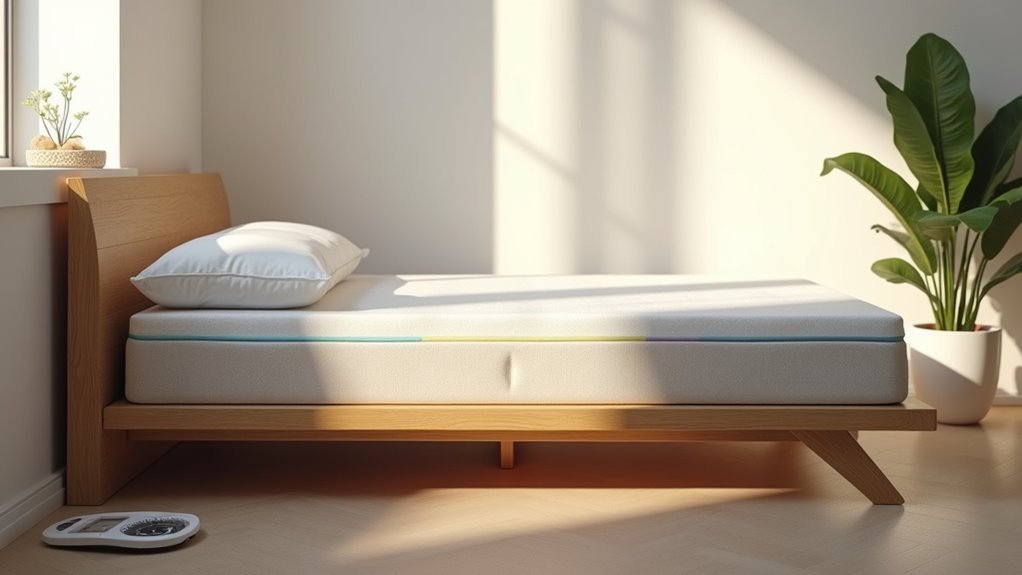
Your body weight considerably influences how firm a mattress feels and how well it supports your spine as a back sleeper.
Lighter sleepers under 130 pounds will find most mattresses feel firmer than advertised, while heavier individuals over 230 pounds experience greater sinkage and may need firmer options.
Understanding how your weight affects both firmness perception and support requirements helps you adjust the standard firmness recommendations to find your ideal comfort level.
Weight Distribution and Support
When you lie down on a mattress, your body weight directly influences how firm or soft it feels, making weight an essential factor in selecting the right firmness level as a back sleeper.
Your weight distribution across the mattress surface determines how much support you’ll receive and affects your spinal alignment throughout the night.
Understanding how your body weight impacts firmness perception helps you choose the ideal mattress:
- Lighter sleepers under 130 pounds need softer surfaces (4-6 firmness) for adequate contouring.
- Average weight sleepers (130-230 pounds) benefit from medium-firm options (5-7 firmness).
- Heavier sleepers over 230 pounds require firmer mattresses (7+ firmness) to prevent excessive sinking.
- Individuals with heavier midsections need extra support to maintain proper spinal alignment.
- Weight affects compression depth, changing how you experience the mattress’s actual firmness rating.
Firmness Scale Adjustments
Although the mattress industry uses a standard 1-10 firmness scale, back sleepers can’t rely solely on these ratings because body weight dramatically alters how firm a mattress actually feels.
Your weight determines how much pressure you’ll apply to the surface, causing the same mattress to feel completely different.
If you’re under 130 pounds, you’ll likely perceive a 6.5-rated mattress as softer than advertised since you won’t compress it as much. Conversely, if you weigh over 230 pounds, that same mattress will feel firmer due to increased compression.
This perception difference can span a full point on the firmness scale.
For back sleepers, understanding these weight-based variations is essential when selecting appropriate firmness levels to maintain proper spinal alignment and support.
Memory Foam Vs Innerspring: Firmness Differences for Back Support
Memory foam and innerspring mattresses deliver distinctly different firmness experiences that directly impact back support.
Memory foam typically feels softer initially, offering deeper body contouring that provides excellent pressure relief. However, if you choose one that’s too soft, you’ll experience excessive sinkage.
Innerspring mattresses feel firmer due to their coil construction, delivering more bounce and support that helps maintain proper spinal alignment.
For ideal back support, you’ll want a medium-firm memory foam mattress (around 6.5 on the firmness scale) to balance comfort and support while maintaining your spine’s natural S-curve.
If you’re heavier, firm mattresses with innerspring construction (7 or higher) provide necessary pushback to prevent sagging.
- Memory foam offers softer initial feel with deeper contouring
- Innerspring provides firmer support through coil construction
- Medium-firm memory foam (6.5) suits most back sleepers
- Firm innerspring (7+) benefits heavier individuals
- Both types prevent spinal misalignment when properly selected
Hybrid Mattresses: Balancing Comfort and Support for Back Sleepers

Hybrid mattresses combine the best features of both memory foam and innerspring designs, creating an ideal sleep surface for back sleepers who want balanced comfort and support.
These mattresses typically offer firmness levels around 6.5, which perfectly maintains your spinal alignment while you sleep.
You’ll find excellent options like the DreamCloud Premier, which provides exceptional cooling and balanced comfort for back sleepers under 230 lbs.
The Leesa Sapira Hybrid delivers medium-firm support with excellent bounce and motion absorption, making it perfect if you share your bed.
Meanwhile, the Saatva Latex Hybrid offers minimal sinkage and high bounce, helping you maintain your spine’s natural S-curve.
The WinkBed EcoCloud combines responsive support with pressure relief, giving you comfort without sacrificing spinal support.
Zoned Support Systems and Their Impact on Back Sleeping Comfort
When you sleep on your back, different parts of your body need varying levels of support to maintain proper spinal alignment. Zoned support systems address this by creating targeted firmness levels across your mattress.
These innovative designs feature softer zones for your shoulders and hips, while maintaining firmer support for your lumbar region.
You’ll benefit from the ideal firmness rating of 6-7 that zoned systems provide through high-density foam or individually wrapped coils. This technology adapts to your body’s natural curves while reducing motion transfer.
- Targeted softness relieves pressure on shoulders and hips
- Enhanced lumbar support maintains proper spinal alignment
- Reduced motion transfer improves sleep quality
- Ideal firmness levels (6-7) achieved through zone variation
- Top-rated mattresses like WinkBed incorporate zoned support technology
Latex Mattresses: Natural Firmness Options for Back Sleepers
You’ll find that natural latex mattresses deliver the ideal medium-firm feel that supports your spine’s natural alignment as a back sleeper.
These mattresses often combine pure latex with hybrid coil systems to enhance both responsiveness and targeted support where you need it most.
When you choose latex, you’re investing in an eco-friendly sleep solution that maintains its firmness for years while keeping you cool throughout the night.
Natural Latex Firmness Benefits
Since natural latex mattresses deliver a medium-firm feel that’s ideally suited for back sleepers, you’ll experience the perfect balance of support and comfort for proper spinal alignment.
The natural elasticity responds to your body’s contours while maintaining consistent support throughout the night.
This firmness level offers several key advantages:
- Responsive pressure relief – The latex’s elasticity adapts to your body while preventing sinking, reducing lower back strain.
- Long-lasting support – Your mattress maintains its ideal firmness level for years, unlike foam alternatives that soften over time.
- Temperature regulation – Natural breathability keeps you cool during sleep, preventing overheating that disrupts rest.
- Allergy protection – Hypoallergenic properties resist dust mites and mold for cleaner sleep.
- Consistent comfort – Natural latex provides uniform support across the entire sleep surface.
Latex Hybrid Support Systems
Latex hybrid mattresses combine the responsive comfort of natural latex with the foundational strength of innerspring coils, creating a perfect support system for back sleepers who need balanced firmness. You’ll experience excellent spinal alignment with these systems, which typically offer medium-firm firmness levels around 6.5. The coils provide targeted support while latex layers deliver pressure relief without excessive sinkage.
| Feature | Benefit for Back Sleepers |
|---|---|
| Medium-firm feel (6.5) | Ideal spinal alignment |
| Minimal sinkage (1.85″) | Maintains lumbar support |
| Weight capacity | Supports 130-230 pounds |
| Airflow design | Cooler sleep temperature |
| Durability | Long-term comfort retention |
These firmness levels guarantee you won’t sink too deeply while maintaining your spine’s natural S-curve throughout the night.
Eco-Friendly Sleep Solutions
When you prioritize both environmental responsibility and ideal spinal support, natural latex mattresses deliver the perfect balance of eco-conscious materials and firm sleeping surfaces.
These eco-friendly mattresses offer medium-firm to firm support and firmness levels (6-9 rating), providing optimal spinal alignment for back sleepers. The responsive latex foam creates a comfortable pushback effect that maintains your natural S-curve without excessive sinking, preventing lower back pain.
You’ll benefit from breathable construction that promotes airflow and temperature regulation throughout the night.
- GOLS and GOTS certifications guarantee chemical-free, healthy sleep environments
- Sustainably sourced materials provide superior durability and longevity
- Natural firmness options maintain proper spinal alignment for back sleepers
- Responsive latex foam prevents excessive body sinking
- Breathable design regulates temperature for comfortable sleep
Adjustable Firmness: Customizing Your Sleep Surface for Back Support
While finding the perfect firmness level can be challenging for back sleepers, adjustable firmness mattresses offer a game-changing solution that lets you customize your sleep surface to achieve ideal spinal alignment. These innovative mattresses feature air chambers or mechanical components that you can adjust to find your best comfort level, typically around 6.5 on the firmness scale for effective back support.
You’ll benefit from targeted pressure relief as these mattresses maintain your spine’s natural S-curve during sleep. Many models include dual-firmness zones, perfect if you’re sharing your bed with a partner who prefers different firmness levels.
| Feature | Traditional Mattress | Adjustable Firmness |
|---|---|---|
| Customization | Fixed firmness | Variable 1-10 scale |
| Partner compatibility | Single firmness | Dual zones available |
| Spine alignment | Limited adjustment | Personalized support |
| Pain relief | Standard support | Targeted relief |
| Longevity | Gradual softening | Maintains adjustability |
Testing Mattress Firmness: What Back Sleepers Should Look For
Although adjustable firmness mattresses provide excellent customization options, you’ll still need to know how to properly evaluate any mattress’s firmness level to confirm it meets your back sleeping needs.
When testing mattress firmness, focus on how well it maintains your spine’s natural S-curve while providing adequate pressure relief. Target firmness levels between 6 and 7, with 6.5 being ideal for most back sleepers.
- Lie on your back and assess lumbar support without excessive sinking.
- Check if your hips and shoulders remain properly aligned.
- Verify the mattress provides adequate pushback to maintain spinal positioning.
- Consider your body weight—heavier individuals typically need firmer support around 7.
- Test for at least 15 minutes to evaluate true comfort and support levels.
Common Firmness Mistakes Back Sleepers Make When Choosing a Mattress
Despite knowing the recommended firmness range, back sleepers frequently make vital errors that compromise their sleep quality and spinal health.
You’re likely choosing a mattress that’s too soft, believing it’ll provide comfort, but this actually creates poor spinal alignment and increases lower back pressure.
Many back sleepers don’t test various firmness options based on their weight—if you’re over 230 pounds, you’ll need firmer support rated 7-10.
You might also ignore responsiveness, selecting a mattress for back sleepers that lacks adequate bounce and causes excessive sinkage.
Additionally, you could overlook cooling features and edge support, missing mattresses with cooling scores above 9 and edge support above 7, which are essential for ideal pressure relief and support.
Frequently Asked Questions
What Is the Best Firmness for a Back Sleeper?
You’ll want a medium-firm mattress rating 6-7 on a 10-point scale. This firmness prevents excessive sinkage while providing proper spinal alignment and lumbar support that back sleepers need for comfortable rest.
What Is the Best Firmness Level for Back Pain?
You’ll find medium-firm mattresses work best for back pain, typically rating 6-7 on firmness scales. They provide essential spinal support while offering enough cushioning to relieve pressure points that often cause discomfort.
Is a Soft or Firm Mattress Better for Back Sleepers?
You’ll find medium-firm mattresses work best as a back sleeper. Soft mattresses cause your spine to sink and misalign, while firm ones create pressure points that’ll disrupt your sleep.
What Mattress Should a Back Sleeper Have?
You should choose a medium-firm mattress rated 6-7 on firmness scales. Hybrid options like DreamCloud Premier or WinkBed work best, combining supportive coils with cushioning foam for proper spinal alignment and comfort.




Leave a Reply