
You’ll notice a distinct chemical smell when you first unpack your new mattress because it’s releasing volatile organic compounds (VOCs) that were trapped during manufacturing and sealed packaging. These compounds include benzene, toluene, and formaldehyde from synthetic foams, adhesives, and fire retardants. Memory foam mattresses typically produce stronger odors due to their synthetic materials and the vacuum-sealing process that concentrates these emissions. Understanding proper ventilation techniques and certification standards can help you minimize exposure and choose safer options.
What Causes Chemical Odors in New Mattresses

When you unbox a new mattress, that distinct chemical smell you notice comes from off-gassing—the emission of volatile organic compounds (VOCs) that become trapped during manufacturing and packaging.
These VOCs include benzene, toluene, chlorofluorocarbons, and formaldehyde, primarily found in foam and adhesive components used during production.
The chemical odor you’re experiencing is most pronounced with synthetic materials.
Synthetic mattress materials produce the strongest chemical odors due to their higher concentration of volatile organic compounds.
Memory foam mattresses typically emit stronger smells compared to natural latex or innerspring alternatives because they contain more synthetic compounds.
During manufacturing, these chemicals get sealed within the mattress materials and compressed packaging.
Once you remove the packaging and your mattress expands, the trapped VOCs release into the air, creating that noticeable off-gassing effect and chemical odor.
Understanding Volatile Organic Compounds in Sleep Products
You’ve likely noticed that chemical smell when unboxing a new mattress, but you mightn’t know it comes from volatile organic compounds (VOCs) – gases released from manufacturing materials like foam, adhesives, and fire retardants.
These compounds include benzene, toluene, formaldehyde, and chlorofluorocarbons that create the distinctive “new mattress” odor during off-gassing.
Understanding what VOCs are and their potential health implications can help you make informed decisions about your sleep environment and know what to expect from your new mattress.
What Are VOCs?
That distinctive “new mattress smell” you notice when unboxing your sleep surface comes from Volatile Organic Compounds, or VOCs—chemical compounds that easily evaporate at room temperature and become airborne.
These chemical odors result from off-gassing, where mattress materials release VOCs into your bedroom air. Common sources include synthetic foams, adhesives, and fire retardants used during manufacturing.
You’ll typically encounter benzene, toluene, formaldehyde, and chlorofluorocarbons among the compounds creating that sharp, chemical scent.
While most VOCs aren’t harmful at low concentrations, they can trigger headaches, nausea, and irritation in sensitive individuals.
Look for certifications like CertiPUR-US and GREENGUARD Gold when shopping—these indicate reduced VOC emissions and safer materials for your sleeping environment.
Health Impact Concerns
How concerned should you be about sleeping on a mattress that’s releasing chemical vapors into your bedroom air?
If you’re experiencing new mattress smell, you’re inhaling volatile organic compounds (VOCs) that can affect your health. These chemicals may cause respiratory issues, headaches, and irritation of your eyes, nose, and throat.
The off-gassing process poses particular risks for sensitive individuals, including children, pregnant women, and those with existing health conditions.
The severity of health issues depends on your exposure level and duration. While most symptoms are temporary and subside as off-gassing decreases, prolonged exposure in poorly ventilated spaces can worsen effects.
You’ll likely notice the strongest odors during the first few days to weeks after unboxing your mattress.
Manufacturing Processes That Contribute to Mattress Emissions
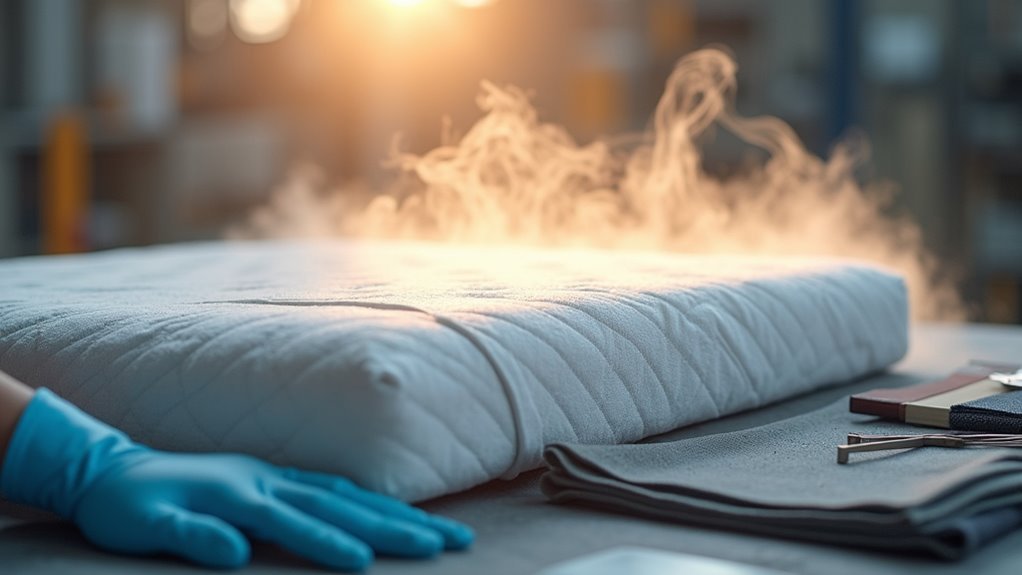
When manufacturers produce mattresses using synthetic foams, they’re incorporating materials that naturally contain volatile organic compounds (VOCs), which become the primary source of those chemical odors you’ll notice after unboxing.
The manufacturing process involves combining foam components with adhesives and chemical agents that enhance durability and performance but also contribute to off-gassing.
Memory foam production specifically requires catalysts and stabilizers that create stronger odors during initial expansion.
When you receive a vacuum-sealed mattress, these synthetic foams have been compressed with trapped VOCs inside the packaging.
Upon opening, the rapid expansion releases concentrated gases all at once, intensifying the chemical odors.
This explains why you’ll experience the strongest smells immediately after unboxing your new mattress.
Common Chemicals Released During Off-Gassing
Several specific volatile organic compounds escape from your new mattress during the off-gassing process, with formaldehyde, toluene, and benzene being among the most common culprits behind those sharp chemical odors.
These volatile organic compounds (VOCs) primarily originate from synthetic materials like memory foam and the adhesives used during manufacturing.
You’ll notice the chemical odor becomes particularly intense when unboxing vacuum-sealed mattresses, as trapped gases release rapidly during foam expansion.
If you’re sensitive to harmful chemicals, these emissions can trigger headaches, nausea, or breathing difficulties.
The concentration of VOCs varies greatly between manufacturers, which is why certifications like CertiPUR-US and GREENGUARD Gold matter—they indicate reduced levels of these problematic compounds in your mattress.
How Packaging and Storage Affect Odor Intensity

When you unbox a vacuum-sealed mattress, you’re releasing concentrated VOCs that’ve been trapped during compression, creating that initial burst of chemical smell.
The longer your mattress sat compressed in storage, the more intense these odors become as volatile compounds accumulate in the sealed environment.
You’ll notice that mattresses stored in hot warehouses or delivery trucks produce stronger smells since heat accelerates the release of chemicals from synthetic materials.
Vacuum-Sealed Packaging Effects
Although all new mattresses contain some level of volatile organic compounds, vacuum-sealed packaging intensifies the chemical odor you’ll encounter when unboxing your mattress.
This packaging method traps volatile organic compounds (VOCs) within the compressed mattress, creating a concentrated buildup of chemical compounds. When you open the sealed package, these trapped VOCs release simultaneously, producing a stronger initial smell than mattresses that aren’t vacuum-packed.
The off-gassing intensity depends largely on your mattress materials. Synthetic foams typically produce more pronounced odors when vacuum-sealed compared to natural materials.
You’ll notice the difference immediately upon unboxing. However, proper ventilation during setup helps dissipate these concentrated odors more effectively. Opening windows and running fans accelerates the process, reducing the chemical odor intensity over time.
Storage Duration Impact
The time your mattress spends in vacuum-sealed packaging directly affects the chemical odor’s strength. Extended storage duration allows volatile organic compounds (VOCs) to accumulate within the sealed environment, creating an intense chemical smell when you finally unbox your mattress.
Without proper ventilation during storage, these compounds can’t escape, leading to concentrated off-gassing once opened.
Here’s what happens during extended storage:
- You’ll face overwhelming odors that can trigger headaches and respiratory irritation
- Your bedroom becomes uninhabitable for days or weeks after delivery
- You can’t sleep comfortably on your expensive investment immediately
- Your family’s health suffers from prolonged exposure to concentrated VOCs
Manufacturers who prioritize proper ventilation during storage help reduce these unpleasant experiences considerably.
Mattress Materials Most Prone to Chemical Emissions
Memory foam mattresses top the list of materials that release the strongest chemical odors when you first unbox them.
These mattresses contain synthetic materials with volatile organic compounds (VOCs) like formaldehyde, benzene, and toluene that create the off-gassing process responsible for chemical odors.
Hybrid mattresses also emit VOCs since they combine foam with innerspring systems, though they typically produce weaker odors than pure memory foam options.
You’ll notice the least problematic emissions from natural latex mattresses, which don’t contain the synthetic chemicals found in foam alternatives.
When you’re shopping, look for VOC certifications like CertiPUR-US or GREENGUARD Gold.
These labels indicate manufacturers have tested their products for low emissions, helping you choose safer mattresses with minimal chemical off-gassing.
Memory Foam Vs Natural Latex Off-Gassing Differences
When you compare memory foam and natural latex side by side, the differences in chemical emissions become immediately apparent.
Memory foam mattresses release stronger chemical odors due to synthetic materials and adhesives containing volatile organic compounds (VOCs) like formaldehyde and toluene.
Natural latex, derived from rubber tree sap, exhibits considerably less off-gassing because it contains fewer synthetic additives.
The timeline differences are striking:
- Memory foam tortures you for weeks – off-gassing can persist from days to several weeks
- Natural latex frees you quickly – odors typically dissipate within 24-72 hours
- Memory foam triggers health symptoms – headaches and nausea from higher VOC content
- Natural latex protects sensitive individuals – less likely to cause irritation
Natural latex mattresses more commonly earn CertiPUR-US and GREENGUARD Gold certifications, ensuring lower chemical emissions.
Health Risks Associated With Mattress Chemical Exposure
When you’re exposed to VOCs from your new mattress, you’ll likely experience immediate symptoms like headaches, nausea, and irritation in your eyes, nose, and throat.
If you continue breathing these chemicals over time, you’re potentially risking more serious health consequences, including organ damage and increased cancer risk from compounds like formaldehyde and toluene.
Your vulnerability to these effects depends largely on your individual sensitivity and whether you’re part of an at-risk group such as children, pregnant women, or those with respiratory conditions.
VOC Exposure Symptoms
Anyone who’s experienced symptoms like headaches, nausea, or eye irritation after sleeping on a new mattress may be reacting to volatile organic compounds (VOCs) released during off-gassing.
These chemical emissions can trigger immediate discomfort, particularly affecting your respiratory system and overall well-being.
Common VOC exposure symptoms include:
- Burning sensations in your eyes, nose, and throat that make sleeping unbearable
- Persistent headaches that worsen throughout the night and into morning hours
- Nausea and dizziness that disrupts your sleep quality and daily functioning
- Respiratory irritation causing coughing, wheezing, or difficulty breathing
If you have asthma or allergies, these symptoms often become more severe.
The intensity typically correlates with your sensitivity level and the duration of exposure to the off-gassing mattress.
Long-Term Health Effects
While immediate symptoms from mattress off-gassing are concerning, prolonged exposure to VOCs poses far more serious health risks that can develop over months or years.
You’re particularly vulnerable if you have existing respiratory conditions, as continuous exposure to volatile organic compounds (VOCs) can worsen asthma and trigger chronic allergic reactions.
Some studies suggest that long-term exposure to formaldehyde and other chemicals may increase cancer risks, especially in sensitive individuals.
Regular contact with low-quality foam that continues off-gassing can lead to persistent respiratory problems and organ damage.
Since long-term health effects aren’t fully understood, you should choose mattresses from reputable mattress manufacturers offering low VOC certifications to minimize these potential risks.
Testing Methods for Measuring Mattress Emissions
To accurately measure mattress emissions, testing professionals employ a dual approach that combines subjective smell assessments with objective scientific measurements.
During smell testing, team members evaluate odor strength immediately after unboxing and monitor how quickly it dissipates over 24 hours. VOC testing uses specialized meters to measure volatile organic compound emissions at set intervals, creating baseline comparisons between mattress models.
Testing protocols that protect your family:
- Controlled environments guarantee unbiased off-gassing results you can trust
- Multiple time intervals reveal how quickly dangerous emissions decrease
- Consistent parameters assure accurate comparisons between mattress types
- Real-world simulation reflects what you’ll actually experience at home
These rigorous testing methods provide valuable insights into emissions performance, helping you make informed decisions about mattress safety.
Duration of Chemical Odor Release in New Mattresses
Most new mattresses release their strongest chemical odors within the first three to seven days after unboxing, though you’ll likely notice the most intense smells disappearing much faster than that.
New mattresses emit their strongest chemical smells during the first week, with the most intense odors fading quickly.
Memory foam and other synthetic materials tend to produce more persistent VOC emissions compared to natural alternatives. If you’ve purchased a vacuum-packed mattress, expect stronger initial odors since trapped gases release rapidly during expansion.
While the most noticeable chemical odor typically fades within days, some off-gassing may continue at lower levels for weeks or months. The duration depends on your mattress’s density and materials.
Many manufacturers now pre-treat their products to reduce initial emissions, but you might still detect faint smells occasionally throughout your mattress’s lifespan, especially with synthetic foam constructions.
Environmental Factors That Influence Off-Gassing
Several environmental factors dramatically affect how quickly your new mattress releases chemical odors and how long those smells linger in your bedroom.
Understanding these conditions helps you minimize off-gassing and create a healthier sleep environment.
Key environmental factors that influence volatile organic compounds (VOCs) release:
- Temperature and humidity levels – Higher temperatures accelerate off-gassing, making your room smell stronger and potentially triggering headaches or respiratory irritation.
- Air circulation quality – Poor airflow traps VOCs, creating a suffocating atmosphere that prolongs your discomfort and delays odor elimination.
- Proper ventilation systems – Open windows and fans dramatically reduce VOC concentration, providing faster relief from chemical smells.
- Sunlight exposure – UV rays naturally break down harmful compounds, offering a chemical-free solution to freshen your sleeping space.
Safety Certifications That Indicate Lower Emissions
You can identify mattresses with lower chemical emissions by looking for specific safety certifications that guarantee rigorous testing standards.
Key foam certifications like CertiPUR-US confirm manufacturers don’t use harmful chemicals, while GREENGUARD Gold and OEKO-TEX STANDARD 100 verify that products meet strict emissions requirements.
These third-party testing standards provide reliable proof that you’re choosing a mattress designed to minimize off-gassing and chemical odors.
Key Foam Certifications
Safety certifications serve as your best defense against mattresses with high chemical emissions. When shopping for foam mattresses, these certifications guarantee reduced VOC levels and minimal off-gassing, protecting your indoor air quality.
Look for these key certifications that’ll give you peace of mind:
- CertiPUR-US – Eliminates formaldehyde, heavy metals, and phthalates from your bedroom sanctuary.
- GREENGUARD Gold – Tests for over 10,000 chemicals, ensuring you’re breathing cleaner air while you sleep.
- STANDARD 100 by OEKO-TEX – Verifies every mattress component is free from health-threatening substances.
- Eco-Institut – Provides independent VOC testing that meets strict environmental standards for your family’s safety.
Choosing certified mattresses dramatically reduces your exposure to harmful chemicals and improves sleep quality by minimizing those unpleasant off-gassing odors.
Third-Party Testing Standards
Third-party testing organizations deliver unbiased evaluations that manufacturers can’t manipulate or influence.
When you’re shopping for a new mattress, certifications to look for include CertiPUR-US, GREENGUARD Gold, and STANDARD 100 by OEKO-TEX. These standards verify that mattresses release fewer volatile organic compounds (VOCs) and reduce off-gassing considerably.
CertiPUR-US guarantees foam doesn’t contain formaldehyde, heavy metals, or phthalates while maintaining low VOC emissions.
GREENGUARD Gold sets even stricter chemical emission limits, making certified products suitable for schools and healthcare facilities.
STANDARD 100 by OEKO-TEX focuses on testing textiles for harmful substances that could contribute to chemical odors.
These independent certifications provide transparency, giving you confidence that your mattress has undergone rigorous testing to minimize chemical emissions and protect indoor air quality.
Effective Techniques for Reducing Mattress Odors
How can you effectively eliminate those unwanted chemical smells from your new mattress? Unwrap your mattress immediately upon delivery to release trapped VOCs faster.
Air out the mattress in a well-ventilated area for three to seven days, allowing off-gassing odors to dissipate naturally.
Here are four proven techniques to accelerate odor elimination:
- Sprinkle baking soda generously across the surface, let it absorb odors for several hours, then vacuum thoroughly.
- Use an air purifier with HEPA filtration to improve indoor air quality and capture lingering chemical particles.
- Sunbathe your mattress outdoors when possible – UV rays break down VOCs and eliminate bacteria naturally.
- Maintain proper ventilation by opening windows and using fans to promote continuous airflow around the mattress.
Choosing Low-Emission Mattresses for Sensitive Individuals
While these odor-reduction techniques help with existing mattresses, you can prevent chemical smells altogether by selecting low-emission mattresses from the start.
Look for certifications like CertiPUR-US or GREENGUARD Gold, which guarantee minimal volatile organic compounds (VOCs) and safer emissions.
Natural latex and hybrid mattresses produce the least off-gassing odors, making them ideal if you’re sensitive to chemical smells.
Avoid high-density foams and synthetic materials that release stronger odors due to production chemicals.
Research specific brands’ chemical compositions and VOC emissions data to make informed decisions.
Choose mattresses using eco-friendly materials and manufacturing processes designed to minimize off-gassing.
These proactive steps guarantee better indoor air quality and reduce health risks from day one.
Frequently Asked Questions
Why Does My Brand New Mattress Smell Like Chemicals?
Your new mattress smells like chemicals because it’s off-gassing volatile organic compounds trapped during manufacturing. These VOCs from synthetic materials and adhesives escape when you unbox it, creating that distinct chemical odor.
Can You Sleep on a Mattress That Is Off-Gassing?
You shouldn’t sleep on a mattress that’s off-gassing. The chemical odors can cause headaches, nausea, and irritation. Wait three to seven days until the smell dissipates before using it.
How to Get Rid of Chemical Smell on a Mattress?
Unwrap your mattress immediately and air it out for 24-72 hours in a well-ventilated room. Sprinkle baking soda on the surface, let it sit, then vacuum. Consider sunlight exposure and air purifiers.
How Long Does a Mattress Offgas?
You’ll typically experience mattress off-gassing for three to seven days, with the strongest odors disappearing within 48 hours. Some mattresses complete off-gassing in one to two days, while others emit faint odors for weeks.




Leave a Reply