
You’ll need 1-3 mg of fast-release melatonin taken 30 minutes before your destination’s bedtime to effectively combat jet lag during international travel. This low dosage works best for eastward flights, while westward travel benefits less from supplementation. Don’t exceed 3 mg, as higher doses won’t improve effectiveness and may cause side effects like drowsiness or headaches. Start your melatonin regimen several days before departure for ideal results, and combine it with strategic light exposure for enhanced circadian rhythm adjustment.
Understanding Melatonin’s Role in Circadian Rhythm Regulation

When you cross multiple time zones, your body’s internal clock struggles to sync with the new environment, but melatonin serves as a powerful reset button for this biological confusion. This hormone naturally signals your brain when it’s time for sleep by responding to darkness and light exposure patterns.
Your circadian rhythm relies on melatonin production from the pineal gland, which communicates with the suprachiasmatic nucleus in your brain. During travel, this system gets disrupted, causing jet lag symptoms like fatigue and sleep disturbances.
Melatonin supplementation helps realign your internal clock to match your destination’s schedule. The key isn’t just taking melatonin—it’s about proper dosage and timing. You’ll need to coordinate when you take it with your intended bedtime to effectively shift your circadian rhythm.
Optimal Melatonin Dosage for Different Time Zone Changes
When crossing multiple time zones, you’ll find that 1-3 mg of melatonin provides ideal benefits without the diminishing returns of higher doses.
Your timing strategy should shift based on whether you’re traveling east or west, with eastward journeys requiring more precise evening dosing to advance your internal clock.
Fast-release melatonin formulations work best since they mimic your body’s natural melatonin surge and help you fall asleep at your destination’s bedtime.
Low Dose Benefits
Although many travelers assume higher doses work better, low-dose melatonin supplements between 1-3 mg prove surprisingly effective for jet lag relief.
Research demonstrates that even 0.5 mg can reset your internal clock as effectively as 5 mg doses, making lower amounts your smartest choice for circadian adjustment.
You’ll experience fewer symptoms while avoiding potential side effects associated with higher dosage levels.
For eastward travel, take your low-dose melatonin 30 minutes before your desired bedtime at your destination. This precise timing helps synchronize your body’s natural rhythms with your new schedule.
Start your melatonin regimen several days before departure when crossing multiple time zones.
Your individual response may vary, so you’ll need to adjust timing and dosage based on your specific travel itinerary and personal sleep patterns.
Timing Zone Adjustments
Your travel direction significantly impacts how you should time your melatonin doses for maximum effectiveness.
When you’re heading eastward across time zones, take melatonin around your destination’s local bedtime, typically between 8 PM and 4 AM. This timing helps advance your circadian clock and reduces jet lag symptoms.
For westward travel, melatonin proves less beneficial, but if you choose to use it, take doses later in the evening to match your delayed bedtime schedule.
Start your melatonin adjustment several days before departure for best results.
Take your 1-3 mg dosage approximately 30 minutes before your intended sleep time. This preparation enhances the supplement’s effective impact on resetting your internal clock, making your shift to new time zones smoother and more comfortable during international travel.
Fast Release Formulations
Since fast-release melatonin formulations work more effectively than slow-release versions for jet lag recovery, you’ll want to stick with the immediate-release options when crossing time zones.
These fast-release supplements help synchronize your internal clock without confusing your circadian rhythms, unlike slow-release versions that can delay sleep onset.
For ideal results, take 1-3 mg of fast-release melatonin thirty minutes before your desired bedtime at your destination. Higher doses above 5 mg won’t provide additional benefits, while some travelers find 0.5 mg equally effective.
The key is finding your personal dosage sweet spot.
Combine your melatonin timing with strategic light exposure for maximum effectiveness. This combination greatly enhances jet lag recovery, helping you adjust faster whether you’re traveling for business or leisure across multiple time zones.
Fast-Release Vs Slow-Release Melatonin Formulations
When choosing melatonin for jet lag, you’ll find that fast-release formulations work better than their slow-release counterparts.
Fast release melatonin formulations provide quick onset sleepiness that’s more effective for circadian rhythm adjustment. Slow release options can actually confuse your circadian clock by prolonging melatonin levels, hindering your body’s natural adaptation to new time zones.
Effective dosages typically range from 1 to 3 mg for jet lag relief. Higher doses over 5 mg won’t provide additional benefits. Quality control varies considerably among products, so choose ‘melatonin-only’ preparations for reliable dosing without extra ingredients.
Proper timing of administration matters fundamentally. Take fast-release melatonin 30 minutes before your desired bedtime at your destination to maximize effectiveness against jet lag symptoms.
Strategic Timing Based on Travel Direction

Travel direction fundamentally determines your melatonin timing strategy for ideal jet lag recovery. Your circadian rhythm responds differently depending on whether you’re flying east or west, requiring distinct approaches to minimize jet lag symptoms.
For effective melatonin timing based on your travel direction:
- Eastward travel: Take melatonin at your destination’s local bedtime to advance the clock and promote sleep readiness. Seek morning light exposure upon arrival to reinforce rhythm adjustment.
- Westward travel: Melatonin offers limited benefits since your body naturally adapts to later bedtimes. Take it shortly before desired sleep time if needed, and aim for evening light exposure to delay the clock.
- General timing: Follow NHS guidelines by taking melatonin between 8 PM and 4 AM at your destination for maximum circadian rhythm effectiveness.
Pre-Travel Preparation and Dosing Schedule
Although timing melatonin correctly during travel is essential, your best results come from preparing your body’s clock before you even board the plane.
Start adjusting your sleep schedule 2-3 days before departure by shifting bedtime one hour earlier for eastward flights or later for westward travel.
Take a low 1-3 mg melatonin dose approximately 30 minutes before your destination’s local bedtime, beginning several days prior to departure.
The Timeshifter app can create personalized dosing schedules based on your specific itinerary and chronotype.
Maintain proper hydration while avoiding caffeine and alcohol near bedtime.
Minimize evening light exposure to enhance melatonin’s effectiveness and help your body naturally adjust to combat jet lag symptoms.
Safety Considerations and Potential Side Effects
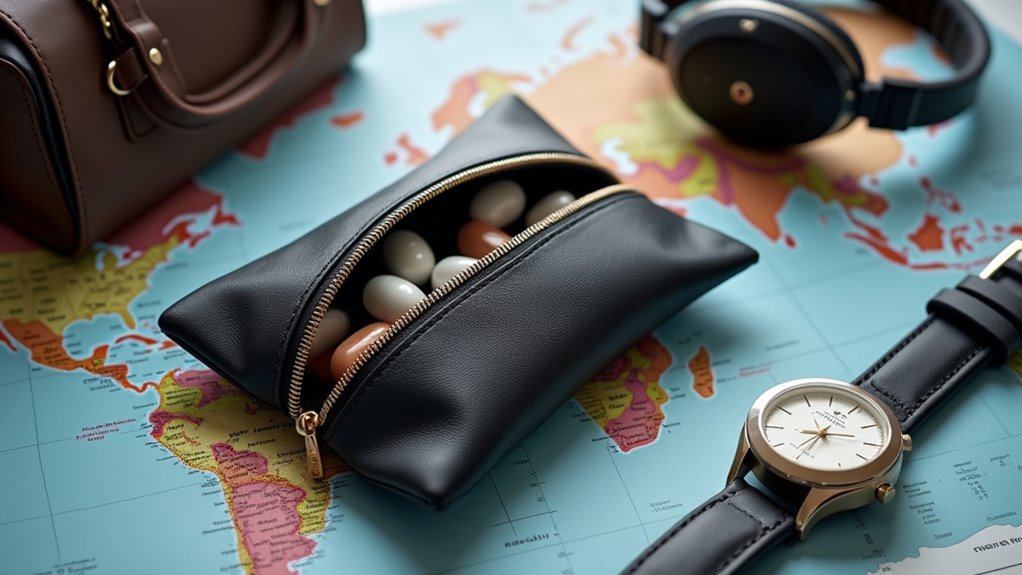
While melatonin offers significant benefits for managing jet lag, you should understand the potential risks before incorporating it into your travel routine. This sleep hormone is generally safe for short-term use, but side effects can occur. Common reactions include daytime drowsiness, headaches, dizziness, nausea, and vivid dreams.
Consider these important safety guidelines:
- Dosage matters – Stick to low doses (1-3mg) as higher amounts don’t improve effectiveness and increase side effects.
- Quality control – Choose melatonin-only products without additional substances to guarantee consistent effects.
- Medical consultation – Consult your healthcare provider if you’re pregnant, breastfeeding, have medical conditions, or take medications.
Older adults typically need lower doses (0.5-1mg) and careful monitoring during use.
Light Exposure Management With Melatonin Use
You’ll maximize melatonin’s effectiveness by strategically timing your light exposure alongside your supplement schedule.
Morning light helps advance your circadian clock for eastward travel, while evening light delays it for westward journeys.
Coordinating these two powerful tools requires understanding when to seek bright light and when to avoid it based on your destination’s time zone.
Optimal Light Timing
Since melatonin’s effectiveness depends heavily on proper light exposure timing, you’ll need to coordinate both elements strategically based on your travel direction.
Your circadian clock responds differently to morning light versus evening light, making timing essential for successful adjustment.
For ideal light timing with melatonin use, follow these essential guidelines:
- Eastward travel: Seek morning light exposure immediately upon arrival while taking melatonin 30 minutes before your desired bedtime at the destination.
- Westward travel: Focus on evening light exposure and delay your melatonin timing accordingly to shift your sleep schedule later.
- Backup strategy: Use portable light therapy devices when natural sunlight isn’t available, especially during winter months or cloudy conditions.
Align your light exposure with local sunrise and sunset patterns to accelerate the adjustment process.
Melatonin Coordination Strategies
Coordination between melatonin timing and light exposure requires precise scheduling to maximize your body’s circadian adjustment.
For eastward travel, take melatonin 30 minutes before your destination’s local bedtime, then seek morning light exposure after arrival to reset your internal clock effectively. This combination helps advance your circadian rhythm and reduces jet lag symptoms.
Westward travelers should focus on evening light exposure rather than melatonin, as it’s less effective for delaying your internal clock. If you do use melatonin for westward travel, combine it with evening light while avoiding morning brightness.
Wrong timing backfires—bright light at inappropriate times actually hinders melatonin’s effectiveness and worsens travel fatigue.
Coordinate both carefully to adjust your circadian rhythm efficiently and minimize jet lag duration.
Morning Versus Evening
Light exposure timing becomes the vital factor that determines whether melatonin will accelerate or sabotage your jet lag recovery. Your travel direction dictates when you should seek or avoid light to optimize your circadian clock adjustment.
For eastward travel, you’ll need:
- Morning light exposure immediately upon arrival to advance your circadian clock
- Melatonin dosage of 1-3 mg taken 30 minutes before your destination’s bedtime
- Evening light avoidance during your first few days to prevent clock confusion
Westward travel requires the opposite approach. You’ll benefit from evening light exposure to delay your circadian clock naturally, while melatonin becomes less essential since you’re adjusting to later bedtimes.
Mistimed light exposure can completely undermine your melatonin’s effectiveness, making proper timing coordination vital for conquering jet lag symptoms efficiently.
Special Considerations for Frequent International Travelers
While occasional travelers can rely on basic melatonin protocols, frequent international travelers need more sophisticated strategies to manage their constantly shifting circadian rhythms.
Start taking low-dose melatonin supplements (1-3mg) several days before departure to pre-adjust your body clock. The Timeshifter app provides personalized timing recommendations based on your travel schedule and individual chronotype, optimizing your melatonin dosage for maximum effectiveness.
Combine melatonin with strategic natural light exposure—morning light is particularly essential when adjusting to new time zones after eastward flights.
Monitor your caffeine and alcohol intake during flights, as both substances can undermine melatonin’s effectiveness.
Keep a detailed sleep diary tracking your sleep patterns and melatonin usage across different trips, helping you identify which strategies work best for reducing jet lag severity.
Combining Melatonin With Other Jet Lag Remedies
Although melatonin effectively promotes sleep during circadian adjustment periods, you’ll achieve faster jet lag recovery by combining it with complementary remedies that work synergistically.
Research shows low doses of melatonin (1-3 mg) paired with behavioral modifications outperform higher doses alone. This holistic approach targets your internal clock more thoroughly.
Low-dose melatonin combined with behavioral changes proves more effective than high doses alone for resetting your internal clock.
Essential combinations for managing jet lag symptoms include:
- Light therapy coordination – Take melatonin 30 minutes before desired bedtime while maximizing bright light exposure in mornings for eastward travel or evenings for westward travel direction.
- Lifestyle adjustments – Focus on adjusting meal times, maintaining hydration, and avoiding alcohol/caffeine near bedtime.
- Pre-flight preparation – Begin sleep schedule modifications before departure to prime your circadian rhythm.
This integrated strategy accelerates adaptation and minimizes disruption duration.
Frequently Asked Questions
Can I Take Melatonin if I’m Pregnant or Breastfeeding?
You shouldn’t take melatonin while pregnant or breastfeeding without consulting your doctor first. There’s limited research on its safety during these periods, so it’s best to discuss alternatives with your healthcare provider.
Will Melatonin Interact With My Prescription Blood Pressure Medication?
You should consult your doctor before combining melatonin with blood pressure medications. Melatonin can potentially lower blood pressure and may interact with certain antihypertensive drugs, creating additive effects.
Can Children Under 12 Safely Use Melatonin for Jet Lag?
Children under 12 shouldn’t use melatonin for jet lag without consulting their pediatrician first. You’ll need professional guidance since dosing and safety aren’t well-established for young children in this situation.
Is It Safe to Drink Alcohol While Taking Melatonin?
You shouldn’t drink alcohol while taking melatonin. Alcohol can worsen melatonin’s sedative effects, causing excessive drowsiness, dizziness, and impaired coordination. This combination increases your risk of falls and accidents considerably.
How Long Should I Stop Taking Melatonin Before Surgery?
You should stop taking melatonin at least one week before surgery. Melatonin can interfere with anesthesia and blood clotting. Always inform your surgeon and anesthesiologist about all supplements you’re taking.




Leave a Reply