
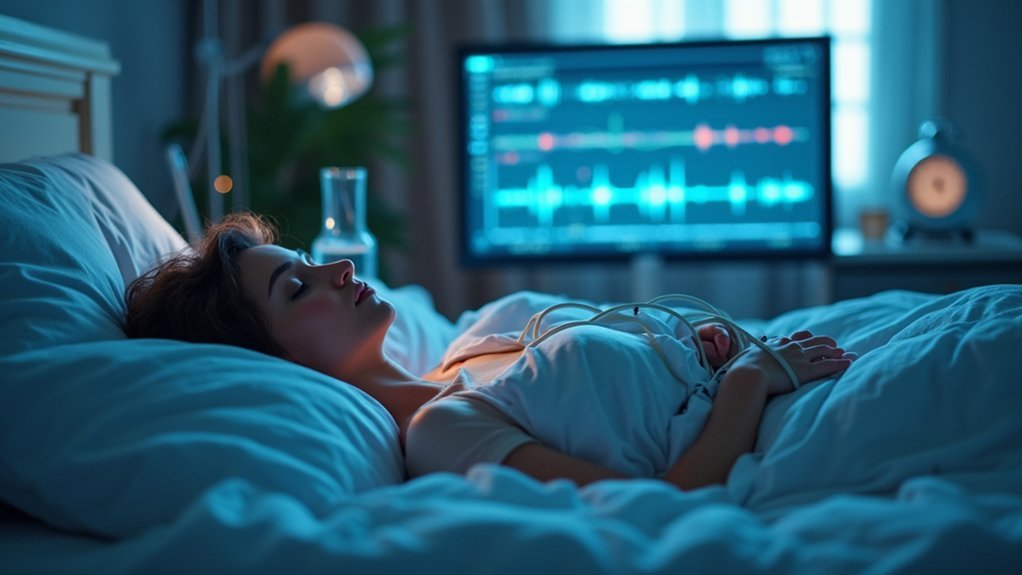
You’ll arrive at the sleep center between 5:30-9:30 pm where technologists will attach small sensors to your scalp, chest, and limbs to monitor brain waves, heart rhythm, and breathing patterns. The comfortable private room includes a bed, bathroom, and TV access while trained staff continuously observe your sleep from a nearby control room. Results become available within two weeks after analyzing roughly 1,000 pages of collected data, and there’s much more to understand about this thorough process.
Understanding the Purpose of Polysomnography Testing

When you’re struggling with persistent sleep issues that affect your daily life, polysomnography testing serves as an essential diagnostic tool that monitors your body’s physiological functions throughout the night.
This thorough sleep study tracks multiple parameters simultaneously, including your brain activity, heart rate, breathing patterns, and blood oxygen levels. Healthcare providers use this monitoring data to diagnose various sleep disorders such as sleep apnea, insomnia, and narcolepsy.
Comprehensive sleep monitoring captures brain waves, heart rhythm, breathing, and oxygen levels to accurately diagnose sleep disorders.
You’ll typically undergo polysomnography testing if you experience symptoms like excessive daytime sleepiness, morning headaches, or difficulty concentrating.
The detailed information collected during your sleep study enables your healthcare provider to identify specific disruptions in your sleep cycles and develop an appropriate treatment plan that’ll greatly improve your overall sleep quality and health outcomes.
When Your Doctor Recommends a Sleep Study
Several specific symptoms and conditions prompt your doctor to recommend a sleep study as the next step in your healthcare journey.
You’ll likely receive this recommendation if you’re experiencing chronic snoring, excessive daytime sleepiness, or frequent breathing interruptions during sleep. These symptoms often indicate sleep apnea, narcolepsy, or other serious disorders requiring professional diagnosis.
Your doctor recognizes that analyzing your sleep patterns through polysomnography provides essential data that simple questionnaires can’t capture. The thorough monitoring reveals how your brain activity, heart rhythm, and oxygen levels fluctuate throughout the night.
Once you complete the study, a sleep specialist analyzes the collected information.
The results of the study typically become available within two weeks, enabling your healthcare team to develop an effective treatment plan tailored to your specific sleep disorder.
Preparing Your Body and Mind for the Test

Since proper preparation greatly impacts your polysomnography results, you’ll need to make several adjustments to your routine before the test.
Preparing your body properly guarantees accurate sleep measurements and reliable data for your doctor’s evaluation.
Follow these essential preparation steps:
- Avoid caffeine and alcohol for at least eight hours before your test to prevent interference with natural sleep patterns.
- Skip naps on the day of your study, as they can disrupt your normal sleep cycle.
- Wash your hair with shampoo only, avoiding conditioners or styling products that prevent sensor adhesion.
- Bring comfortable pajamas and personal items that help you relax during the overnight stay.
- Confirm appointment details and inquire about available meal options.
These preparations help create ideal conditions for accurate sleep monitoring and meaningful results.
What to Bring to the Sleep Laboratory
You’ll need to pack essential personal items like comfortable sleepwear, toiletries, and all your current medications with a complete list for the technician.
Bring entertainment materials such as books or magazines to help you relax before the study begins.
Don’t forget to avoid lotions or creams that might interfere with sensor placement, and check with the lab about available meal options beforehand.
Essential Personal Items
Preparing for your overnight sleep study becomes much easier when you pack the right personal items beforehand. Bringing the right essentials guarantees you’ll feel as comfortable as possible during testing, which helps your sleep study produce more accurate results.
Pack these key items for your stay:
- Comfortable pajamas or sleepwear that won’t restrict movement
- Complete list of medications and supplements, including over-the-counter drugs
- Basic toiletries like toothbrush, toothpaste, and face wash
- Entertainment items such as books, phone charger, or tablet for downtime
- Light snacks and drinks if permitted by your sleep center
You’ll want to confirm dietary restrictions with the facility beforehand.
Having familiar personal items reduces anxiety and creates a more home-like environment, ultimately improving your sleep quality during the study.
Comfort and Entertainment
Beyond the basics you’ll pack, focusing on comfort and entertainment items can make your sleep laboratory experience considerably more pleasant.
Bring comfortable pajamas or sleepwear since personal comfort directly impacts sleep quality during testing. Pack your usual toiletries and other personal items to create a familiar environment in the unfamiliar sleep lab setting.
Consider bringing entertainment materials like books to help pass time while waiting for the study to begin or during breaks. These items can help you relax and feel more at ease.
Upon arrival, inform the staff about any specific needs or concerns you have. Check with the sleep center beforehand about available amenities, such as televisions, which can help you unwind before the study starts.
Arriving at the Sleep Center: Check-In Process

When you arrive at the sleep center, you’ll typically check in between 5:30 pm and 9:30 pm to allow adequate preparation time.
A technologist will greet you, explain the monitoring equipment, and attach sensors to track your heart rate, breathing, and brain activity.
You’ll then have a brief relaxation period to help you adjust to the environment before your sleep study begins.
Arrival Time Guidelines
Since polysomnography requires extensive setup and calibration, you’ll arrive at the sleep center between 5:30 pm and 9:30 pm to allow ample time for preparation before your study begins.
This early arrival at the sleep center assures technologists have sufficient time to prepare for a sleep study and properly configure all monitoring equipment.
Your arrival timeline includes several important steps:
- Complete check-in paperwork and discuss any special needs or concerns
- Meet with your technologist who’ll explain the monitoring your sleep equipment
- Undergo sensor placement to track heart rate and breathing patterns
- Participate in equipment testing to confirm everything functions correctly
- Enjoy a brief relaxation period to acclimate before your sleep study begins
This structured approach guarantees ideal data collection throughout the night.
Equipment Setup Process
After completing your check-in paperwork, a certified sleep technologist will greet you and begin the detailed equipment setup process.
The technologist will carefully apply multiple sensors to your skin, including specialized electrodes that monitor brain activity and patches designed to track your heart rate and movement patterns. This thorough sensor placement guarantees accurate data collection throughout your sleep study.
Before proceeding, the technologist conducts a systematic test to verify all monitoring equipment functions properly. They’ll check connections and confirm sensor placements are secure and positioned correctly.
You’re encouraged to ask questions or voice concerns about the equipment during this setup phase. Once everything’s verified, you’ll have time to relax and adjust to the environment before your sleep study officially begins, creating ideal conditions for natural sleep.
Pre-Sleep Preparation Steps
Most sleep centers schedule your arrival between 5:30 pm and 9:30 pm, giving you ample time to settle in before your study begins.
When you check in, you’ll complete the arrival process and meet your sleep technologist who’ll guide you through the evening.
Your preparation includes several key steps:
- Complete check-in paperwork and discuss any special needs with staff
- Meet your sleep technologist who’ll explain the equipment and procedures
- Have sensors applied to monitor brain activity, heart rate, and breathing
- Conduct equipment testing to verify all devices function properly
- Enjoy relaxation time to help you feel comfortable before sleep
The sleep center staff prioritizes your comfort throughout this process.
Don’t hesitate to voice concerns or questions—they’re experienced in making participants feel at ease during their overnight study.
Meeting Your Sleep Technician and Medical Team
When you arrive for your polysomnography testing, a sleep technician will greet you and walk you through the procedures and equipment you’ll encounter during your study. This professional will explain each step to guarantee you feel comfortable and informed about what’s happening throughout the night.
The medical team, including sleep specialists and technicians, will review your sleep history and discuss any specific concerns before beginning. They’re trained to monitor your sleep patterns and essential signs continuously, keeping you safe and supported during the study.
If you have special needs or concerns, your sleep technician will address them and make necessary accommodations. An intercom system connects you with the medical team throughout the night, making certain assistance is always available when needed.
Sensor Placement and Equipment Setup
Once you’ve met your medical team, the technician will begin applying sensors to various parts of your body to monitor your sleep patterns.
You’ll have electrodes placed on your scalp and face for brain activity, patches on your chest for heart rhythm, and elastic belts around your torso to track breathing.
The setup also includes a small clip on your finger to measure oxygen levels, and while it might seem like a lot of equipment, the process is completely non-invasive and designed to let you sleep as naturally as possible.
Sensor Application Process
Before you settle in for your sleep study, technicians will systematically attach various sensors across your body to capture extensive data about your sleep patterns.
The sensor application process involves careful placement of multiple monitoring devices designed to track different physiological functions throughout the night.
The technicians will apply:
- Small sensors to your scalp and face using medical adhesive for brain wave monitoring
- EKG patches on your chest to record heart rhythm and activity
- Elastic belts around your chest and abdomen to measure respiratory patterns
- Movement sensors on your limbs to detect any restless activity
- A pulse oximeter clipped to your finger or earlobe for oxygen monitoring
This thorough monitoring equipment setup guarantees accurate data collection while maintaining your comfort.
The sensor wires won’t restrict your movement considerably during sleep.
Equipment Function Overview
Although the sensors might look complex at first glance, each device serves a specific purpose in creating a thorough picture of your sleep health. The sensors used monitor various physiological functions simultaneously throughout the night.
Electrodes on your scalp capture brain waves, tracking your sleep stages and detecting any abnormal electrical activity. Chest sensors continuously record your heart rate, identifying irregular rhythms or changes that occur during different sleep phases.
The elastic belts around your chest and abdomen measure respiratory effort, documenting how hard your body works to breathe while you’re asleep. Meanwhile, the finger or earlobe clip tracks blood oxygen saturation levels.
This extensive monitoring system works together to provide sleep specialists with essential data for accurate diagnosis and treatment recommendations.
The Sleep Laboratory Environment and Room Features
When you arrive at a sleep laboratory, you’ll find that the environment has been carefully designed to replicate the comfort of your own bedroom while accommodating the technical requirements of polysomnography testing.
The sleep lab features private sleeping rooms that prioritize your comfort and privacy throughout the night.
Sleep laboratories provide dedicated private rooms designed specifically to ensure patient comfort and maintain personal privacy during overnight testing procedures.
Each room includes essential amenities to guarantee you feel at ease:
- Private bathroom and shower facilities for maintaining personal hygiene
- Comfortable standard beds with quality pillows and bedding
- Television access for pre-study entertainment and relaxation
- Space for personal items you’re encouraged to bring from home
- 24-hour intercom access to trained technicians for immediate assistance
You’ll discover that these thoughtfully designed rooms balance the clinical nature of testing with a welcoming atmosphere that promotes natural sleep patterns.
Monitoring Throughout the Night: What Happens While You Sleep
Once you’re settled and the sensors are attached, continuous surveillance begins as technologists monitor your sleep from a nearby control room throughout the entire night.
They’ll watch real-time data from your brain waves, heart rhythm, breathing patterns, and oxygen levels to guarantee your safety and gather thorough sleep information.
This constant observation allows them to make immediate adjustments if needed and intervene quickly if serious breathing problems occur during your study.
Continuous Sleep Surveillance
While you sleep peacefully in the lab, technicians maintain vigilant watch over your body’s nocturnal activity through an intricate network of sensors.
These specialists monitor your brain waves, heart rate, breathing patterns, and oxygen levels in real-time throughout the entire night. They’re particularly alert for serious conditions like sleep apnea, ready to intervene if your breathing becomes compromised.
The continuous surveillance captures:
- Multiple sleep stages including REM and non-REM cycles
- Real-time oxygen saturation monitoring for breathing irregularities
- Heart rhythm variations throughout different sleep phases
- Movement patterns that might disrupt your rest
- Video documentation of sleep behaviors and potential disorders
This thorough data collection generates approximately 1,000 pages of information.
A sleep medicine specialist later analyzes this extensive dataset to determine if you need treatments like continuous positive airway pressure therapy.
Technologist Real-Time Monitoring
Behind the scenes of this extensive data collection, a trained sleep technologist serves as your dedicated guardian throughout the night.
From a nearby room, they’ll continuously watch your real-time data streaming from sensors attached to your body. Your technologist monitors essential signs including heart rate, breathing patterns, and brain waves, ready to intervene immediately if serious issues like sleep apnea emerge.
A video camera may capture your movements and behaviors, providing valuable context to the physiological data.
If you need bathroom breaks, your technologist will quickly disconnect and reconnect monitoring equipment. Throughout your sleep study, they’ll make certain all sensors function properly and make necessary adjustments to optimize data collection, guaranteeing accurate analysis of your sleep patterns.
Managing Bathroom Breaks and Movement During Testing
During polysomnography testing, you’re not confined to one position throughout the night, and bathroom breaks are always available when needed.
The sensors are specifically designed to accommodate natural movement, allowing you to shift positions comfortably while maintaining accurate monitoring. Technologists remain nearby to assist with any needs that arise during testing.
Your comfort is prioritized through several accommodations:
- Flexible sensor design – Equipment allows natural sleep movement without disrupting data collection
- Immediate bathroom access – Technologists quickly disconnect and reconnect wires when needed
- Position changes encouraged – You can move freely to find comfortable sleeping positions
- Continuous support – Staff monitor from nearby rooms and respond promptly to requests
- Open communication – You’re encouraged to express any discomfort or needs throughout the night
This balanced approach guarantees accurate sleep data while maintaining your natural sleep patterns.
Potential Disruptions and Sleep Quality Concerns
Although polysomnography equipment accommodates movement and comfort needs, you’ll likely experience some sleep disruptions during your study. The sensors and wires attached to your body can feel uncomfortable as you adjust to the unfamiliar equipment and lab environment.
| Disruption Source | Impact on Sleep Quality |
|---|---|
| Sensors and wires | Physical discomfort affecting position |
| Unfamiliar environment | Difficulty falling/staying asleep |
| Technician interventions | Interruptions for adjustments or safety |
| Study anxiety | Reduced restfulness throughout night |
| Environmental factors | Lab setting differs from home |
You might feel anxious about the testing process itself, which can further impact your sleep quality. Technicians may need to wake you for sensor adjustments or if severe breathing issues occur. Despite these potential disruptions, polysomnography remains highly reliable for diagnosing sleep disorders and developing effective treatment plans.
Split-Night Studies and Additional Testing Procedures
Some patients require a split-night study, where your sleep technician can diagnose severe obstructive sleep apnea and begin CPAP therapy treatment within the same testing session.
If apnea’s detected within your first two hours of sleep, you’ll shift to CPAP therapy for the remaining night.
Key aspects of split-night studies include:
Split-night studies provide immediate treatment feedback, require proper medication preparation, and significantly streamline the diagnosis and therapy process.
- You’ll sleep at least four additional hours after CPAP therapy begins
- Immediate feedback on your treatment response enhances diagnosis accuracy
- Proper medication preparation following your physician’s instructions is essential
- Results streamline your treatment process considerably
- Same-night therapy initiation reduces wait times
Some patients may need a Multiple Sleep Latency Test following their overnight study.
This additional testing evaluates conditions like narcolepsy through scheduled nap opportunities throughout the day, providing thorough sleep disorder assessment.
Post-Study Procedures and Leaving the Sleep Center
After your sleep study concludes, you’ll disconnect from monitoring equipment and can prepare to leave the sleep center. You can take your medications as usual unless your doctor specifically advises otherwise.
Don’t expect immediate feedback about your sleep patterns, as results of the sleep study require detailed analysis by a sleep specialist and typically aren’t available for up to two weeks.
You’ll need to schedule a follow-up appointment approximately two weeks after your study to discuss findings and explore potential treatment options.
During this appointment, bring an extensive list of all medications and supplements you’re taking for review. This follow-up visit is essential for understanding your sleep study results and developing an appropriate treatment plan if sleep disorders are identified.
Results Timeline and Follow-Up Appointments
While you might be keen to learn about your sleep patterns immediately, understanding your polysomnography results requires patience as sleep specialists need approximately two weeks to thoroughly analyze the extensive data collected during your study.
Your sleep study generates roughly 1,000 pages of complex data that requires meticulous evaluation:
- Brain wave activity patterns throughout different sleep stages
- Eye movement recordings indicating REM and non-REM cycles
- Breathing patterns and potential respiratory irregularities
- Heart rate variations during sleep shifts
- Movement and position changes throughout the night
A board-certified sleep specialist conducts this detailed analysis before delivering accurate diagnosis and treatment recommendations.
You’ll need to schedule follow-up appointments approximately two weeks post-study to discuss findings. These visits are essential for understanding your results and determining appropriate treatment options based on your specific sleep patterns and any identified disorders.
Frequently Asked Questions
What Not to Do During a Sleep Study?
Don’t consume caffeine or alcohol eight hours before your study, avoid naps that day, skip creams or hair products, and don’t forget to inform technicians about all medications you’re taking.
Can You Go to the Bathroom During a Sleep Study?
Yes, you can go to the bathroom during a sleep study. Simply inform the technologist when you need to go, and they’ll quickly disconnect the necessary wires and reconnect them when you return.
What Makes You Fail a Sleep Study?
You’ll fail a sleep study if you consume caffeine or alcohol beforehand, don’t disclose medications, can’t sleep six hours minimum, or experience severe environmental disruptions affecting data collection.
Do You Wear Clothes During a Sleep Study?
You’ll wear your own comfortable pajamas or sleepwear during a sleep study. Bring loose-fitting clothes that allow sensor attachment and avoid lotions that might interfere with equipment adhesion.




Leave a Reply