

You’ll find that sleep researchers primarily use polysomnography analysis software like SleepSign and Brain Vision Analyzer for thorough data processing, alongside MATLAB’s EEGLAB toolbox and Python libraries such as MNE-Python for EEG signal analysis. Open-source platforms dominate academic studies, utilizing NumPy, pandas, and SciPy for statistical analysis, while commercial solutions like SleepScore and ActiGraph offer advanced pattern recognition and real-time classification. These tools achieve 85%+ accuracy in automated sleep stage scoring, transforming how researchers understand sleep architecture and disorders.
Understanding Sleep Architecture and Its Research Applications
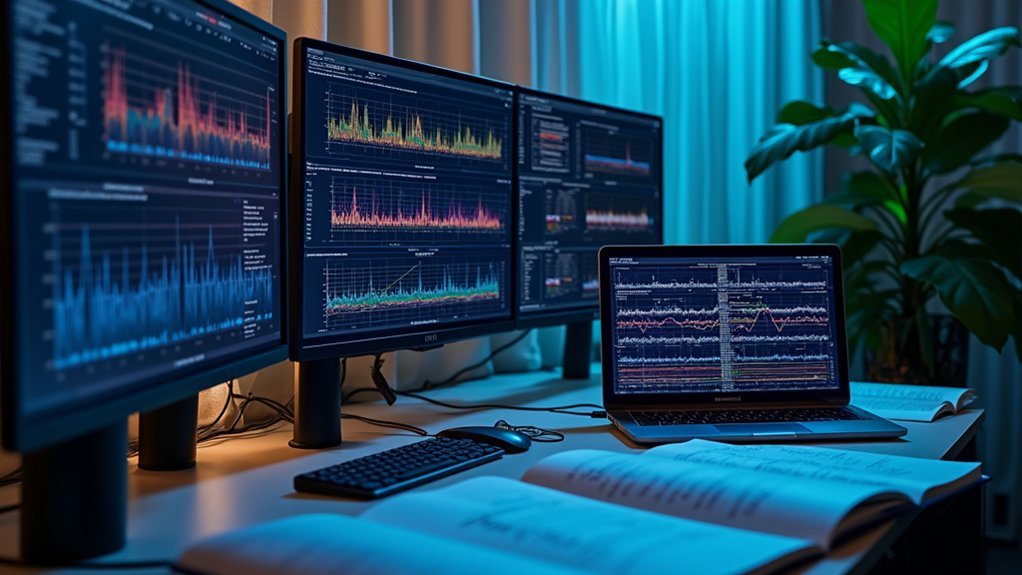
Sleep’s intricate choreography unfolds nightly as your brain cycles through distinct stages that researchers call sleep architecture.
Your brain orchestrates a nightly performance, cycling through carefully choreographed sleep stages that scientists have mapped and named sleep architecture.
You’ll experience 4-6 complete cycles each night, with each lasting roughly 90 minutes and containing both NREM and REM phases. Researchers study these sleep patterns using polysomnography, the gold standard that monitors your brain waves, heart rate, breathing, and oxygen levels throughout the night.
When your sleep architecture becomes disrupted—showing reduced slow-wave sleep or frequent nighttime awakenings—it often signals underlying sleep disorders or mental health conditions.
That’s why researchers rely on sophisticated analysis tools like ActiGraph and SleepScore to decode your sleep data. These software solutions help scientists understand how sleep patterns impact your physical and mental wellbeing.
Key Features Researchers Need in Sleep Analysis Software
When you’re selecting sleep analysis software for research, you’ll need real-time data processing capabilities that can handle continuous streams of physiological information without delays or bottlenecks.
You should prioritize automated pattern recognition features that can identify sleep stages, arousals, and anomalies without requiring constant manual intervention.
Your software must also support multi-channel signal integration to simultaneously analyze EEG, EMG, EOG, and other biosignals for thorough sleep architecture assessment.
Real-Time Data Processing
As sleep research demands increasingly sophisticated analysis capabilities, real-time data processing has become the cornerstone of effective sleep analysis software. You’ll need software architecture tools that handle multiple sensor inputs simultaneously, processing EEG, heart rate, and movement data instantly. Advanced algorithms enable immediate identification of sleep disorders as they occur, while design and analysis components create thorough assessments of sleep stages. Visualization tools present real-time metrics through intuitive diagrams and models, helping you understand sleep dynamics immediately.
| Processing Capability | Research Impact |
|---|---|
| Instant disorder detection | Saves lives through early intervention |
| Multi-sensor integration | Prevents misdiagnosis |
| Real-time visualization | Reduces researcher frustration |
| Mobile device compatibility | Enables breakthrough discoveries |
Integration with wearables facilitates continuous monitoring, providing immediate insights into sleep health patterns.
Automated Pattern Recognition
Building on real-time processing capabilities, automated pattern recognition transforms raw sleep data into meaningful insights that researchers can act upon immediately.
This software architecture analyzes polysomnography data through sophisticated algorithms that identify sleep stages and detect abnormalities with remarkable precision. The design incorporates machine learning techniques that continuously improve accuracy while adapting to new datasets over time.
You’ll find these tools essential for handling complex pattern classification tasks that would be impossible to perform manually.
The software’s architecture guarantees seamless integration with various data sources, from wearable devices to clinical studies. This thorough design allows you to cross-validate results effectively while maintaining the high accuracy standards required for sleep research.
The automated approach eliminates human error and provides consistent, reliable pattern identification across all your sleep analysis projects.
Multi-Channel Signal Integration
While automated pattern recognition provides the foundation for accurate sleep analysis, multi-channel signal integration represents the cornerstone technology that enables extensive sleep research.
You’ll need software that simultaneously processes EEG, EOG, and EMG signals, giving you a detailed view of sleep patterns and disturbances.
Real-time data processing capabilities are essential for capturing transient sleep events and accurately classifying sleep stages. You can’t afford to miss critical moments that occur during brief shifts between sleep phases.
Effective visualization tools enhance your interpretation of complex multi-channel data through custom plots and graphs that highlight significant characteristics and anomalies.
Additionally, robust artifact detection algorithms guarantee environmental noise and movement artifacts don’t compromise your analysis accuracy, maintaining data integrity throughout your research.
Polysomnography Data Processing and Visualization Tools
When you’re analyzing sleep data from polysomnography studies, specialized processing and visualization tools become essential for transforming raw physiological signals into meaningful clinical insights.
You’ll find that data analysis software like SleepSign offers advanced features for monitoring sleep stages, respiratory events, and movement patterns. These platforms incorporate automatic scoring algorithms that enhance both efficiency and accuracy in your sleep study interpretations.
For creating detailed visualizations of your sleep metrics, you can utilize MATLAB or Python libraries such as Matplotlib to generate extensive graphs and plots. These visualization tools help you interpret complex polysomnography data more effectively.
Many researchers also integrate ActiGraph devices with their polysomnography setups, allowing you to correlate physical activity levels with sleep quality for more extensive assessments.
Automated Sleep Stage Scoring and Classification Systems

You’ll find that signal processing architectures form the backbone of automated sleep stage scoring systems, transforming raw polysomnographic data into meaningful patterns for classification.
Your machine learning models then analyze these processed signals using deep learning techniques like CNNs to accurately distinguish between sleep stages with remarkable precision.
When you implement real-time classification systems, you’re enabling continuous monitoring that can instantly categorize sleep stages and provide immediate clinical insights.
Signal Processing Architectures
As sleep medicine advances toward more precise diagnostic capabilities, automated sleep stage scoring systems represent a significant leap forward in signal processing architecture design.
You’ll find these systems leverage sophisticated software architectures that integrate wavelet transforms and Fourier analysis to extract meaningful features from raw EEG data.
When modernizing legacy sleep analysis platforms, developers implement machine learning algorithms trained on extensive annotated datasets to enhance classification accuracy.
The signal processing frameworks you encounter utilize deep learning approaches that generalize effectively across diverse populations.
Real-time code generation capabilities guarantee immediate feedback on sleep patterns, enabling timely clinical interventions.
These robust architectures process complex brain activity signals while maintaining high-performance standards essential for accurate sleep stage differentiation and disorder diagnosis.
Machine Learning Models
The core computational engines driving these advanced signal processing architectures rely on sophisticated machine learning models that transform raw polysomnography data into accurate sleep stage classifications.
Software architects can leverage convolutional neural networks and recurrent neural networks to analyze complex EEG, EOG, and EMG signal patterns, achieving classification accuracies exceeding 85% across REM, NREM, and awake states.
Your design decisions should incorporate feature extraction techniques like wavelet transforms and spectrogram analysis to enhance model performance.
Best practices include utilizing large annotated datasets such as Sleep-EDF for robust training and validation.
When modeling and diagramming these systems, you’ll find that automated scoring markedly reduces manual analysis time while enabling large-scale sleep disorder studies and pattern recognition research.
Real-Time Classification Systems
While traditional sleep analysis requires hours of manual scoring by trained technicians, real-time classification systems transform this paradigm by delivering automated sleep stage identification within seconds of data acquisition.
You’ll find these real-time systems leverage machine learning algorithms to analyze EEG signals, heart rate variability, and movement patterns for accurate REM, NREM, and wakefulness classification.
For software development, you can utilize Python libraries like TensorFlow and Keras alongside MATLAB platforms to build robust classification models.
These tools help researchers achieve correlation coefficients above 0.85 when validated against expert manual scoring.
EEG Signal Analysis Software for Sleep Research
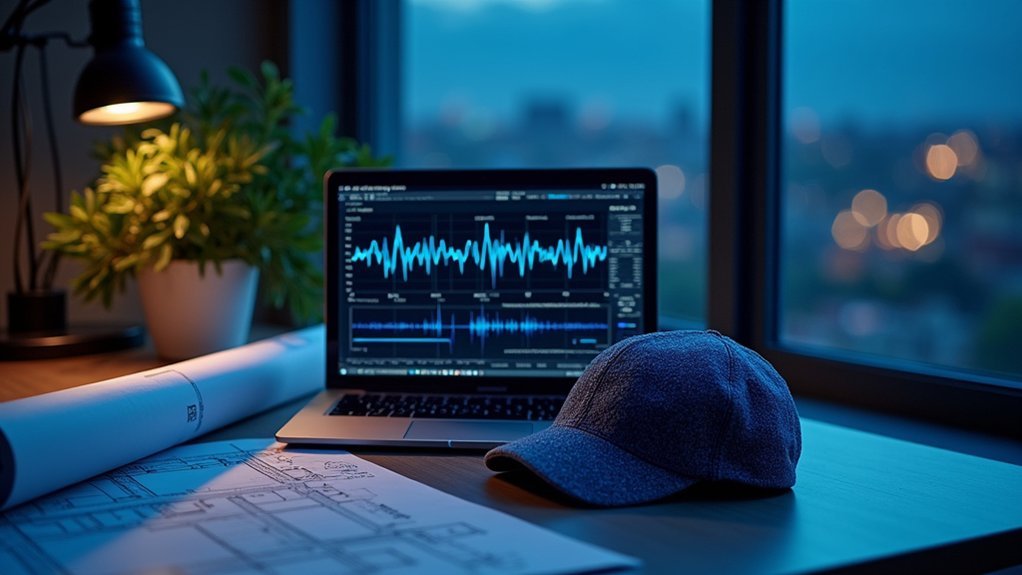
When researchers plunge into sleep studies, they rely heavily on EEG signal analysis software to decode the complex brain wave patterns that reveal sleep stages and identify disorders like insomnia and sleep apnea.
Your research focuses will determine which tools you’ll use most effectively. MATLAB with EEGLAB toolbox offers advanced data processing and visualization capabilities.
Brain Vision Analyzer provides user-friendly interfaces with thorough artifact rejection features. If you prefer open source solutions, OpenViBE enables real-time processing during sleep phases, while MNE-Python delivers powerful automation workflows.
These platforms facilitate collaboration and documentation across research teams, allowing you to share findings efficiently. Each software package brings unique strengths to sleep architecture analysis.
Open Source Solutions for Academic Sleep Studies
Building on specialized EEG platforms, academic researchers often turn to open-source alternatives that offer greater flexibility and cost-effectiveness for sleep studies.
You’ll find Python and R dominating these software systems, with libraries like NumPy, pandas, SciPy, and Statsmodels providing extensive statistical analysis capabilities. OpenSignals serves as your primary diagramming tool for physiological data collection and visualization, while LibreOffice Calc and Gnumeric handle spreadsheet-based preliminary assessments.
When you’re working within enterprise architecture frameworks, these tools integrate seamlessly with cloud platforms, allowing collaborative research across institutions.
Python’s Matplotlib and Seaborn enable you to create publication-ready visualizations that effectively communicate findings.
You’ll appreciate how these open-source solutions eliminate licensing costs while providing the analytical depth necessary for rigorous sleep research, making them ideal for budget-conscious academic environments.
Commercial Sleep Analysis Platforms Used in Research
Several commercial sleep analysis platforms have revolutionized how you’ll conduct research by offering sophisticated monitoring capabilities that surpass traditional laboratory setups.
SleepScore represents one of the best tools available, utilizing non-contact technology with cloud architecture design to deliver personalized insights from user data.
SleepScore delivers cutting-edge non-contact monitoring with cloud-based analytics, providing researchers with personalized sleep insights that transform traditional study methodologies.
ActiGraph’s wearable monitors enable precise sleep duration and quality measurements across clinical and field studies.
Though discontinued, Zeo Sleep Manager provided detailed EEG-based sleep stage analysis that many researchers valued.
Embletta Gold facilitates large-scale studies through portable polysomnography in home settings.
These systems allow users to work efficiently by collecting extensive data that you’ll analyze using statistical software like SPSS or R, identifying essential sleep patterns and health correlations.
Integration With Wearable Devices and Mobile Health Technologies
As wearable devices and mobile health technologies continue advancing, you’ll find that architecture analysis software has become crucial for evaluating how these systems integrate with existing healthcare infrastructures. You can use these tools to assess interoperability between different devices and applications, ensuring seamless data transfer across platforms.
The software enables you to aggregate real-time health data from multiple sources, including essential signs and activity metrics, creating thorough user health profiles.
When you’re developing predictive health models, architecture analysis helps identify patterns in collected data. You’ll also discover these tools support designing user-centric applications that prioritize security and accessibility.
Frequently Asked Questions
What Software Do Researchers Use?
You’ll find researchers using AutoCAD, SketchUp, Revit, and Archicad for architectural drawing. They also rely on NVivo for qualitative analysis, Adobe Photoshop for image editing, and specialized GIS systems for building design data.
What Software Do Most Architects Use?
You’ll primarily use AutoCAD, Revit, and SketchUp for design and drafting. You’ll also work with Archicad for BIM modeling, Rhino for complex geometries, and Adobe Creative Suite for presentations and visualizations.
What Is Software Architecture Analysis?
You’ll analyze your software’s design and structure to identify vulnerabilities, performance issues, and compliance gaps. You’re evaluating how well your architecture meets functional requirements while examining scalability, maintainability, and security throughout development.
What Are the Three Types of Software Architecture?
You’ll encounter three main software architecture types: monolithic architecture, where all components are interconnected; microservices architecture, using loosely coupled services; and serverless architecture, which eliminates server management responsibilities.




Leave a Reply