

You’ll calculate your Sleep Fragmentation Index by dividing your total number of awakenings and arousals by your total sleep time in hours. For example, if you experience 30 disruptions during 6 hours of sleep, your SFI would be 5.0. Normal values stay below 5, while scores above 20 indicate severe fragmentation that can affect your daily functioning. Track this data over multiple nights using sleep monitoring devices for the most accurate assessment and discover extensive strategies to optimize your results.
Understanding Sleep Fragmentation Index and Its Role in Sleep Quality

When you’re trying to understand the quality of your sleep, the Sleep Fragmentation Index (SFI) serves as an essential measurement tool that reveals how often your sleep gets interrupted throughout the night.
Your SFI calculates the number of awakenings and arousals per hour of sleep, giving you a clear picture of your sleep quality. You’ll find that normal SFI values stay below 5, while anything above this threshold indicates sleep disruption.
If your SFI reaches 20 or higher, you’re experiencing severe fragmentation. Elevated SFI connects to sleep disorders like sleep apnea and insomnia, which can cause daytime fatigue and cognitive decline.
With Ametris Support and proper monitoring, you can identify disruption patterns and implement targeted interventions.
Essential Data Collection Methods for Accurate SFI Measurement
Understanding your SFI’s significance naturally leads to the question of how you’ll gather the reliable data needed for accurate calculations.
You’ll need precise information about awakenings and arousals during sleep to compute your fragmentation index effectively.
The most reliable approach combines multiple data collection methods:
- Objective monitoring devices – Accelerometers and actigraphy units track your movements throughout the night, helping distinguish between sleep and wake states while measuring total sleep time.
- Sleep diaries – Document your perceived awakenings and disturbances to supplement objective measurements and provide context for unusual patterns.
- Multi-night data collection – Gather information across several nights to account for natural variations in your sleep patterns and guarantee thorough assessment.
This multi-faceted approach guarantees you’re capturing accurate, representative data for meaningful SFI calculations.
Step-by-Step Mathematical Formula for Sleep Fragmentation Index

Once you’ve collected your sleep data, calculating your Sleep Fragmentation Index becomes straightforward with a simple mathematical formula.
With your sleep data in hand, the Sleep Fragmentation Index calculation follows a straightforward mathematical approach that anyone can master.
You’ll use this equation: SFI = Number of awakenings and arousals ÷ Total sleep time in hours.
Here’s how you’ll calculate it step-by-step:
First, count all your awakenings and arousals throughout the night. Include brief awakenings you mightn’t fully remember and micro-arousals detected during sleep studies.
Next, determine your total sleep time in hours. Convert minutes to decimal format—for example, 7 hours and 30 minutes becomes 7.5 hours.
Finally, divide your total disruptions by sleep hours. If you’d 30 disruptions during 6 hours of sleep, your SFI would be 5.0, indicating borderline sleep fragmentation requiring attention.
Tracking Sleep Awakenings and Arousal Episodes Effectively
Accurate tracking forms the foundation of meaningful Sleep Fragmentation Index calculations, and you’ll need reliable methods to capture every awakening and arousal episode throughout your night.
Start by maintaining a detailed sleep diary where you record each time you wake up, noting the approximate duration and cause. This manual approach helps you become more aware of your sleep patterns.
For enhanced precision, consider these tracking strategies:
- Use wearable devices to automatically monitor heart rate changes, movement patterns, and sleep stage shifts that indicate awakenings
- Track multiple nights consistently to establish reliable patterns rather than relying on single-night data
- Note environmental factors like room temperature, noise levels, or stress that might contribute to fragmentation
Combining manual recording with technology provides the most thorough data for accurate index calculations.
Interpreting Your Sleep Fragmentation Index Results
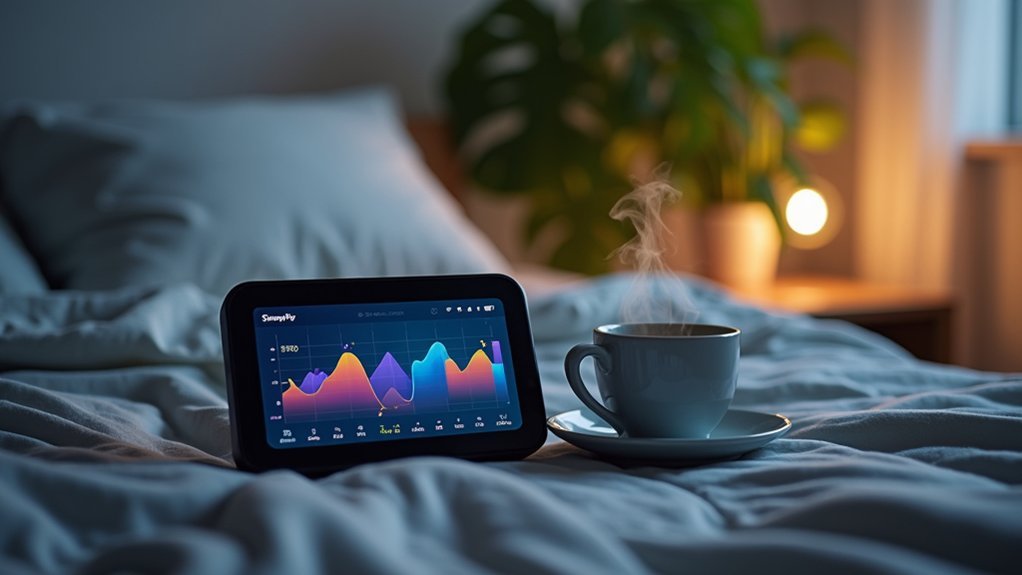
Your Sleep Fragmentation Index number tells a story about your sleep quality that goes beyond simple duration.
If you’ve calculated an SFI below 5, you’re experiencing normal sleep patterns with minimal disruptions. Values between 5 and 20 indicate varying degrees of fragmentation – the higher the number, the more frequently your sleep’s being interrupted.
An SFI of 20 or greater signals severe disruption that’s likely affecting your daily life.
Pay attention to how your SFI correlates with your daytime experience. Higher values often mean you’ll feel more fatigued and notice cognitive difficulties, even after spending adequate time in bed.
Your SFI can also reveal underlying sleep disorders like sleep apnea or insomnia, making it a valuable diagnostic tool for targeted treatment approaches.
Normal vs. Elevated SFI Values and Their Health Implications
Understanding where your SFI falls within established ranges helps you gauge whether your sleep patterns warrant concern or intervention.
Normal SFI values below 5 indicate excellent sleep quality with minimal disruptions. When your SFI climbs between 5-10, you’re experiencing mild fragmentation that’s still acceptable.
However, moderate values of 10-20 signal significant awakenings that can affect your daytime performance and cognitive function.
Severely elevated SFI values above 20 demand immediate attention, as they often indicate serious sleep disorders like sleep apnea or chronic insomnia.
These frequent interruptions can lead to:
- Cognitive decline affecting memory and decision-making abilities
- Chronic daytime fatigue impacting work and personal relationships
- Increased health risks including cardiovascular problems and weakened immunity
Regular SFI monitoring enables early detection and targeted treatment strategies.
Technology Tools and Devices for Monitoring Sleep Fragmentation
Modern sleep tracking technology has revolutionized how you can monitor and analyze your sleep fragmentation patterns from the comfort of your home.
Today’s advanced sleep monitoring devices empower you to track and understand your nighttime sleep disruptions without leaving your bedroom.
Wearable devices like fitness trackers, smartwatches, Oura Rings, and Fitbits use built-in accelerometers to detect movement and calculate your Sleep Fragmentation Index by tracking nighttime awakenings and arousals. These devices provide detailed insights into your sleep disturbances over time.
You can also leverage smartphone apps that utilize your phone’s sensors and sophisticated algorithms to analyze sleep data and visualize fragmentation patterns.
For thorough analysis, sleep clinics employ advanced polysomnography devices that capture detailed sleep architecture data essential for diagnosing disorders.
Smart home technology, including intelligent mattresses and monitoring systems, automatically adjusts environmental conditions like temperature and firmness when detecting fragmentation, actively improving your sleep quality.
Strategies to Reduce Sleep Fragmentation and Improve SFI Scores
You’ll want to focus on two key areas to improve your Sleep Fragmentation Index scores: optimizing your sleep environment and monitoring your daily activity patterns.
Your bedroom setup directly impacts how often you wake during the night, while your daytime habits influence your body’s natural sleep-wake cycle.
Optimize Sleep Environment
While calculating your Sleep Fragmentation Index provides valuable insight into your sleep quality, implementing targeted environmental changes can dramatically improve your SFI scores.
Your bedroom’s conditions directly impact how often you wake during the night, affecting your overall sleep continuity.
Creating the ideal sleep sanctuary requires attention to three critical factors:
- Temperature control: Keep your room between 60-67°F to prevent heat-related awakenings.
- Light elimination: Use blackout curtains or eye masks to block disruptive light sources.
- Noise reduction: Employ earplugs, white noise machines, or soundproofing to minimize disturbances.
You’ll also want to invest in quality sleep surfaces.
A supportive mattress and pillows tailored to your sleep position prevent discomfort that causes frequent position changes and awakenings, directly lowering your SFI score.
Monitor Activity Patterns
Beyond creating the perfect sleep environment, tracking your daily activity patterns reveals powerful insights into what’s disrupting your sleep and driving up your SFI scores.
You’ll want to utilize accelerometers to monitor your movement patterns throughout both day and night. These devices provide valuable data on activity levels and rest periods, helping you assess and improve sleep fragmentation.
Regular physical activity during the day considerably improves sleep quality and reduces your Sleep Fragmentation Index by promoting deeper sleep cycles.
However, timing matters. You’ll also need to track your screen exposure and limit blue light at least an hour before bedtime to enhance melatonin production.
Optimizing Sleep Environment to Minimize Fragmentation Patterns
You can dramatically reduce your fragmentation index by controlling two critical environmental factors in your bedroom.
Managing light exposure through blackout curtains or eye masks prevents circadian rhythm disruption that leads to frequent awakenings throughout the night.
Maintaining your room temperature between 60-67°F creates ideal conditions for deeper sleep stages and fewer interruptions.
Light Exposure Control
Since light exposure acts as your body’s primary timekeeper, controlling it strategically can dramatically reduce your Sleep Fragmentation Index.
You’ll want to maximize bright light during the day to promote alertness, then minimize blue light exposure from screens in the evening to enhance melatonin production.
Create an ideal light schedule with these key strategies:
- Maximize daytime brightness – Seek natural sunlight or bright artificial light during morning and afternoon hours to reinforce your circadian rhythm.
- Eliminate evening blue light – Use blue light filters on devices or avoid screens entirely 2-3 hours before bedtime.
- Establish darkness at night – Install blackout curtains and use dim, warm lighting to signal your body it’s time to wind down.
This consistent approach helps regulate your sleep-wake cycles and reduces nighttime awakenings.
Temperature Regulation Methods
Temperature control works hand-in-hand with light management to create the perfect sleep environment for reducing fragmentation.
You’ll want to maintain your bedroom between 60-67°F (15-19°C) for ideal sleep quality. This cooler range naturally reduces nighttime awakenings and promotes deeper rest.
Switch to breathable bedding materials like cotton or bamboo sheets. These fabrics allow moisture and heat to escape, preventing the temperature spikes that cause sleep disruption.
You’ll notice fewer fragmented sleep patterns when your body can regulate temperature naturally.
Install blackout curtains to support stable sleep temperatures while blocking light intrusion. Use a fan or air conditioner for improved air circulation and white noise masking.
Don’t forget to adjust your thermostat before bedtime consistently—this simple habit greatly decreases fragmentation and enhances restorative sleep.
Frequently Asked Questions
How to Calculate Sleep Fragmentation Index?
You’ll calculate your sleep fragmentation index by dividing your total number of awakenings and arousals during sleep by your total sleep time in hours. Higher values indicate more fragmented, poorer quality sleep.
How to Calculate Fragmentation Index?
You’ll calculate fragmentation index by dividing your total number of awakenings and arousals during sleep by your total sleep time in hours. Higher values indicate more disrupted, poorer quality sleep.
How Do You Find the Index Fragmentation Status?
You’ll find index fragmentation status by querying SQL Server’s sys.dm_db_index_physical_stats DMV. This returns fragmentation percentages for each index, helping you identify which indexes need rebuilding or reorganizing based on performance thresholds.
How to Calculate Total Fragmentation?
You’ll calculate total fragmentation by counting all awakenings and arousals during sleep, then dividing by your total sleep time in hours. This gives you the Sleep Fragmentation Index for evaluating sleep quality.




Leave a Reply