

Your sleeping position directly affects how gravity and your body weight compress the twenty-three intervertebral discs in your spine throughout the night. When you sleep on your stomach, you’re flattening your spine’s natural curves and creating uneven pressure distribution that squashes these shock-absorbing cushions. Side and back sleeping maintain better spinal alignment, but without proper pillow and mattress support, you’ll still experience harmful compression that leads to morning stiffness and long-term disc damage. Understanding ideal positioning techniques can transform your spine’s nightly recovery.
Understanding Spinal Disc Anatomy and Function

Your spine depends on twenty-three intervertebral discs that function as shock absorbers between your vertebrae. These spinal discs contain two distinct components: a tough outer ring called the annulus fibrosus and a gel-like inner core known as the nucleus pulposus that provides essential cushioning. This structure allows your spine to maintain flexibility while supporting your body weight.
Since spinal discs lack direct blood supply, they’re vulnerable to degeneration over time. As you age, your discs lose hydration and elasticity, reducing disc height and increasing compression risks.
Poor spinal alignment can lead to herniation, where disc material bulges outward and potentially compresses nearby nerves. This compression causes pain and limits mobility, making proper disc health vital for your overall spinal function.
How Gravity and Body Weight Affect Your Spine During Sleep
When you’re sleeping, gravity doesn’t take a break—it continuously pulls your body downward, creating constant pressure on your spine throughout the night.
Your body weight becomes a significant factor in this process, as every pound adds to the compressive forces acting on your spinal discs.
The way this weight gets distributed across your spine depends entirely on how you position yourself, making your sleeping posture essential for spinal health.
Gravity’s Constant Downward Pull
Even while you’re fast asleep, gravity relentlessly pulls your body downward, creating continuous pressure on your spinal discs that can greatly impact your long-term back health.
Your spine experiences approximately 48.5 pounds of pressure when lying on your back, and this constant force compresses your discs throughout the night. Without proper spinal alignment, your body weight creates uneven distribution that can accelerate disc degeneration.
Key effects of gravity’s downward pull include:
- Continuous compression of spinal discs during sleep
- Increased discomfort from unsupported natural curvature
- Risk of long-term damage from poor sleeping positions
- Uneven pressure distribution when spine alignment is compromised
- Greater strain without appropriate mattress support
Understanding gravity’s impact helps you make informed decisions about your sleep setup.
Weight Distribution While Lying
Something remarkable happens the moment you settle into bed—your body weight begins redistributing across your spine in ways that can either promote healing or create lasting damage.
Your sleeping position determines where this weight concentrates, creating varying pressure patterns on your spinal discs.
Back sleepers experience approximately 22 kilograms of pressure directly on their spine, while side sleepers distribute weight across hips and shoulders.
This weight distribution notably impacts existing conditions like herniated discs and back pain. Without proper mattress support, gravity amplifies spinal compression throughout the night, potentially causing discomfort and worsening disc problems.
Maintaining neutral alignment becomes essential for minimizing harmful pressure on your spinal discs and preventing long-term damage during sleep.
Stomach Sleeping: The Worst Position for Disc Compression
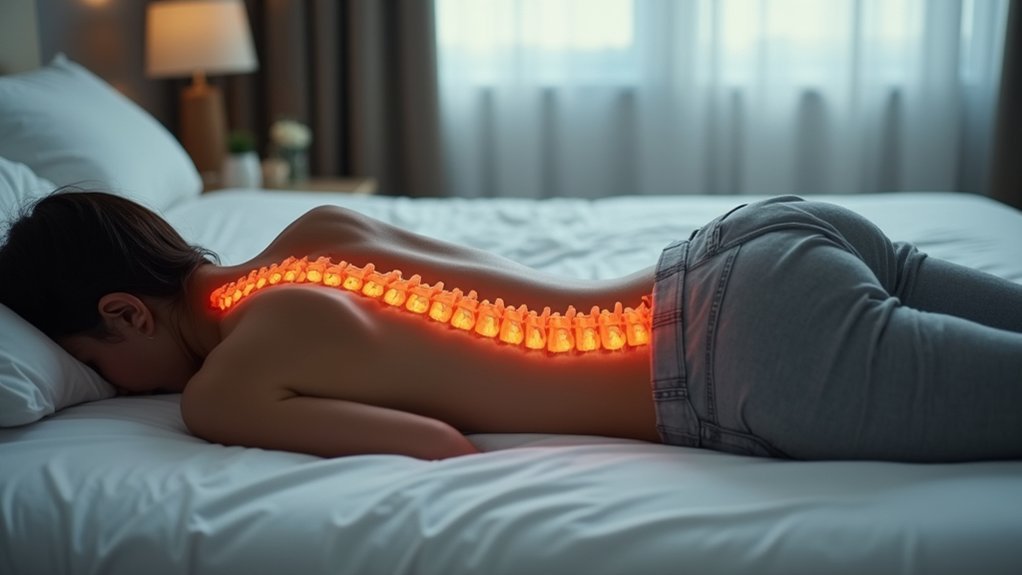
When you sleep on your stomach, you’re forcing your spine into an unnatural position that flattens its healthy curves.
This flattening creates concentrated pressure points along your spinal discs, particularly in your lower back where the natural lumbar curve gets compressed.
You’ll find that this position makes it nearly impossible to maintain proper spinal alignment, setting you up for disc-related pain and potential injury.
Flattens Natural Spine Curve
Stomach sleeping fundamentally disrupts your spine’s natural S-shaped curve, forcing it into an unnaturally flat position that considerably increases pressure on your spinal discs.
When you’re sleeping on the stomach, this flattens natural curvature creates uneven pressure distribution across your entire spine, compromising healthy spinal alignment. Your neck twists into unnatural rotation while your lower back loses its essential curve, intensifying pressure on spinal structures.
- Increased disc compression from flattened lumbar curve
- Enhanced risk of nerve irritation and inflammation
- Accelerated wear on cartilage and joint surfaces
- Heightened morning stiffness and discomfort or pain
- Worsening of existing disc issues like herniation
To maintain a more neutral spine position, place a pillow under your abdomen if you can’t avoid stomach sleeping entirely.
Increases Disc Pressure Points
Although your body naturally seeks comfortable positions during sleep, stomach sleeping creates dangerous pressure points that concentrate excessive force on individual spinal discs.
When you’re sleeping on the stomach, your spine experiences uneven weight distribution that targets specific disc areas with concentrated pressure. This unnatural positioning forces your lower back into an exaggerated arch, creating intense stress on already vulnerable spinal discs and potentially worsening a herniated disc condition.
The pressure points don’t stop at your lower back. Turning your neck to breathe while stomach sleeping creates additional strain on your upper back and cervical spine.
These multiple pressure points work together to compress your discs from various angles, leading to discomfort and pain that can develop into chronic pain patterns affecting your entire spinal column.
Side Sleeping and Its Impact on Spinal Alignment
Side sleeping emerges as one of the most spine-friendly positions you can adopt during sleep. This position naturally maintains spinal alignment by keeping your spine in a neutral position, reducing harmful compression on your spinal discs.
When you place a pillow between your knees, you’ll further enhance this benefit by reducing hip strain and preventing misalignment.
Proper support for your head and neck guarantees your cervical spine stays aligned, while the fetal position can open up vertebrae to alleviate pressure on herniated discs.
Key benefits of ideal side sleeping:
- Maintains natural spinal curves and neutral positioning
- Reduces disc compression through better weight distribution
- Prevents lower back tension with knee pillow support
- Keeps cervical spine aligned with proper head positioning
- Opens vertebrae spacing for herniated disc relief
Back Sleeping: Benefits and Risks for Disc Health

While side sleeping offers excellent spinal benefits, back sleeping provides its own advantages for disc health through superior weight distribution. When you sleep on your back, you’ll maintain natural spinal alignment that reduces disc compression and lower back pain. This position distributes your body weight evenly across the spine, minimizing strain on pressure points and potentially decreasing your risk of herniated discs.
You can enhance these benefits by placing a pillow under your knees, which relieves pressure on your lumbar spine by promoting its natural curve.
However, you’ll need proper pillow support under your head to prevent neck strain that affects overall posture. If you’re dealing with existing disc issues, make certain your mattress provides adequate support to maximize back sleeping’s protective effects on your disc health.
The Role of Mattress Firmness in Spinal Support
Your mattress firmness directly influences how well your spine maintains proper alignment throughout the night, making it one of the most critical factors in disc health.
A medium-firm mattress provides ideal spinal support by preventing excessive sinking while offering necessary cushioning for your spinal discs.
Soft mattresses create problems by allowing your body to sink too deeply, causing misalignment and increased pressure on the spine.
Conversely, overly firm surfaces lack adequate contouring, potentially worsening conditions like herniated discs and reducing sleep quality.
- Medium-firm surfaces balance support and comfort for ideal spinal health
- Excessive sinking from soft mattresses misaligns your spine during sleep
- Firm mattresses can increase pressure points along your spine
- Proper mattress firmness greatly impacts herniated disc pain levels
- Regular mattress replacement every 7-10 years maintains supportive qualities
Pillow Placement and Neck-Spine Alignment
Although many people focus solely on mattress quality, pillow placement plays an equally essential role in maintaining proper neck-spine alignment throughout the night.
Your cervical spine needs adequate support to maintain its natural curve and prevent misalignment that compresses spinal discs.
If you’re a back sleeper, you’ll need a thin pillow that supports your neck’s natural curve without pushing your head forward.
Side sleepers require thicker, firmer pillows to fill the gap between your shoulder and neck, ensuring proper alignment.
A contoured pillow or memory foam pillow can enhance spinal alignment by conforming to your head and neck’s unique shape.
Wrong pillow height causes misalignment, leading to discomfort and potential disc compression.
Replace your pillow every 1-2 years to maintain ideal support.
Signs Your Sleeping Position Is Harming Your Discs
How can you tell if your nightly rest is actually damaging your spinal discs? Your body sends clear warning signals when poor alignment during sleep begins to compress these essential structures.
Back pain that’s worse upon waking indicates your sleep posture isn’t providing proper spinal alignment throughout the night.
Watch for these telltale signs your sleeping position is harming your discs:
- Morning stiffness that takes hours to subside
- Numbness or tingling in your arms or legs upon waking
- Sharp pain when getting out of bed
- Chronic lower back aches that worsen overnight
- Muscle weakness in your limbs after sleep
Whether you’re side sleeping without adequate support or you’re back sleepers using poor pillow placement, these symptoms suggest your spinal discs need better protection during rest.
Optimal Sleep Positions for Disc Decompression
Three proven sleep positions can greatly reduce disc compression and promote spinal decompression throughout the night.
Sleeping on your back with knee support maintains your spine’s natural curve while reducing intervertebral disc pressure. Place a pillow under your knees to achieve ideal spinal alignment and pressure relief.
Side sleeping offers excellent disc decompression when you position a pillow between your knees. This alignment prevents hip rotation and maintains proper spinal positioning throughout sleep.
The fetal position creates additional vertebral space by drawing your knees toward your chest, particularly beneficial for herniated disc relief. This position opens up compressed areas and allows natural decompression.
A firm mattress supports these ideal sleep positions by preventing spinal sagging.
Softer surfaces compromise alignment and increase disc compression, undermining your decompression efforts.
Frequently Asked Questions
Does Sleeping Compress Your Spine?
Yes, you’ll experience spinal compression while sleeping. Your spine bears significant pressure, especially when you’re stomach sleeping, which flattens natural curves. Back sleeping creates about 22 kilograms of pressure on your spine.
What Is the Best Position to Sleep in With Degenerative Discs?
Sleep on your back with a pillow under your knees to maintain spine’s natural curve. Side sleeping with a pillow between knees also works well for degenerative discs.
Why Do Spinal Discs Compress?
Your spinal discs compress because gravity constantly pulls your body weight downward, creating pressure on them. Poor posture, aging, and daily activities worsen this compression by reducing disc hydration and flexibility.
What Is the Best Position to Decompress the Spine?
You’ll decompress your spine best by lying on your back with a pillow under your knees. This position maintains your spine’s natural curve and reduces pressure on your lumbar discs effectively.




Leave a Reply