Sleep apnea studies reveal your diagnosis through five key methods: thorough breathing pattern monitoring tracks your airflow and measures apnea/hypopnea events per hour, heart rate and oxygen analysis detects drops in blood oxygen and cardiovascular responses, detection systems categorize your sleep interruption episodes from mild to severe, specialized testing differentiates between obstructive and central sleep apnea types, and sleep stage assessment evaluates how breathing disruptions affect your REM cycles. Understanding these diagnostic approaches helps you grasp what’s happening during your study.
Comprehensive Breathing Pattern Monitoring During Sleep

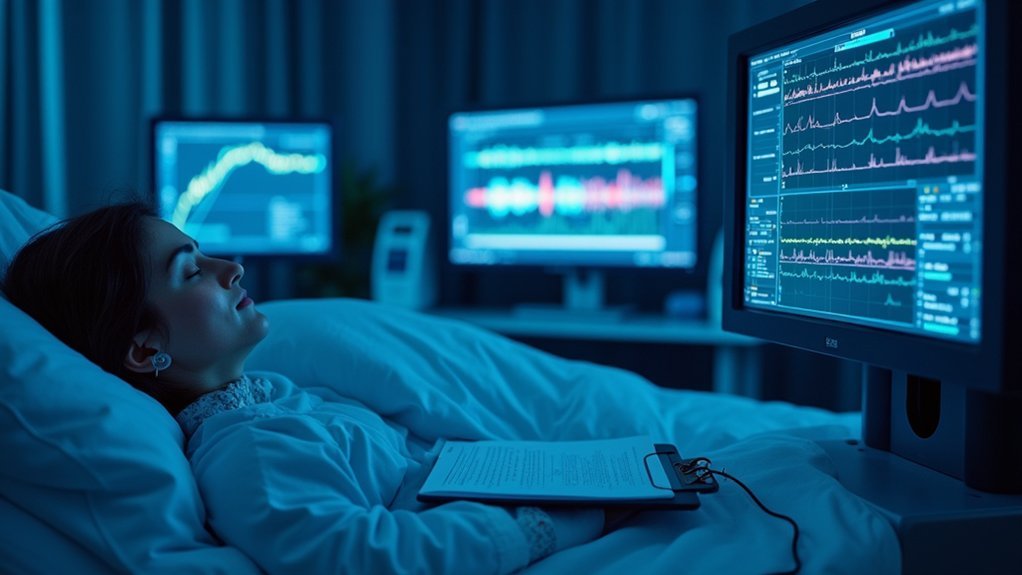
When you undergo thorough breathing pattern monitoring during sleep, polysomnography tracks multiple physiological parameters including your heart rate, oxygen levels, and airflow to detect any interruptions in breathing.
Sleep studies utilize sensors to measure your apnea/hypopnea index, quantifying breathing pauses and shallow breathing episodes per hour. This data helps classify severity for diagnosis of obstructive sleep apnea.
Sleep sensors precisely track breathing interruptions per hour, providing the critical apnea/hypopnea measurements needed for accurate sleep disorder diagnosis.
Home sleep tests offer convenient alternatives, effectively identifying moderate to severe cases through oxygen saturation monitoring, though they’re less extensive than in-lab studies.
Your polysomnography captures breathing disruptions while evaluating brain waves and muscle movements, revealing additional sleep disorders.
The collected data becomes vital for creating individualized treatment plans, including CPAP therapy and lifestyle modifications tailored to improve your outcomes.
Heart Rate and Oxygen Level Analysis Throughout the Night
As your body cycles through sleep stages, continuous pulse oximetry sensors track your heart rate and blood oxygen saturation levels, creating a detailed physiological map of how breathing disruptions affect your cardiovascular system.
When an apnea event occurs, you’ll experience decreased airflow that triggers oxygen level drops, prompting your heart rate to spike as your body fights to restore normal breathing.
This polysomnography data reveals critical patterns distinguishing obstructive sleep apnea from central variants through heart rate variability analysis.
Your sleep study technicians use these measurements to calculate your apnea/hypopnea index, determining severity based on hourly breathing interruptions.
The correlation between blood oxygen dips and cardiovascular responses provides definitive evidence for sleep apnea diagnosis and treatment planning.
Detection of Sleep Interruption Episodes and Their Severity

During your sleep study, sophisticated monitoring equipment captures and categorizes each breathing interruption to determine both the frequency and severity of your sleep apnea.
Polysomnography tracks your breathing patterns continuously, identifying complete breathing pauses and partial reductions in airflow. The apnea/hypopnea index measures these events per hour, directly linking your sleep apnea symptoms to their clinical severity.
Continuous breathing monitoring during polysomnography directly correlates hourly apnea events with clinical severity through the apnea/hypopnea index.
Your diagnostic test classifies mild sleep apnea as 5-14 events hourly, moderate as 15-29, and severe as 30 or more. This classification guides treatment decisions and helps predict health risks.
While home sleep tests can effectively detect obstructive sleep apnea through simplified monitoring, they may miss some episodes compared to thorough lab studies. The detailed analysis reveals how breathing interruptions fragment your sleep quality and impact your overall health.
Differentiation Between Obstructive and Central Sleep Apnea Types
Beyond measuring the frequency and severity of breathing interruptions, your sleep study must identify which type of sleep apnea you’re experiencing. Polysomnography serves as the gold standard to diagnose both obstructive sleep apnea and central sleep apnea by monitoring your brain activity, heart rate, and breathing patterns.
| Obstructive Sleep Apnea | Central Sleep Apnea |
|---|---|
| Physical airway obstruction | Brain signal failure |
| Loud snoring present | Irregular breathing patterns |
| Significant oxygen level drops | No airway blockage detected |
| Home sleep apnea tests effective | Requires thorough evaluation |
Your sleep study differentiates these conditions by analyzing whether airway obstruction causes your breathing interruptions or if your brain fails to signal breathing muscles properly. This distinction determines your treatment options, as obstructive cases often respond to CPAP therapy, while central sleep apnea may require addressing underlying medical conditions.
Sleep Stage Assessment and Movement Pattern Evaluation

While your sleep study identifies breathing interruptions, it simultaneously maps your complete sleep architecture by tracking which sleep stages you enter and how movement patterns affect your rest quality.
Sleep stage assessment through polysomnography reveals how apnea events disrupt your REM and non-REM cycles, while movement pattern evaluation monitors limb movements that compound sleep disturbances.
Healthcare providers analyze this data to determine the severity of sleep apnea and its impact on your overall sleep quality.
You’ll receive treatment plans tailored to your specific sleep profile, addressing both breathing issues and movement-related disruptions.
Frequently Asked Questions
What Diagnostic Method Is Used to Confirm OSA?
You’ll undergo polysomnography to confirm OSA, which monitors your brain waves, oxygen levels, heart rate, and breathing patterns during sleep. Alternatively, you can use home sleep testing for moderate-to-severe cases.
What Is the Gold Standard for Diagnosing OSA?
You’ll find polysomnography is the gold standard for diagnosing OSA. It’s conducted overnight in specialized sleep centers, thoroughly monitoring your brain waves, oxygen levels, heart rate, breathing patterns, and body movements.
What Is the Most Accurate Test to Diagnose Sleep Apnea?
You’ll need polysomnography to get the most accurate sleep apnea diagnosis. This thorough test monitors your brain waves, oxygen levels, heart rate, breathing patterns, and body movements throughout the night.
What Are the Criteria for Diagnosis of Obstructive Sleep Apnea?
You’ll need an apnea/hypopnea index of five or more events per hour, plus symptoms like snoring or daytime sleepiness, confirmed through polysomnography or acceptable home testing methods.




Leave a Reply