

You’ll get more accurate sleep tracking from the Oura Ring, which identifies 89% of sleep epochs compared to the Whoop Band’s 86% accuracy rate when measured against clinical polysomnography standards. The Oura Ring’s lightweight design won’t disrupt your sleep, while its 7-day battery life means fewer charging interruptions. Though Whoop offers continuous HRV monitoring, it underestimates readings by 4.5 milliseconds on average. Both devices provide valuable recovery insights that’ll help optimize your rest quality and performance outcomes.
What Makes Sleep Tracking Devices Effective for Rest Monitoring
When you’re evaluating sleep tracking devices, the effectiveness hinges on their ability to capture extensive physiological data through advanced sensor technology.
Both the Oura Ring and Whoop utilize photoplethysmography (PPG) sensors to accurately measure heart rate variability and sleep stages, providing thorough rest monitoring.
These devices translate complex data into actionable insights through sleep score systems – Oura identifies 89% of sleep epochs compared to clinical polysomnography standards.
You’ll receive personalized recovery metrics that track sleep efficiency and identify patterns over time.
The combination of precise sensors and intelligent algorithms enables these devices to generate daily readiness assessments and detailed recovery analyses, empowering you with data-driven recommendations for optimizing your sleep quality.
Oura Ring Design and Comfort for Overnight Wear
You’ll find the Oura Ring’s lightweight, jewelry-like design makes it barely noticeable during sleep, weighing just a few grams compared to bulkier wristbands.
The ring’s comfort depends heavily on finding your perfect fit, as it needs to be snug enough for accurate sensor readings without restricting blood flow or causing pressure points.
Your sleep position won’t be compromised since the ring’s slim profile eliminates the wrist bulk that often interferes with side sleepers or those who rest their hands under pillows.
Lightweight Jewelry-Like Feel
Unlike bulky fitness bands that constantly remind you of their presence, the Oura Ring’s jewelry-like design transforms sleep tracking into an effortless experience.
Weighing just 4-6 grams, you’ll forget you’re wearing this lightweight device throughout the night. Its elegant appearance blends seamlessly with other rings, making it a stylish accessory rather than obvious tech gear.
The ring’s water resistant construction means you won’t need to remove it for showers or swimming, maintaining consistent data collection.
With seven-day battery life, you’ll enjoy uninterrupted sleep monitoring without frequent charging disruptions. The snug fit guarantees accurate sensor readings while remaining comfortable enough for all-night wear.
This combination of style, durability, and convenience makes overnight tracking feel natural rather than burdensome.
Sleep Position Comfort
Since your finger remains in a relatively stable position throughout the night, the Oura Ring won’t interfere with your natural sleep postures or create uncomfortable pressure points that plague wrist-worn devices.
This sleep position comfort stems from the ring’s lightweight design and slim profile, which you’ll barely notice during rest. Unlike bulky wristbands that shift and create pressure against your mattress or pillow, the Oura Ring maintains consistent contact with your skin for accurate sensor measurements of heart rate and body temperature.
The ring’s snug fit guarantees reliable data collection without movement disruption, while its water resistance means you don’t need to remove it for hygiene routines.
This seamless integration into your nightly routine delivers uninterrupted, precise sleep tracking without compromising your comfort.
Ring Sizing Considerations
Getting the right fit becomes paramount when you’re planning to wear your Oura Ring throughout the night, as sensor accuracy depends entirely on consistent skin contact. A loose ring won’t deliver accurate sensor measurements, while an overly tight fit creates discomfort during extended wear.
Oura addresses this challenge by providing a free sizing kit that helps you select the perfect size before purchasing. This guarantees your ring will be comfortable to wear while maintaining ideal sensor contact for reliable sleep metrics tracking.
The ring’s lightweight design contributes greatly to overnight comfort:
- Unnoticeable weight – You’ll forget you’re wearing it while sleeping
- Jewelry-like appearance – More comfortable than bulky wristbands for continuous wear
- Water-resistant construction – No need for removal during daily activities, maintaining consistent wear patterns
Whoop Band Ergonomics and Sleep Position Impact
You’ll find the Whoop band’s flexible placement options greatly impact your sleep tracking experience, as you can position it on your wrist, bicep, or waistband based on your preferred sleeping posture.
The band’s low-profile design guarantees you won’t feel bulky hardware disrupting your rest, unlike chunkier fitness trackers that can dig into your skin during side sleeping.
Your chosen placement directly affects the accuracy of heart rate readings through photoplethysmography, making wrist and bicep positions generally more reliable than waistband mounting for overnight monitoring.
Band Comfort During Sleep
Three key design elements make the Whoop band particularly well-suited for overnight wear: its screenless profile, lightweight construction, and flexible positioning options.
You’ll experience enhanced band comfort through its low-profile design that eliminates bulk and screen distractions while you sleep. The lightweight, breathable materials promote better airflow, reducing nighttime discomfort that could interrupt your restful sleep.
The adjustable strap guarantees a snug fit that’s essential for accurate sleep tracking metrics throughout the night. You can customize positioning by wearing it on your wrist or bicep based on your preferred sleep positions.
However, consider these potential drawbacks:
- Daily journal requirements may create pre-sleep stress
- Focus on logging data might distract from actual rest
- Some users need adjustment time for peak comfort
Sleep Position Accuracy
While the Whoop band’s flexible design accommodates various sleep positions, your body positioning throughout the night directly impacts tracking accuracy. The band’s photoplethysmography technology identified 86% of sleep epochs compared to clinical polysomnography, but this performance depends heavily on proper ergonomics during different sleeping postures.
You’ll get ideal results when you position the Whoop snugly but comfortably on your wrist or bicep. Side sleeping, stomach sleeping, and back sleeping each present unique challenges for heart rate monitoring.
If you wear it too tight or loose, motion artifacts will compromise your sleep data quality. The key is finding that sweet spot where the band maintains consistent skin contact regardless of how you move.
This guarantees reliable heart rate readings and accurate sleep stage detection throughout the night.
Wrist Placement Options
Ideal placement becomes even more important when you consider the Whoop band’s multiple wearing options.
While rings lock you into finger placement, the Whoop band offers flexibility that directly impacts your sleep tracking accuracy.
Your placement choice affects heart rate monitoring precision throughout the night. Users often discover wrist placement creates interference during certain sleep positions, particularly for side sleepers who compress their arms against pillows.
Consider these three strategic placement options:
- Wrist placement – Traditional positioning that works well for back sleepers
- Bicep placement – Reduces sleep disruption and maintains consistent contact
- Waistband attachment – Minimizes movement interference for restless sleepers
Different users report varying accuracy levels depending on their chosen placement.
The Whoop band’s versatility means you can experiment to find what delivers the most reliable tracking for your specific sleep habits.
Battery Life During Extended Sleep Tracking Sessions
When you’re committed to tracking multiple nights of sleep without interruption, battery life becomes a critical factor in choosing between these wearable devices. The Oura Ring delivers up to seven days of battery life, giving you extended sleep tracking without frequent charging interruptions. Meanwhile, the Whoop band offers approximately five days but compensates with on-wrist charging capabilities.
| Feature | Oura Ring | Whoop Band |
|---|---|---|
| Battery Life | 7 days | 5 days |
| Charging Time | 1 hour | 90 minutes |
| Charging Method | Must remove | Worn while charging |
| Sleep Interruption | Minimal with planning | None during charging |
For users focused on consecutive nights of monitoring, Oura Ring’s longer battery life proves advantageous. However, Whoop’s continuous charging capability guarantees uninterrupted data collection during your sleep tracking sessions.
Sleep Stage Detection Accuracy Comparison
You’ll find the Oura Ring outperforms Whoop 4.0 in sleep stage detection, identifying 89% of sleep epochs compared to Whoop’s 86% when measured against clinical polysomnography standards.
Both devices use photoplethysmography technology to analyze your heart rate patterns and determine sleep stages, but they process this data differently.
Your device’s accuracy can vary based on factors like proper ring placement on your finger, which directly impacts how well it estimates your sleep stages throughout the night.
Sleep Stage Validation
Sleep stage detection accuracy represents one of the most critical performance metrics when comparing wearable devices, and both the Oura Ring and Whoop 4.0 demonstrate impressive capabilities in this area.
Your sleep stage validation depends on how well these devices interpret physiological signals during rest.
The Oura Ring’s superior performance stems from three key advantages:
- 89% sleep epoch identification compared to polysomnography gold standard
- Multiple biometric tracking including body temperature and respiratory rate for enhanced validation
- Comprehensive sleep data analysis combining heart rate variability with additional physiological markers
Whoop achieves 86% accuracy but relies primarily on heart rate variability measurements.
While both devices show minor discrepancies in heart rate readings, Oura’s additional sensors provide more robust sleep stage validation, making it potentially more reliable for detailed sleep analysis.
Detection Method Differences
Although both devices achieve impressive sleep tracking results, their detection methodologies reveal fundamental differences that directly impact your sleep analysis experience.
Your Oura Ring leverages multiple sensors to monitor heart rate variability, resting heart rate, and body temperature for thorough sleep stages analysis. This multi-metric approach delivers 89% accuracy compared to clinical polysomnography standards.
Meanwhile, Whoop relies primarily on photoplethysmography technology, achieving 86% accuracy in sleep tracking while providing sleep performance percentages.
The Oura Ring’s finger placement can occasionally affect heart rate readings, potentially influencing sleep assessment precision. However, both devices utilize advanced sensors for reliable sleep stage detection, though Oura Ring’s streamlined data presentation offers more accessible insights for users prioritizing essential sleep quality information.
Heart Rate Variability Monitoring While Resting
Two prominent wearables take distinctly different approaches to measuring your heart rate variability during rest periods. The Oura Ring focuses primarily on analyzing your sleep data to determine resting heart rate and HRV patterns, while the Whoop band continuously monitors these metrics throughout day and night cycles.
When comparing accuracy for heart rate variability measurements, you’ll find notable differences:
- Oura Ring achieves 89% agreement with clinical polysomnography equipment
- Whoop underestimates HRV by approximately 4.5 milliseconds on average
- Both devices recommend ideal ranges to guide your recovery planning
You can access your HRV trends through each device’s respective app, helping you understand your body’s recovery status and adjust your wellness routines accordingly for better stress resilience.
Recovery Score Algorithms and Daily Readiness Metrics
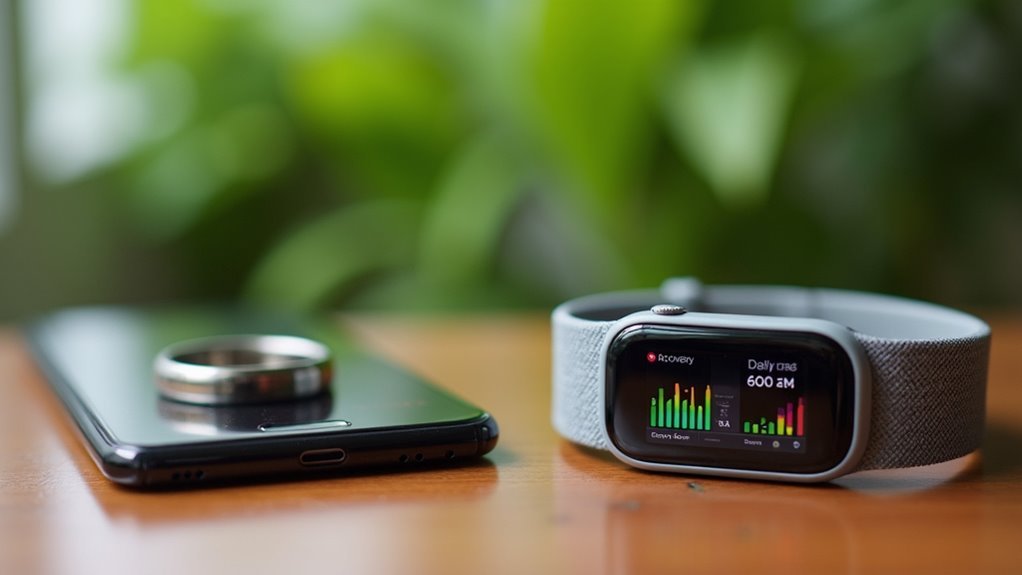
Beyond monitoring heart rate variability patterns, both devices transform this raw biometric data into actionable daily guidance through sophisticated recovery algorithms.
Whoop’s Recovery Score analyzes heart rate variability, resting heart rate, sleep performance, and strain to determine your physical readiness. You’ll receive detailed insights that encourage workout adjustments based on your body’s recovery state.
Whoop delivers comprehensive recovery insights by analyzing multiple biometric factors to guide your daily training decisions effectively.
Oura Ring’s Readiness Score takes a different approach, incorporating sleep duration, sleep efficiency, heart rate variability, and body temperature into simpler daily summaries.
While Whoop focuses on complex cardiovascular load metrics, Oura emphasizes straightforward health insights.
Both methodologies prove effective for evaluating daily readiness, with research showing accurate recovery tracking reduces injury risk and improves performance outcomes.
Temperature Tracking for Sleep Quality Assessment
While heart rate variability reveals much about your recovery state, temperature fluctuations during sleep provide equally valuable insights into your body’s restorative processes.
Both the Oura Ring and Whoop excel at temperature tracking, though they approach it differently.
The Oura Ring monitors your body temperature deviations from your personal baseline, helping you spot potential health issues or recovery changes.
Whoop tracks skin temperature variations and correlates them directly with your recovery scores and sleep quality metrics.
Here’s how temperature tracking enhances your sleep assessment:
- Illness Detection – Temperature spikes often signal incoming sickness before symptoms appear
- Environmental Impact – Room temperature changes affecting your sleep quality become visible
- Stress Correlation – Body temperature patterns reveal how stress impacts your recovery
You’ll gain deeper sleep quality understanding through these thermal insights.
Breathing Pattern Analysis During REM Sleep
As your body cycles through REM sleep, your breathing patterns reveal vital information about sleep quality that both devices capture with remarkable precision.
Oura Ring analyzes your breathing through body temperature and heart rate variability measurements, detecting stress levels and recovery status during this essential sleep stage.
Whoop takes a different approach by directly tracking respiratory rate alongside heart rate and sleep stages, providing detailed analysis of breathing fluctuations throughout REM sleep.
When your breathing patterns show disturbances during REM sleep, both devices correlate this data with overall sleep quality metrics.
This helps you identify environmental stressors or lifestyle choices impacting your rest. You’ll receive actionable insights about how breathing irregularities affect daily performance and recovery, enabling targeted improvements to your sleep environment and habits.
Data Visualization and Sleep Trend Reporting
How effectively can you track your sleep improvements without clear data visualization? Both the Oura Ring and Whoop excel at transforming complex health metrics into actionable insights, though they take different approaches to presenting your sleep trends.
The Oura Ring delivers a clean, user-friendly interface featuring:
- Daily scores ranging 0-100 for Sleep, Activity, Readiness, and Resilience
- Simplified visualization that makes sleep quality patterns easily identifiable
- Streamlined metrics that don’t overwhelm casual users
Whoop offers information-dense data visualization with detailed biometric analysis and daily journal entries that help you understand how lifestyle changes impact your sleep trends.
Both platforms enable you to assess patterns and make informed wellness decisions, but Oura prioritizes simplicity while Whoop emphasizes extensive data depth.
Subscription Costs for Advanced Sleep Analytics
Beyond the initial device purchase, ongoing subscription fees greatly impact your long-term investment in sleep analytics.
Oura Ring costs range from $299-$449 upfront, but its subscription price drops to just $5.99 monthly after the first free month. This totals approximately $72 annually for continued access to advanced sleep analytics.
The Whoop device operates differently, requiring $30 monthly or $239 yearly after an initial free period. Over two years, you’ll pay around $360 annually for your monthly subscription.
While Oura’s higher initial cost might seem steep, its lower ongoing fees make it more economical long-term.
Among health trackers requiring subscriptions, you’ll find Oura averages $31 monthly initially, then drops to $5, while Whoop maintains $17 monthly averaged over two years.
User Experience With Sleep Coaching Features
When you’re investing in a sleep tracker, the coaching experience can make or break your journey toward better rest.
Both the Oura Ring and Whoop offer distinct approaches to sleep coaching that shape your user experience differently.
The Oura Ring delivers straightforward app insights through daily scores for Sleep, Activity, Readiness, and Resilience.
Oura Ring provides effortless sleep understanding with clear daily scores across four key wellness metrics.
You’ll appreciate its user-friendly interface that makes understanding your sleep quality effortless.
Women particularly benefit from menstrual cycle tracking and temperature insights.
Whoop’s sleep coaching takes a more analytical approach with:
- AI-powered personalized coaching based on your strain and performance data
- Sleep debt calculator tracking recovery needs from previous deficiencies
- Detailed biometric analysis for optimization-focused users
Your preference depends on whether you want simple, accessible insights or thorough data-driven coaching.
Which Device Delivers Better Long-Term Sleep Insights
Why does long-term sleep tracking matter more than daily snapshots? You’ll discover patterns that single nights can’t reveal, helping you understand how lifestyle changes truly impact your rest quality over weeks and months.
The Oura Ring excels at delivering thorough long-term sleep insights through its user-friendly app interface. You’ll easily track trends in your sleep efficiency, heart rate variability, and recovery patterns without getting overwhelmed by complex data. The ring’s 89% accuracy in sleep stage identification ensures reliable long-term analysis.
Whoop’s sleep tracking offers valuable cumulative data through its sleep debt calculator, showing how your rest patterns compound over time. However, you might find its complex interface challenging when seeking straightforward sleep insights.
Both devices provide heart rate monitoring, but Oura’s simplified approach makes long-term trend analysis more accessible for sustained habit improvement.
Frequently Asked Questions
Are Rings or Watches Better for Health Tracking?
You’ll find rings offer better sleep tracking accuracy and discreteness, while watches provide extensive fitness data and larger displays. Your choice depends on whether you prioritize comfort or detailed metrics.
Which Oura Ring Is Best for Sleep Tracking?
You’ll want the Oura Ring Gen 3 for sleep tracking since it’s the newest model with enhanced sensors, 89% accuracy compared to medical sleep studies, and improved temperature monitoring for better cycle detection.
Are Fitness Rings Better Than Bands?
You’ll find fitness rings better if you want simplicity and comfort, while bands excel for detailed analytics. Your choice depends on whether you prefer streamlined insights or extensive data tracking capabilities.
Which Ring Has the Best Sleep Tracking?
You’ll find Oura Ring Gen 3 offers superior sleep tracking with 89% accuracy versus Whoop’s 86%. It provides thorough sleep scores, better heart rate variability measurements, and includes menstrual cycle tracking for enhanced insights.




Leave a Reply