
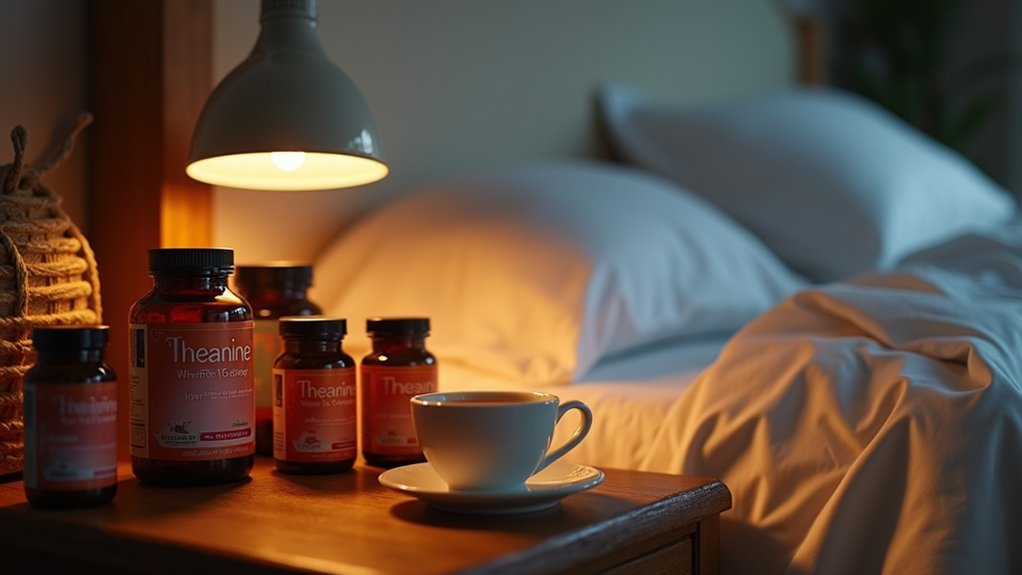
You’ll find the best L-theanine supplements for sleep include Innerbody Labs Focus Support (200mg), Swanson Suntheanine (100-400mg), and generic L-theanine options for budget-conscious buyers. This calming amino acid enhances alpha brain waves and boosts GABA, serotonin, and dopamine while reducing anxiety-causing glutamate. Take 200mg about 30-60 minutes before bedtime for ideal results. Users report 15% faster sleep onset and 33% less daytime dysfunction. The complete breakdown of top-rated options and precise dosing strategies awaits below.
What Is L-Theanine and How Does It Promote Better Sleep?

While you’ve probably heard of caffeine’s energizing effects from tea, you mightn’t know about L-theanine, a calming amino acid found in those same tea leaves that can actually help you sleep better.
This unique amino acid works by increasing levels of calming neurotransmitters like GABA, serotonin, and dopamine in your brain. When you take L-theanine, it enhances alpha brain wave activity, which creates a relaxed state without causing daytime drowsiness.
Studies show that L-theanine can greatly improve sleep quality by reducing the time it takes you to fall asleep. Unlike sedatives, this amino acid helps you maintain alertness during the day while preparing your mind for restful sleep at night, making it an ideal natural solution to improve sleep.
Science Behind L-Theanine’s Calming Effects on the Brain
Your brain responds to L-theanine through specific mechanisms that directly influence how calm and relaxed you feel.
The supplement crosses your blood-brain barrier efficiently, allowing it to alter neurotransmitter activity and enhance alpha brain wave production.
These neurological changes work together to create the peaceful mental state that makes falling asleep easier.
Neurotransmitter Balance Mechanisms
L-theanine’s remarkable calming effects stem from its sophisticated ability to orchestrate neurotransmitter activity in your brain, creating a cascade of neurochemical changes that naturally promote relaxation without sedation.
Your brain experiences a dual-action mechanism when you consume L-theanine. It simultaneously boosts calming neurotransmitters while suppressing excitatory ones, creating favorable conditions for improved sleep quality.
| Neurotransmitter Action | Sleep Quality Impact |
|---|---|
| Increases GABA, Serotonin, Dopamine | Enhanced relaxation and mood stability |
| Decreases Glutamate Binding | Reduced neural excitability |
| Lowers Norepinephrine | Decreased stress and anxiety |
This neurotransmitter rebalancing doesn’t just prepare you for sleep—it enhances alpha brain wave activity, promoting wakeful relaxation. You’ll experience L-theanine’s calming effects within 30-40 minutes, making it ideal for evening supplementation.
Alpha Brain Wave Enhancement
When you take L-theanine, your brain begins producing more alpha waves—the same brainwave pattern associated with deep meditation and calm focus.
These alpha brain waves create a unique state of relaxed alertness that directly improves your sleep quality without causing drowsiness during the day.
L-theanine’s ability to cross your blood-brain barrier allows it to enhance alpha wave activity while simultaneously blocking glutamate, an excitatory neurotransmitter that increases anxiety and alertness.
This dual action produces a profound calming effect that prepares your mind for restful sleep.
The increased alpha wave activity doesn’t just promote relaxation—it creates an ideal mental environment for creativity and focus while reducing stress levels.
This enhanced brainwave pattern helps you shift more easily from wakefulness to sleep.
Blood-Brain Barrier Crossing
Unlike many supplements that struggle to reach your brain, L-theanine easily crosses the blood-brain barrier—a selective membrane that typically blocks most compounds from entering your central nervous system.
This unique ability sets L-theanine apart from other amino acids and explains why it’s so effective for improving sleep quality.
Once L-theanine crosses this protective barrier, it directly influences your brain’s neurotransmitter activity.
It blocks glutamate from binding to brain cells, reducing alertness and calming your nervous system.
Simultaneously, it increases GABA, serotonin, and dopamine availability—neurotransmitters essential for mood regulation and sleep enhancement.
This direct brain access allows L-theanine to promote alpha brain wave activity, creating a relaxed yet wakeful state that naturally facilitates sleep onset and improves overall sleep quality.
Top-Rated L-Theanine Supplements for Sleep Enhancement
Though numerous L-theanine supplements flood the market, only a select few have earned consistent recognition for their sleep-enhancing properties. Innerbody Labs Focus Support and Swanson Suntheanine stand out as top-rated options that can considerably improve sleep quality and reduce the time it takes you to fall asleep.
| Supplement | Dosage | Key Benefit |
|---|---|---|
| Innerbody Labs Focus Support | 200mg | Enhanced sleep onset |
| Swanson Suntheanine | 100-400mg | Stress reduction |
| Generic L-theanine | 200mg | Cost-effective option |
These L-theanine supplements work as an effective natural sleep aid by promoting relaxation and reducing stress levels. You’ll find that taking 200mg before bed typically delivers ideal results, helping you improve sleep without the side effects associated with prescription medications.
Dosage Guidelines for Maximum Sleep Benefits

You’ll want to start with 200mg of L-theanine taken 30-60 minutes before your intended bedtime for ideal sleep enhancement.
If you don’t notice improvements after a week, you can gradually increase your dose to 300-400mg while monitoring how your body responds.
It’s essential to find your personal sweet spot since some people experience decreased sleep quality when exceeding their ideal dose.
Optimal Nightly Dose
When determining your ideal L-theanine dose for sleep, you’ll want to start with 100-200 milligrams taken 30-60 minutes before bedtime. Research shows that 200 milligrams represents the sweet spot for most people, delivering notable improvements in sleep onset and overall sleep quality.
However, you shouldn’t exceed this amount initially, as some users report diminished benefits at higher doses.
Begin your supplementation journey with 100 milligrams and gradually increase if needed. Remember that your daily green tea consumption already provides 25-60 milligrams of L-theanine per cup, so factor this into your total dosage calculations.
While the FDA considers up to 250 milligrams safe per serving, individual responses vary greatly. You’ll achieve optimal results by finding your personal threshold through careful experimentation and monitoring your sleep patterns.
Timing Before Bed
Beyond finding your ideal dose, mastering the timing of your L-theanine intake proves equally essential for maximizing sleep benefits. Research shows L-theanine reduces sleep onset latency when taken 30-60 minutes before bedtime, giving your body adequate time to process the supplement.
| Timing Before Bed | Dosage | Expected Effect |
|---|---|---|
| 30 minutes | 200mg | Faster sleep onset |
| 45 minutes | 200-400mg | Best absorption |
| 60 minutes | 400mg | Maximum benefits |
Taking L-theanine too close to bedtime may increase diuretic effects, potentially disrupting your sleep. You’ll want to find that sweet spot where the supplement kicks in just as you’re ready to wind down, allowing for seamless progression into restful sleep.
Progressive Dose Adjustment
Finding the right timing sets the foundation, but determining your ideal L-theanine dose requires a methodical approach that starts small and builds gradually.
Begin your supplementation journey with 100 mg, the lowest effective dosage for sleep quality improvement. Monitor your sleep patterns for several nights before making any adjustments.
If you’re not experiencing desired results, gradually increase to 200 mg—the most commonly recommended L-theanine dosage for peak sleep benefits. This amount typically provides the perfect balance between relaxation and avoiding next-day drowsiness.
You can cautiously explore higher doses up to 400 mg if needed, but proceed carefully. Some individuals experience decreased sleep quality at elevated levels.
Track your response to each dosage adjustment, as your ideal amount depends entirely on your unique physiology and sleep requirements.
L-Theanine vs. Other Natural Sleep Aids: Effectiveness Comparison

Although many natural sleep aids flood the supplement market, L-theanine stands out through its unique mechanism of action that promotes relaxation rather than sedation.
While melatonin often causes next-day grogginess, you’ll find L-theanine maintains your daytime alertness. This effectiveness comparison shows L-theanine increases GABA, serotonin, and dopamine levels, creating genuine relaxation instead of simple sedation like other natural sleep aids.
Studies demonstrate L-theanine considerably improves sleep quality scores and onset latency, matching or exceeding valerian root and chamomile’s benefits.
You’ll experience quicker stress relief compared to passionflower and kava, with minimal side effects.
Meta-analysis results confirm L-theanine reduces daytime dysfunction while improving sleep disturbances, making it your ideal choice for sustainable sleep enhancement without dependency risks.
Safety Profile and Potential Side Effects
While L-theanine’s effectiveness makes it an attractive sleep aid option, you’ll want to understand its safety profile before incorporating it into your routine.
The FDA recognizes the safety of L-theanine up to 250 milligrams per serving, with minimal side effects reported when taken alone. However, you might experience gastrointestinal upset, particularly at higher doses.
If you’re consuming L-theanine through green tea extract, be aware that rare liver problems have been associated with these products.
Additionally, caffeine in teas can counteract L-theanine’s calming effects, potentially causing anxiety and insomnia.
Pregnant or breastfeeding women should consult your doctor before use due to insufficient safety data.
Always speak with a healthcare professional if you’re taking medications or have underlying health conditions.
Best L-Theanine Combinations With GABA and Melatonin
You’ll find that combining L-theanine with GABA and melatonin creates a powerful trio that works through different but complementary pathways to improve your sleep quality.
When you’re choosing these combinations, you’ll need to take into account the ideal dosing ratios, as L-theanine typically works best at 200mg while GABA ranges from 100-750mg depending on your individual needs.
Before you start any combination therapy, it’s essential that you understand how these compounds interact with each other and any medications you’re currently taking.
Synergistic Sleep Mechanisms
When L-theanine works alongside other sleep-promoting compounds like GABA and melatonin, it creates a powerful synergistic effect that can greatly enhance your sleep quality.
These compounds work through complementary pathways to address different aspects of sleep challenges.
L-theanine naturally increases GABA levels in your brain, amplifying the calming neurotransmitter’s relaxation effects.
Meanwhile, melatonin regulates your circadian rhythm and signals your body it’s time to sleep.
This triple combination targets stress reduction, nervous system calming, and sleep timing simultaneously.
Here’s how these mechanisms work together:
- GABA enhancement – L-theanine boosts your brain’s natural GABA production for deeper relaxation
- Stress reduction – L-theanine counteracts cortisol while GABA promotes calmness
- Sleep timing optimization – Melatonin synchronizes your natural sleep-wake cycle with the calming effects
Optimal Dosage Combinations
Finding the right dosage combination of L-theanine with GABA and melatonin requires careful consideration of each compound’s ideal range and your individual sleep needs.
L-theanine’s best dosages typically range from 100-400 mg, with 200 mg proving effective for most users when taken before bed.
For melatonin, you’ll want to start with 0.5-5 mg, as it works synergistically with L-theanine to enhance sleep quality without causing sedation.
While animal studies show promising results combining L-theanine with GABA for faster, longer sleep, human research remains limited.
Many users report that combining all three compounds greatly reduces sleep onset latency and improves overall sleep quality, though you should start with lower doses to assess your tolerance.
Safety and Interactions
While L-theanine, GABA, and melatonin combinations generally offer excellent safety profiles, you’ll need to evaluate several important interactions and precautions before starting this supplement stack.
The FDA recognizes L-theanine as safe up to 250mg per serving, but you should monitor your individual response when combining with other sleep aids. Pay special attention if you’re taking blood pressure medications or anxiety treatments, as these supplements can amplify their effects.
- Pregnancy and breastfeeding safety: Avoid L-theanine, GABA, and melatonin combinations during pregnancy or while nursing, as safety data remains insufficient for these periods.
- Medication interactions: Consult your healthcare provider if you’re taking blood pressure or anxiety medications before combining these supplements.
- Individual tolerance monitoring: Start with lower doses to assess your personal response, as combining multiple sleep aids can intensify sedative effects.
User Reviews and Real-World Sleep Quality Results
Real users consistently report meaningful improvements in their sleep quality after incorporating L-theanine supplements into their nightly routines. The calming effect helps you fall asleep faster without causing sedation, maintaining your daytime alertness. User feedback consistently highlights reduced anxiety before bedtime and enhanced overall sleep satisfaction.
| Sleep Benefit | Improvement Level | User Experience |
|---|---|---|
| Sleep Onset | Moderate | Fall asleep 15% faster |
| Daytime Function | Significant | 33% less dysfunction |
| Overall Quality | Notable | Better rest satisfaction |
| Stress Management | High | Calmer bedtime routine |
While most users experience positive results, individual responses vary based on dosage and personal sensitivity. Some report mixed experiences with occasional daytime sleepiness, emphasizing the importance of finding your ideal dose for maximum L-theanine benefits.
How to Choose the Right L-Theanine Supplement Form
Given that users report varied experiences with L-theanine supplements, choosing the right form becomes critical for achieving your desired sleep benefits.
When evaluating L-theanine supplementation options, you’ll want to focus on several key factors. Start with dosage considerations—most effective formulations range from 100-400 mg, with 200 mg being ideal for sleep support. Look for supplements featuring Suntheanine, a patented form known for superior purity and effectiveness.
Consider these essential selection criteria:
- Form specificity: Choose supplements clearly identifying Suntheanine or pharmaceutical-grade L-theanine
- Combination ingredients: Evaluate add-ins like GABA or melatonin carefully, as research on combinations remains limited
- Quality standards: Prioritize high-quality formulations that are vegan and allergen-free
Always review user feedback to gauge real-world performance before making your final decision.
Timing Your L-Theanine Intake for Optimal Sleep Results
Once you’ve selected your ideal L-theanine supplement, proper timing becomes the deciding factor between restful nights and groggy mornings.
Take your L-theanine dosage 30 to 60 minutes before bedtime to allow adequate absorption and promote relaxation. This timing window guarantees peak sleep quality without next-day drowsiness.
Consistency matters—take L-theanine at the same time nightly to regulate your sleep-wake cycle. Start with 200 milligrams, though some find 400 milligrams more effective for enhanced sleep quality.
However, higher doses may cause gastrointestinal upset in sensitive individuals.
If you’re combining L-theanine with other supplements like GABA or melatonin, space them appropriately to prevent counterproductive interactions.
Avoid taking L-theanine too close to bedtime, as this can disrupt your natural sleep patterns.
Frequently Asked Questions
Does L-Theanine Improve Sleep Quality?
Yes, L-theanine can improve your sleep quality. You’ll likely experience faster sleep onset and better overall rest, as studies show significant improvements with reduced daytime dysfunction from sleep disturbances.
What Is the Most Natural Form of L-Theanine?
You’ll find the most natural form of L-theanine in tea leaves from the Camellia sinensis plant. Green tea contains 25-60 milligrams per serving, making it your best natural source over supplements.
What Drugs Interact With L-Theanine?
You should watch for interactions with stimulant medications, blood pressure drugs, antidepressants, and anti-seizure medications. L-theanine’s calming effects can alter their effectiveness, so you’ll need professional guidance before combining supplements.
Does L-Theanine Work Right Away?
You’ll typically feel l-theanine’s calming effects within 30 to 60 minutes after taking it. However, you might experience immediate relaxation, while others need several doses before noticing significant improvements in sleep quality.
In Summary
You’ve now got the knowledge to choose an effective L-theanine supplement for better sleep. Start with a 100-200mg dose taken 30-60 minutes before bedtime, and don’t hesitate to experiment with combinations that include GABA or melatonin. Remember, you’ll likely see the best results when you’re consistent with timing and dosage. Trust user reviews, but pay attention to how your body responds individually to find what works best for you.




Leave a Reply