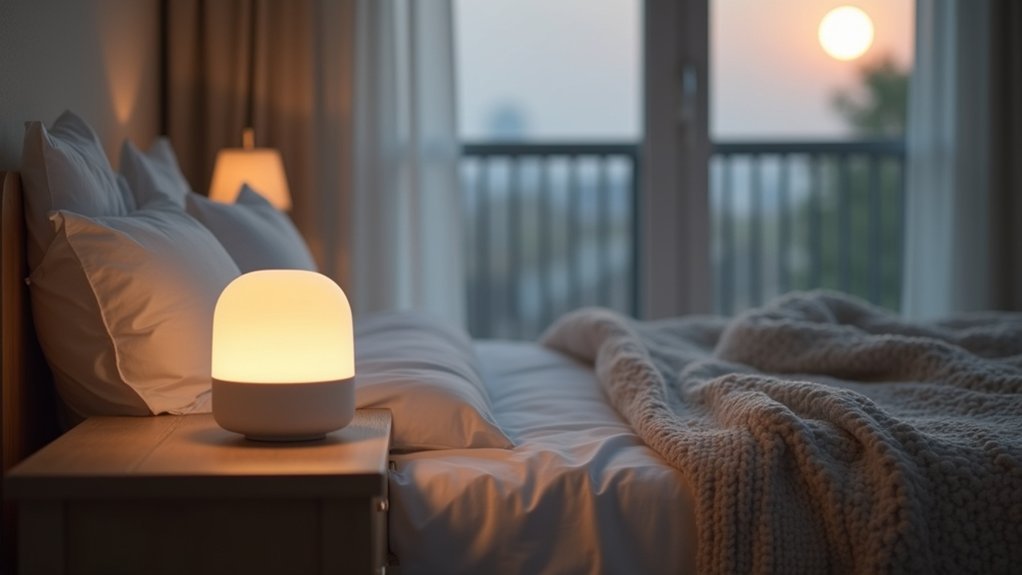
White noise machines transform your sleep quality by generating consistent sound frequencies that mask disruptive environmental noises like traffic, sirens, and sudden sounds that interrupt your natural sleep cycles. They synchronize your brain waves with steady audio patterns, reducing your sensitivity to jarring noise shifts and creating a stable auditory background that protects your sleep architecture. This sound masking accelerates sleep onset by 38% and helps you achieve deeper, more restorative rest stages. Discover how different noise types can optimize your specific sleep challenges.
What Are White Noise Machines and How Do They Work
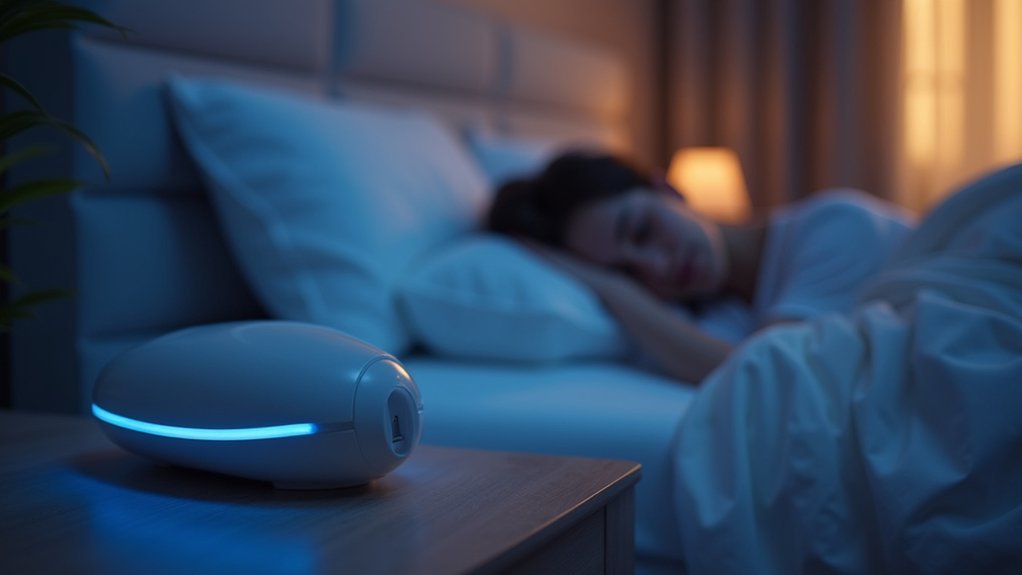
White noise machines generate a steady, consistent sound by blending multiple frequencies across the audible spectrum, creating an audio blanket that effectively masks disruptive background noise.
Think of it as static from an untuned radio—that’s fundamentally what you’re hearing. These devices work by producing sound at various frequencies simultaneously, which helps mask background noise that could otherwise wake you up or prevent you from falling asleep.
You can adjust the volume to your preference, typically keeping it at a soft rustle level.
Modern machines like the Dohm Classic offer multiple sound options including white, pink, and brown noise.
The Science Behind White Noise and Sleep Enhancement
Your brain responds to white noise through specific neurological mechanisms that promote better sleep quality.
White noise works by synchronizing your brain waves with consistent sound frequencies, while simultaneously masking disruptive environmental noises that would otherwise interrupt your sleep cycles.
This dual action protects your natural sleep stages, allowing you to maintain deeper, more restorative rest throughout the night.
Brain Wave Synchronization Effects
When you listen to white noise during sleep, your brain waves begin to synchronize with the consistent auditory pattern, creating a neurological foundation for enhanced rest. This synchronization process fundamentally alters how your nervous system responds to nighttime disturbances.
White noise’s impact on brain wave activity produces measurable improvements in sleep quality through several mechanisms:
- Accelerated Sleep Onset – You’ll fall asleep 38% faster as white noise helps your brain shift smoothly between wakeful and sleep states.
- Enhanced Relaxation Response – The consistent sound pattern calms your nervous system, reducing heart and respiratory rates.
- Reduced Sleep Interruptions – External noise sensitivity decreases considerably, maintaining sleep continuity throughout the night.
- Deeper Sleep Stages – Brain waves stabilize more effectively, allowing you to achieve more restorative sleep cycles.
Frequency Masking Mechanisms
Because your ears constantly process thousands of different sound frequencies throughout the day, disruptive noises can easily jolt you awake or prevent you from falling asleep in the first place.
White noise machines solve this problem by producing consistent sound across all audible frequencies at equal intensity. This creates an effective barrier that masks environmental noise from traffic, neighbors, or household activities that would otherwise trigger your brain’s alertness response.
When your white noise machine generates this steady acoustic blanket, it prevents sudden sound variations from reaching your consciousness.
Research demonstrates this masking effect reduces sleep disturbances greatly, particularly in noisy environments. The consistent frequency coverage fundamentally drowns out unpredictable sounds that disrupt your sleep cycles, allowing your brain to maintain the stable auditory environment necessary for quality rest.
Sleep Stage Protection
While environmental noise interferes with your natural sleep progression, white noise actively protects the delicate architecture of your sleep stages throughout the night. This consistent auditory shield maintains your sleep quality by preventing sudden disruptions that typically fragment your rest cycles.
White noise protects your sleep stages through these mechanisms:
- REM Sleep Preservation – Creates a protective barrier against noise interruptions during this critical dream stage.
- Deep Sleep Extension – Maintains the slow-wave sleep phase essential for physical recovery and memory consolidation.
- Shift Smoothing – Reduces sensitivity to environmental noise during vulnerable stage transitions.
- Brain Wave Synchronization – Helps coordinate neural activity for more stable, restorative sleep patterns.
White Noise Vs Pink Noise Vs Brown Noise for Sleep
You’ve likely heard about white noise, but pink and brown noise offer different frequency patterns that might better suit your sleep needs.
Each type affects your brain waves and sleep quality differently, with studies showing pink noise may provide deeper, more restorative sleep than its white counterpart.
Understanding these differences will help you choose the most effective noise type for your specific sleep challenges and preferences.
Frequency Differences Explained
Although they all fall under the category of “noise machines,” white, pink, and brown noise each produce distinctly different sound profiles that can affect your sleep quality in unique ways.
Understanding these sound frequencies helps you choose the most effective option for your needs:
- White noise contains all audible frequencies at equal intensity, creating static-like sounds that effectively mask environmental disturbances and help you fall asleep faster in noisy environments.
- Pink noise emphasizes lower frequencies, producing gentler sounds like rustling leaves or steady rain that research shows can enhance deep sleep and improve cognitive performance.
- Brown noise features even deeper, lower frequencies resembling ocean waves or heavy rainfall, making it excellent for masking high-pitched disturbances.
- Personal experimentation remains essential since individual sensitivity to different frequencies varies considerably among sleepers.
Sleep Quality Comparison
When choosing between white, pink, and brown noise for sleep improvement, research reveals significant differences in how each frequency affects your rest quality.
White noise excels in noisy environments, helping you fall asleep 38% faster than silence by masking disruptive sounds effectively.
Pink noise targets lower frequencies and specifically enhances deep sleep while boosting cognitive performance, particularly in older adults.
Brown noise offers the lowest frequencies, resembling gentle rainfall, and may reduce tinnitus symptoms that interfere with sleep.
Your choice depends on your specific sleep challenges. If you’re battling environmental noise, white noise machines provide superior masking capabilities.
For deeper, more restorative sleep, pink noise delivers targeted benefits.
Those with tinnitus often find brown noise most soothing for achieving quality rest.
Choosing Your Noise
How do you determine which noise color will transform your nightly rest? Your personal preferences and sleep challenges should guide your decision when selecting between different noise types for ideal relaxation.
- Test white noise first – Since research shows it helps adults fall asleep 38% faster, start with this consistent frequency blend that effectively masks disruptive environmental sounds in noisy settings.
- Consider pink noise for deeper rest – If you’re seeking enhanced deep sleep and cognitive benefits, especially as an older adult, this lower-frequency option provides a more soothing sound profile than traditional white noise.
- Try brown noise for ultimate relaxation – When you need deeper sound quality resembling rainfall, this option reduces higher frequencies for maximum calming effects.
- Experiment with different noise machines – Personal experimentation remains essential since individual responses to each sound type vary greatly for improving sleep quality.
Proven Benefits of White Noise for Sleep Quality
Since sleep disruptions can greatly impact your overall health and daily performance, you’ll find it reassuring that numerous studies have documented white noise’s ability to enhance sleep quality across diverse populations. Research shows that white noise machines effectively mask disruptive environmental sounds, helping you fall asleep faster and achieve deep sleep more consistently.
| Benefit | Research Finding |
|---|---|
| Reduced interruptions | Participants experienced fewer sleep disturbances during treatment |
| Faster sleep onset | White noise masks disruptive sounds effectively |
| Lasting improvements | Benefits persisted even after machine removal |
| Tinnitus relief | Masks persistent ringing sounds |
| Enhanced well-being | Promotes deeper, more restful sleep |
You’ll particularly benefit if you live in high-noise environments or deal with tinnitus, where white noise’s consistent sound pattern helps improve your overall sleep experience.
How White Noise Masks Disruptive Environmental Sounds

While you sleep, your brain continues processing sounds from your environment, and sudden noises like car horns, barking dogs, or slamming doors can jolt you awake or prevent you from falling asleep initially.
White noise machines solve this problem through masking—creating a consistent sound barrier that covers multiple frequencies simultaneously.
White noise creates a steady acoustic shield that masks disruptive environmental sounds across multiple frequency ranges simultaneously.
Here’s how noise machines protect your sleep quality:
- Sound masking – They produce steady frequencies that cover disruptive sounds before they reach your consciousness.
- Reduced sensitivity – Your brain becomes less reactive to sudden environmental changes.
- Stable auditory background – Consistent sound levels prevent jarring shifts from quiet to loud.
- Urban protection – They’re especially effective against traffic, sirens, and neighbor noise.
This masking effect helps you fall asleep 38% faster by eliminating sound-related sleep interruptions.
Research Studies on White Noise Effectiveness for Sleep
You’ll find that research on white noise effectiveness presents a complex picture with mixed results across different studies.
While some research shows significant benefits for adults in noisy environments, studies focusing on infant sleep reveal more varied outcomes that don’t always support white noise use.
These conflicting findings highlight the need for more thorough investigation to better understand when and for whom white noise truly works.
Mixed Research Results
Although white noise machines have gained popularity as sleep aids, research on their effectiveness presents a complex picture with conflicting findings. While some studies show white noise helps you fall asleep faster, the overall impact on sleep quality reveals mixed results with minimal benefits in certain cases.
Here’s what research reveals about white noise effectiveness:
- Environmental noise masking – You’ll find white noise reduces sensitivity to disruptive environmental noises, especially in high-noise urban areas.
- Quality improvements – Some users experience significant sleep quality enhancements with fewer interruptions, effects that persist even after discontinuing use.
- Volume concerns – Excessively loud white noise can disrupt your REM and deep sleep stages.
- Individual responses vary – You might find white noise distracting rather than helpful for masking external sounds.
Infant Sleep Studies
When researchers studied white noise effects on infant sleep patterns, they discovered compelling evidence for its effectiveness as a sleep aid.
You’ll find that white noise markedly reduces crying in infants, helping them fall asleep faster even in noisy environments. Studies show improved sleep quality as white noise masks disruptive background sounds, resulting in longer sleep durations for your baby.
Research reveals that infants exposed to white noise experience decreased heart and respiratory rates, indicating a genuine calming effect during sleep.
A study in Sleep Medicine confirmed that white noise reduces sleep interruptions in high-noise environments.
However, you must maintain safe volume levels, as excessively loud sounds can negatively impact your infant’s hearing development and compromise the benefits.
Need Further Investigation
While infant studies provide valuable insights, white noise research in broader populations reveals significant gaps that demand further scientific inquiry.
You’ll find that current studies show mixed results, with effectiveness varying dramatically among individuals. This inconsistency highlights critical areas requiring deeper exploration:
- Safety standards – Researchers need to establish clear guidelines for safe sound output levels across all age groups, not just infants.
- Individual variation – Scientists must investigate why white noise improves sleep quality for some people while showing minimal effects for others.
- Long-term effects – Studies should examine whether prolonged white noise exposure impacts hearing or sleep dependency.
- Optimal parameters – Further investigation into frequency ranges, volume levels, and duration that maximize benefits while ensuring safety for all individuals.
Choosing the Right White Noise Machine for Your Needs
Since sleep needs vary dramatically from person to person, selecting the right white noise machine requires careful consideration of several key features that’ll directly impact your sleep quality.
| Feature | What to Look For | Why It Matters |
|---|---|---|
| Sound Quality | Wide frequency range with clear output | Better masking of disruptive noises |
| Volume Control | Adjustable volume settings | Maintains safe, comfortable sound levels |
| Sound Variety | Multiple sound options including white, pink, nature sounds | Enables personalization for individual preferences |
Portability becomes vital if you travel frequently, so consider lightweight designs that guarantee consistent sleep quality anywhere. Reading credible reviews helps you identify machines that address your specific sleep challenges. Focus on adjustable volume capabilities that let you maintain ideal comfort levels, typically around light rustling volume for safety and effectiveness.
Optimal Placement and Volume Settings for White Noise Machines
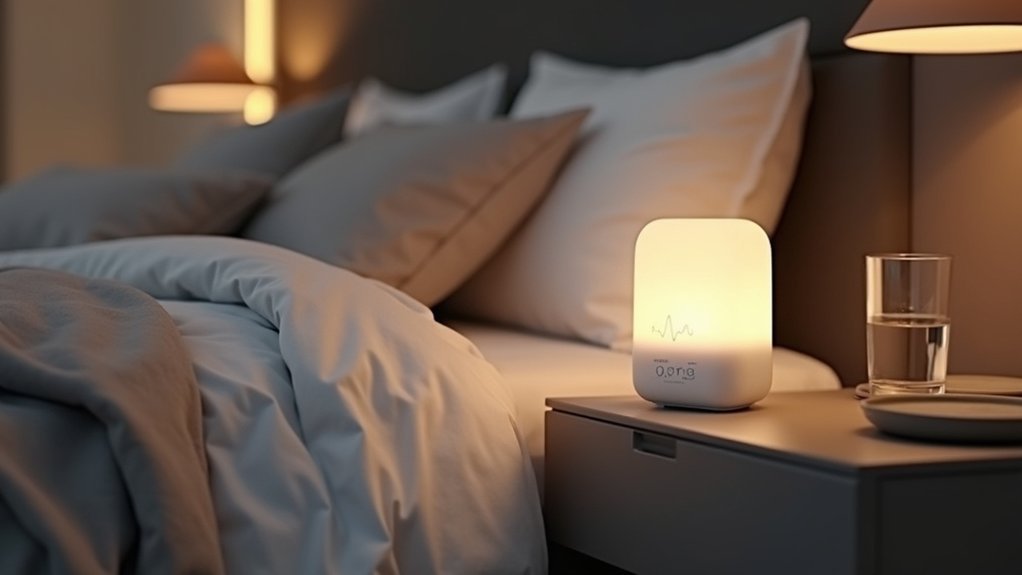
Three critical factors determine how effectively your white noise machine improves your sleep: where you place it, how loud you set it, and when you turn it on.
Optimal placement and volume settings directly impact your sleep quality. Here’s how to maximize effectiveness:
- Position in bedroom corner – This disperses sound evenly throughout your room, creating consistent coverage that masks external noises effectively.
- Set volume to 50-60 decibels – Match the level of background conversation to avoid sleep disruption while maintaining noise-masking benefits.
- Start before bedtime – Activate your machine early to establish a calming atmosphere that prepares your mind for rest.
- Adjust timing and placement – Monitor your sleep response and experiment with different settings to find what works best for your specific needs.
White Noise for Different Sleep Challenges and Disorders
You’ll find that white noise machines offer targeted solutions for specific sleep challenges beyond general noise masking.
If you’re dealing with ADHD-related focus issues at bedtime, tinnitus that disrupts your sleep, or irregular shift work schedules, white noise can address each condition’s unique sleep barriers.
Let’s examine how you can customize white noise applications to tackle these distinct sleep disorders and challenges.
ADHD and Focus Issues
While traditional sleep solutions often fall short for individuals with ADHD, white noise machines offer a targeted approach that addresses both sleep difficulties and focus challenges.
If you’re struggling with ADHD, white noise creates the consistent auditory environment your brain needs for better cognitive performance.
Here’s how white noise transforms your sleep and focus:
- Reduces environmental distractions – The masking effect blocks disruptive sounds that typically interrupt your concentration and sleep cycles.
- Creates predictable calm – Consistent background sound reduces anxiety and establishes the routine your ADHD brain craves for quality sleep.
- Enhances task performance – Studies show improved attention and academic performance when white noise provides steady auditory backdrop.
- Improves sleep quality – Better rest directly translates to enhanced focus and symptom management during waking hours.
Tinnitus Relief Solutions
When tinnitus creates a constant soundtrack of ringing, buzzing, or whooshing in your ears, falling asleep becomes an exhausting battle against your own auditory system.
White noise machines offer effective tinnitus relief by masking these persistent sounds with consistent auditory coverage. Research shows you’ll experience reduced perception of tinnitus symptoms when white noise provides a steady backdrop that drowns out distracting internal sounds.
This soothing sound promotes essential relaxation, particularly important since tinnitus often triggers heightened anxiety and stress that worsens your condition.
You’ll discover improved sleep quality as white noise creates the consistent environment your brain needs to settle. Best of all, you’re choosing a non-invasive, drug-free solution that doesn’t require medication dependency while effectively addressing your tinnitus-related sleep challenges.
Shift Worker Sleep
Since shift work forces your body to fight against its natural circadian rhythm, you’re already battling biology before external noise compounds your sleep struggles.
White noise machines offer shift workers a practical solution for achieving better sleep quality during unconventional hours.
- Mask environmental noise – White noise creates a consistent auditory backdrop that blocks traffic, household sounds, and daytime disturbances that interrupt your sleep.
- Signal sleep time – The machine helps regulate your sleep patterns by conditioning your brain to recognize it’s time to rest, regardless of the hour.
- Accelerate sleep onset – You’ll fall asleep faster when disruptive sounds can’t penetrate the steady audio barrier.
- Prevent sleep deprivation – Deeper, more restful sleep reduces health risks associated with chronic sleep loss.
Potential Drawbacks and Risks of White Noise Use
Although white noise machines offer numerous sleep benefits, they’re not without potential risks and limitations that you should consider before incorporating them into your nightly routine.
Prolonged exposure to high volumes can cause hearing damage, so you’ll want to keep sound levels similar to light rustling. You might develop dependency on these machines, making it challenging to sleep in different environments without them.
Keep white noise volumes low to protect your hearing and avoid becoming dependent on the device for sleep.
White noise can mask critical sounds like smoke alarms or emergency knocks, potentially compromising your safety. Not everyone finds white noise effective—some people actually find it distracting rather than helpful.
Additionally, quality machines can create a financial burden through initial costs and ongoing maintenance or replacements.
White Noise Apps Vs Dedicated Sound Machines
Despite these potential concerns, you’ll still need to choose the right white noise solution for your sleep needs.
White noise apps and dedicated sound machines each offer distinct advantages for improving sleep quality.
- Sound Quality: Dedicated sound machines deliver superior audio through specialized speakers, while white noise apps depend on your smartphone’s limited speaker capabilities.
- Consistency: Sound machines provide reliable, fan-based white noise that runs continuously, whereas apps may produce repetitive digital loops that disrupt your sleep.
- Customization: Devices like the Dohm Classic offer precise volume and tone adjustments, while apps typically provide fewer sound characteristic controls.
- Performance: Research shows dedicated sound machines outperform apps in noisy environments, effectively masking disruptive sounds throughout the night for better sleep quality.
Creating the Perfect Sleep Environment With White Noise
How can you transform your bedroom into the perfect sanctuary for restorative sleep? Position your sound machine in a corner where it’ll maintain consistent background conversation levels throughout your space.
This strategic placement guarantees white noise effectively masks disruptive noises without overwhelming your senses.
You’ll create an ideal sleep environment by setting the volume just loud enough to cover intermittent sounds like traffic, neighbors, or household activity. The consistent audio barrier helps your brain filter out disturbances that typically fragment sleep cycles.
Studies show you can fall asleep 38% faster with white noise, especially in high-noise environments. If you’re dealing with tinnitus, the masking effect provides additional relief from persistent ringing.
This simple adjustment transforms your bedroom into a controlled acoustic space that dramatically improves sleep quality.
White Noise for Special Populations: Infants, Shift Workers, and Seniors
While white noise benefits most sleepers, certain populations experience uniquely powerful advantages from targeted sound therapy.
Infants respond remarkably well to white noise, which reduces crying and helps them fall asleep faster.
You’ll notice lower heart and respiratory rates in babies exposed to consistent sound, creating a more peaceful sleep environment.
Shift workers face unique challenges sleeping during daylight hours.
White noise machines effectively mask disruptive daytime activities, improving your sleep duration and quality when the world’s awake around you.
Seniors may find pink noise particularly beneficial.
This white noise variation enhances deep sleep and cognitive performance in older adults.
- Reduces infant crying and physiological stress
- Masks daytime noise for shift workers
- Improves cognitive function in seniors
- Creates consistent auditory security for all populations
Combining White Noise With Other Sleep Optimization Strategies
Beyond selecting the right population-specific approach, you’ll maximize white noise benefits by weaving sound therapy into a thorough sleep strategy.
Integrate your white noise machine into consistent bedtime routines that signal sleep time to your brain, enhancing both onset and sleep quality. You’ll see amplified results when combining white noise with proper sleep hygiene—maintaining regular schedules and reducing screen time before bed.
Consistent bedtime routines with white noise signal your brain that it’s sleep time, amplifying results when combined with proper sleep hygiene.
Pair your auditory environment with relaxation techniques like meditation or deep breathing exercises to deepen calm and ease sleep shifts.
If you’re battling noisy surroundings, combine white noise with blackout curtains to eliminate both sound and light disturbances.
Consider experimenting with different sound types—pink or brown noise alongside white noise—to customize your best sleep-promoting auditory environment.
Frequently Asked Questions
Do White Noise Machines Improve Sleep Quality?
Yes, you’ll experience improved sleep quality with white noise machines. They’ll help you fall asleep 38% faster, reduce interruptions from environmental sounds, and provide deeper, more restful sleep in noisy environments.
Why Do I Sleep so Much Better With White Noise?
You sleep better with white noise because it masks disruptive sounds that’d normally wake you, creating consistent audio backdrop. This reduces your sensitivity to environmental disturbances, helping you fall asleep faster and stay asleep longer.



Leave a Reply